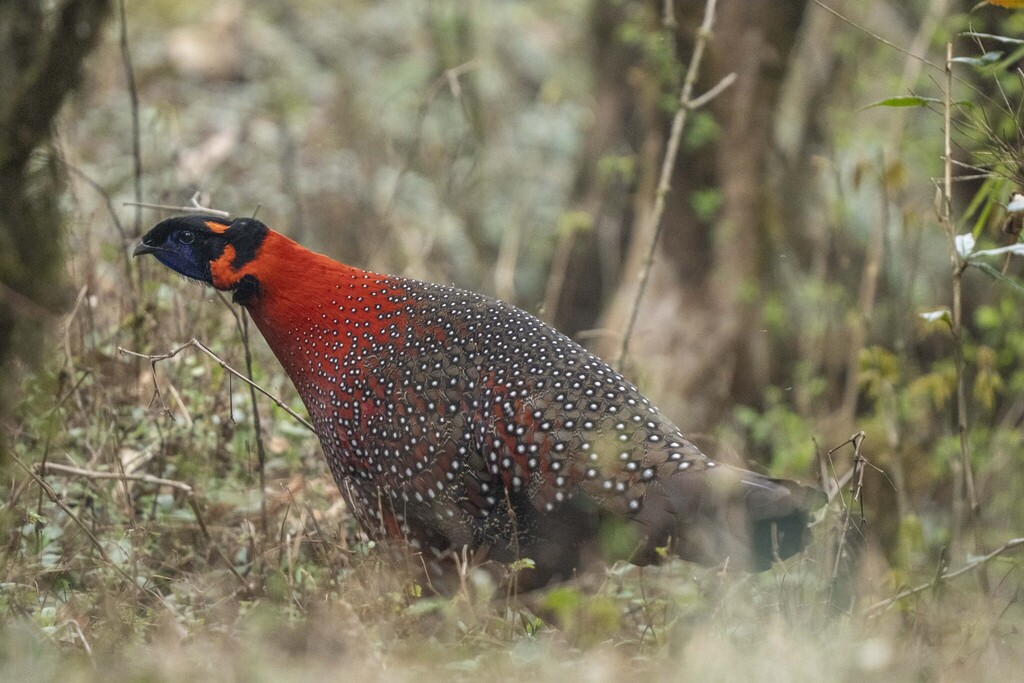
Satyr Tragopan
Photo © Luciano Massa
Photo © Luciano Massa — CC BY 4.0 — Source: iNaturalist photo #487055050Identification
The satyr tragopan, also known as the crimson horned pheasant, is a striking medium-sized pheasant approximately 70 cm in length. Males are unmistakable in their vibrant plumage: predominantly red with blue, black, and white spots and freckles covering their bodies. Females are considerably more subdued, displaying brown coloration that provides effective camouflage in their forest habitat. The most dramatic feature appears during the breeding season, when males develop distinctive blue horns and a gular wattle (the fleshy skin beneath the throat), transforming them into even more ornamental birds.
Range & Habitat
This species is found exclusively in the Himalayan regions of India, Tibet, Nepal, and Bhutan. They inhabit moist oak and rhododendron forests with dense undergrowth and bamboo clumps—environments that provide both shelter and food sources. Altitude varies seasonally: birds range from 2,400 to 4,200 meters during summer months, descending to around 1,800 meters in winter, following the pattern typical of high-altitude Himalayan species.
Behaviour & Diet
During the mating season, male satyr tragopans employ a remarkable courtship strategy. They position themselves behind rocks and inflate their ornamental horns, waiting for females to pass nearby. When a female approaches, the male performs an elaborate, multi-part display showcasing his vibrant plumage and decorative features. The performance culminates with the male stretching to his full height to present all of his ornaments—a dramatic finale designed to impress potential mates.
Best Time & Places to See It
The breeding season offers the best opportunity to observe these birds, particularly males, as their displays and prominent ornamentation make them more conspicuous. Visitors should focus their search in the moist oak and rhododendron forests of the Indian, Tibetan, Nepalese, and Bhutanese Himalayas. Summer visitors might explore higher elevations (2,400–4,200 meters), while winter observers should concentrate on lower elevations around 1,800 meters where birds congregate during the colder months.
Photography Tips
Photographing satyr tragopans requires patience and positioning. During breeding season, position yourself near potential display sites—particularly around rocks where males typically hide—and wait for females to approach. Early morning offers the best light and highest activity levels. The males' brilliant red plumage with blue, black, and white markings photograph beautifully in natural forest light. The inflated blue horns and gular wattle are particularly striking features worth capturing. Respect the birds' natural behavior and maintain a discreet distance to avoid disturbing these moderately threatened birds.
Langtang National Park
Helambu, Nepal
+364 birds+14 mammals
Where the southern slopes of the Himalayan highlands descend toward the subtropical valleys of central Nepal, Langtang National Park sprawls across one of the subcontinent's most…
VIEW NATIONAL PARKKhangchendzonga National Park
Sakkyong, India
+290 birds+1 mammals
Where the eastern Himalayas surge toward their crowning peaks, Khangchendzonga National Park embraces a landscape of almost overwhelming vertical drama. Rising from subtropical river valleys into…
VIEW NATIONAL PARKNo community photos yet. Log in to add the first one.
No community observations of this species yet.