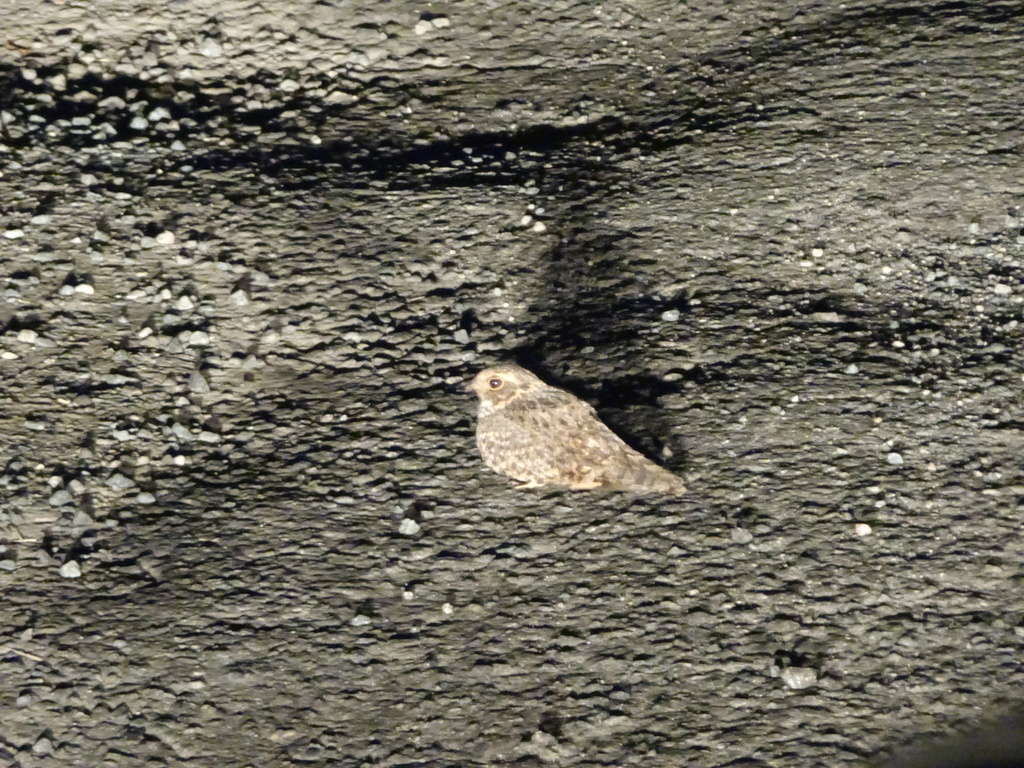
Savanna Nightjar
Photo © Rex Leung
Photo © Rex Leung — CC BY 4.0 — Source: iNaturalist #91266869Identification
The Savanna Nightjar is a small to medium-sized nocturnal bird measuring 20–26 cm in length, with a wingspan of 64 cm and weighing 54–110 g. Like all nightjars, it possesses the family's characteristic features: large forward-facing eyes, a wide bill with enormous gape fringed by facial bristles, long pointed wings, and small feet adapted for perching rather than walking. Its plumage is vermiculated grey-brown, providing excellent camouflage against rocky and open ground.
Sexual dimorphism is visible in the field: males display distinctive white patches on the throat, tail, and wings, while females show only subtle throat patches, lack white tail markings, and display a reddish tint to their feathers. Females and juveniles are notably difficult to distinguish from one another. Among similar South Asian nightjar species, the Savanna Nightjar's unique vocalizations are the most reliable identification feature.
Range & Habitat
This species has a widespread distribution across South and Southeast Asia, ranging from northern Pakistan to Indonesia, with different subspecies occupying distinct geographic regions. Eight subspecies are recognized, including populations across Pakistan, India, southern China, Taiwan, and Indonesia. The species is classified as of Least Concern by the IUCN, with a stable population trend across its large range.
Savanna Nightjars favor open lowland habitats including grasslands, sugar cane plantations, wheat fields, and rocky soils around rivers and streams. Remarkably, in rapidly urbanizing regions of Indonesia and Taiwan, they have adapted to nesting on the roofs of tall buildings. Migration patterns vary by subspecies, from nonmigratory populations to locally migratory ones; notably, C. a. monticolus migrates through the Punjab plains to northeastern Pakistan for summer breeding.
Behaviour & Diet
This is a strictly nocturnal insectivore, most active in feeding from dusk to dawn. It hunts by sight, using its large eyes and massive gape to capture insects in flight. Vocalization begins during early dusk and continues throughout the night until dawn, becoming especially intense during breeding season. The characteristic "chwip" call serves dual purposes: territorial advertisement and female attraction. Interestingly, vocalizations differ significantly among subspecies—the Philippine population produces raspier calls, while northern populations deliver longer calls with greater frequency variation than southern birds.
Breeding occurs from March to August in the western range and March to January in the eastern range, depending on subspecies. Savanna Nightjars lay 1–2 pale pink, blotched eggs directly on the ground in open, exposed rocky areas, with no nest construction. The female incubates while the male stands guard. Chicks are precocial, becoming active and mobile just four days after hatching. Both adults and young possess exceptional camouflage and will feign injury to distract predators away from vulnerable nesting sites.
Best Time & Places to See It
The best time to observe Savanna Nightjars is during breeding season (March–August in the west, March–January in the east), when they are most vocal and active. They are strictly nocturnal, so night visits to suitable habitats from dusk through dawn offer the best viewing opportunities. Listen for the diagnostic "chwip" call during early dusk.
Search open lowland habitats including grasslands, sugar cane plantations, wheat fields, and rocky soils near water. In urbanized areas of Indonesia and Taiwan, check rooftops of tall buildings at dusk. Since different subspecies occupy specific geographic regions across the range from Pakistan to Indonesia, your location will determine which subspecies you encounter.
Photography Tips
Photographing Savanna Nightjars presents significant challenges due to their nocturnal habits and cryptic behavior. Use a headlamp with a red filter to locate birds without fully disrupting their activity. Position yourself near calling birds during breeding season, when they are most vocal and predictable. Work during early dusk when there is still available light but birds are beginning activity, as this offers better lighting conditions than deep night.
The bird's exceptional camouflage makes locating perched birds extremely difficult; listening for calls is often more effective than scanning. When photographing, prioritize capturing the white throat and wing patches visible on males, which are key field marks. Patient, ethical observation from a distance is essential—avoid disturbing nesting birds. Night vision or thermal imaging equipment may be necessary for full nocturnal documentation.
Kanha Tiger Reserve
Bandhavgarh National Park
Bandipur National Park
Bardiya National Park
Chitwan National Park
Doi Inthanon National Park
Gir National Park
Kaziranga National Park
Keoladeo National Park
Nothing matches these filters.
No community photos yet. Log in to add the first one.
No community observations of this species yet.