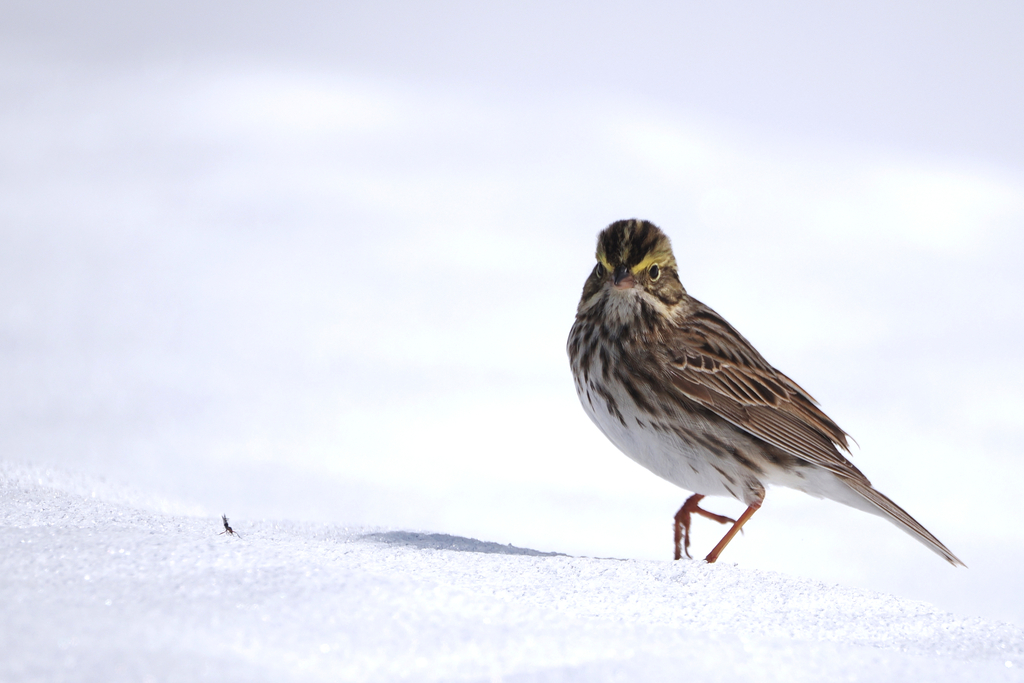
Savannah Sparrow
Photo © steve b
Photo © steve b — CC0 1.0 — Source: iNaturalist photo #287296611Identification
The Savannah sparrow is a small New World sparrow notable for its considerable variability across its range. It is sexually monomorphic, meaning males and females look alike. Around 17 subspecies are currently recognized, divided into several groups, which accounts for the species' diverse appearance. Some subspecies have historically been considered separate species, reflecting the complexity of this widespread group.
The Ipswich sparrow subspecies, once treated as a distinct species, is somewhat larger and paler than eastern Savannah sparrows, with narrower, pale brown breast streaks. In contrast, the large-billed sparrows are notably dark and rufous with rather long bills. This remarkable variation across subspecies makes field identification challenging and rewarding for birders seeking to understand regional populations.
Range & Habitat
The Savannah sparrow is widespread and abundant across North America, occupying open grassland habitats. Over most of its range it is migratory, breeding in Canada and the northern United States while wintering in Mexico and the southern United States. Several subspecies breed across different regions, from Newfoundland and Labrador in the northeast to the Aleutian Islands and Alaska in the northwest, and south through the Great Plains and western mountains to Guatemala.
Notable populations include the Ipswich sparrow, which breeds almost exclusively on Sable Island southeast of Nova Scotia, with some birds overwintering on the island while others migrate south along the Atlantic coast. The large-billed sparrows inhabit salt marshes, including year-round residents of the Californian Pacific coast and coastal areas of northwest Mexico. This habitat diversity reflects the species' adaptability to various grassland and coastal environments.
Behaviour & Diet
The Savannah sparrow exhibits different migratory patterns depending on subspecies and location. Most populations are migratory, though some large-billed sparrows are year-round residents. The Ipswich sparrow shows some post-breeding dispersal, with some birds departing later in autumn and returning sooner in spring than mainland populations. These birds are notably productive, with Ipswich sparrows frequently raising three broods in a year.
Interbreeding occurs between closely related subspecies where their ranges overlap, as documented between the Ipswich sparrow and eastern Savannah sparrow in Nova Scotia. This genetic exchange highlights the species' relatively recent diversification and the clinal nature of much variation across the genus Passerculus.
Best Time & Places to See It
Savannah sparrows can be found year-round in different parts of North America depending on season and subspecies. Breeding birds arrive in northern regions during spring, making late spring through summer the best time to observe them in Canada and the northern United States. Winter offers excellent opportunities in Mexico and the southern United States, where migratory populations congregate.
Specialized locations offer unique viewing opportunities: Sable Island for the distinctive Ipswich sparrow, the Pacific coast of California and Baja California for the dark large-billed sparrows, and the Aleutian Islands for the Aleutian subspecies. Open grasslands, coastal marshes, and prairie habitats throughout the species' range provide consistent sightings during appropriate seasons.
Photography Tips
Photographing Savannah sparrows requires patience, as they are small birds often found in open, exposed habitats. Early morning light in grasslands works well for capturing their subtle plumage details. The species' considerable geographic variation makes it worthwhile to photograph birds from different regions to document the range of subspecific forms, particularly the striking differences between migratory eastern birds and darker, resident salt-marsh populations.
Focus on capturing diagnostic features such as breast streaking patterns, head markings, and overall coloration, which vary by subspecies. Birds in their breeding territories are often more approachable than wintering birds. Spring and early summer visits to northern grasslands and prairie habitats offer the best combination of abundant birds and favorable lighting conditions for photography.
Tombstone Territorial Park
Acadia National Park
Alaska Maritime National Wildlife Refuge
Algonquin Provincial Park
Alligator River National Wildlife Refuge
Arches National Park
Arctic National Wildlife Refuge
Badlands National Park
Banff National Park
Nothing matches these filters.
No community photos yet. Log in to add the first one.
No community observations of this species yet.