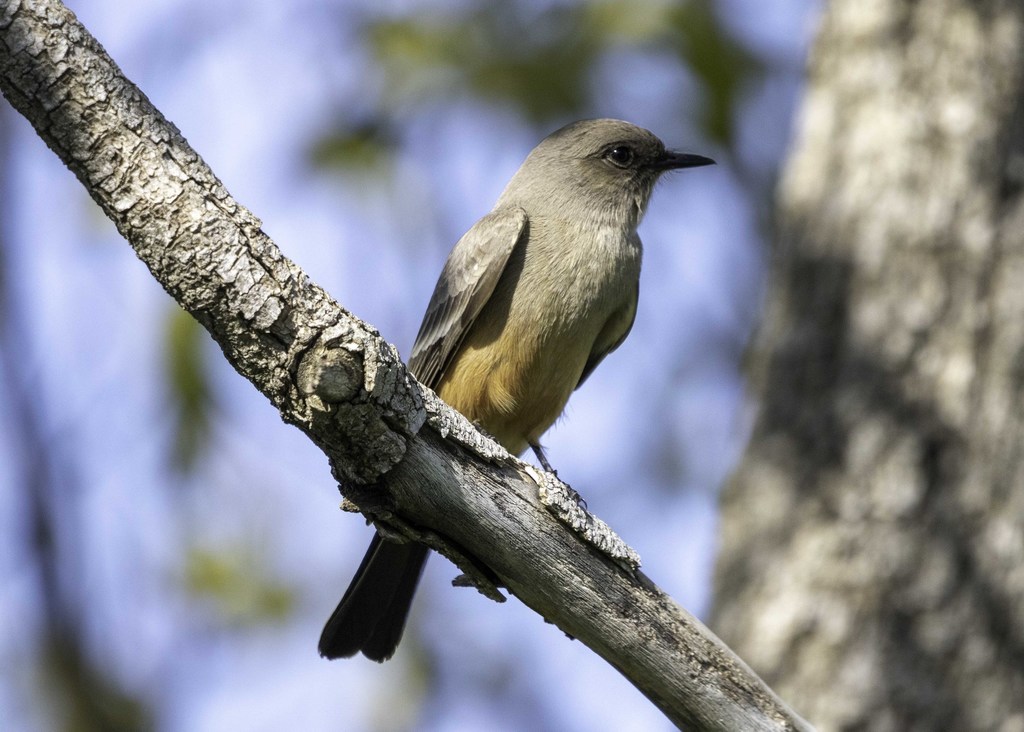
Say’s Phoebe
Photo © Zack Abbey
Photo © Zack Abbey — CC BY 4.0 — Source: iNaturalist photo #171009568Identification
Say's Phoebe is a compact, barrel-chested flycatcher with a squared-off head and distinctly long tail. The plumage is gray-brown above with a black tail, while the underparts are buffy cinnamon, becoming distinctly orange around the vent. In flight, the wings appear pale and can resemble those of a female Mountain Bluebird. Adults measure 7.5 inches (19 cm) in length with a 13-inch wingspan and weigh approximately 0.75 ounces (21 g). Juveniles are similar to adults but show buffy orange to whitish wingbars and a yellow gape.
Range & Habitat
Say's Phoebe is found year-round across a broad swath of western North America, from western Colorado south to southern California and east to the western Texas Panhandle, extending through western Mexico. They breed from Alaska south through western and south-central Canada, across the Great Plains to New Mexico. Winter ranges shift to the desert southwest, southern Texas, and Mexico south to northern Central America. These birds prefer dry, desolate, arid landscapes including farmland, savanna, and open woodlands, typically near water sources. They are early migrants to the western United States, and occasionally wander thousands of miles outside their normal range, with regular fall records in New England and Nova Scotia.
Behaviour & Diet
Say's Phoebe is an active aerial forager that sallies from perches to catch insects mid-air and also hovers kestrel-like while scanning for prey. It characteristically dips its tail while perched and frequently feeds just above water surfaces. The diet consists almost exclusively of insects including grasshoppers, flies, crickets, beetles, and bees, though berries have occasionally been recorded. Nesting follows typical phoebe behavior, with females constructing cup-shaped nests beneath bridges, canyon walls, wells, and abandoned mines using grass, forbs, moss, and plant fibers lined with fine materials. Clutches comprise three to seven eggs, typically four or five, which are white and mostly unmarked, though some may have red spotting.
Best Time & Places to See It
Say's Phoebe breeds anytime between late March and late August across elevations from 300 to 1,800 meters throughout open, arid country of western continental North America. As early migrants, they arrive in western areas ahead of many other species. Open landscapes with scattered perches near water—such as desert washes, grasslands with isolated trees or structures, and arid canyons—offer the best viewing opportunities. During migration periods, birds may appear far outside their regular range, making vagrant sightings possible in unexpected locations.
Photography Tips
Photograph Say's Phoebes from below to capture their characteristic tail-dipping behavior and the distinctive orange vent coloration. The pale wing pattern visible in flight offers excellent contrast against clear desert skies. Early morning light accentuates the gray-brown and cinnamon tones of their plumage. Position yourself near open perches or water edges where birds predictably hunt. Watch for hovering displays over open fields, which present dynamic flight photography opportunities. The bird's small size and distant hunting perches often require telephoto lenses (400mm or longer) for frame-filling portraits.
Tombstone Territorial Park
Alaska Maritime National Wildlife Refuge
Algonquin Provincial Park
Alligator River National Wildlife Refuge
Arches National Park
Arctic National Wildlife Refuge
Badlands National Park
Banff National Park
Bear River Migratory Bird Refuge
Nothing matches these filters.
No community photos yet. Log in to add the first one.
No community observations of this species yet.