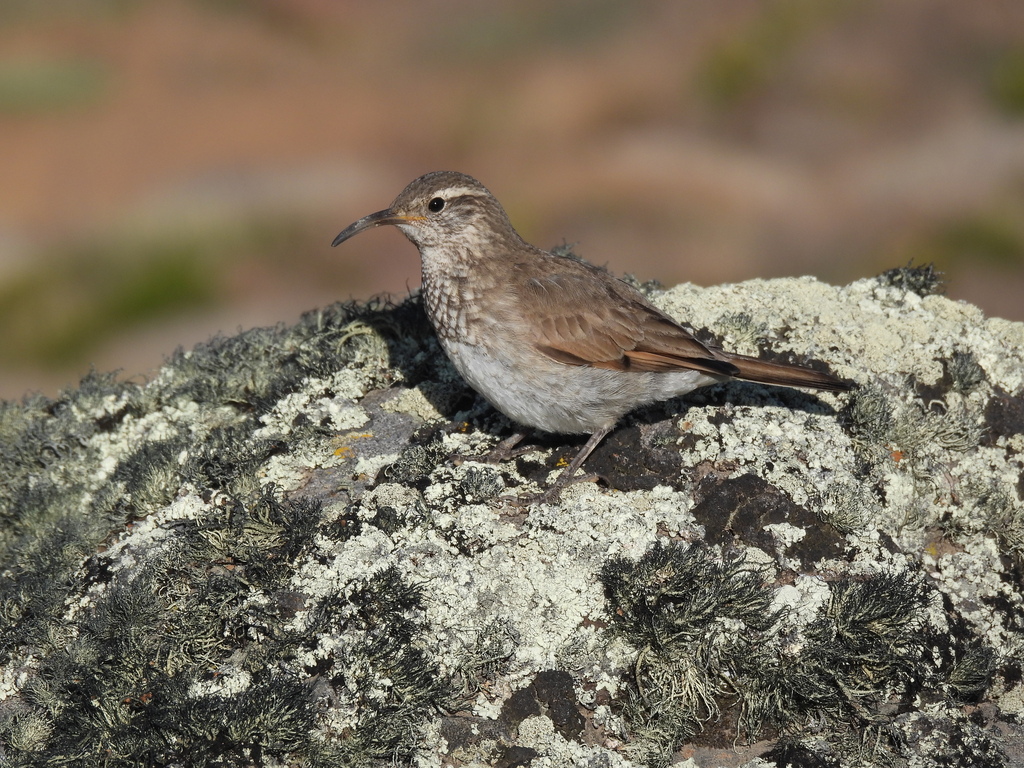
Scale-throated Earthcreeper
Photo © Tomás Tamagno
Photo © Tomás Tamagno — CC BY 4.0 — Source: iNaturalist photo #615857512Identification
The scale-throated earthcreeper is a large member of the ovenbird family, measuring 20 to 22 cm in length with a distinctive long, strongly curved bill. Both sexes share identical plumage. Adults display a whitish supercilium and grayish-white face contrasting with dark grayish-brown crown and back. The throat is whitish with thin dark barring, while the breast is notably dark grayish-brown with a striking black scalloped appearance. The belly is whitish, and the tail features blackish-brown feathers with rufous tips that increase toward the outer feathers. The iris is dark brown, the bill blackish, and the legs and feet dark brown. Juveniles are distinguishable by fine forehead and back streaks and more extensive scalloping on their underparts.
Three subspecies are recognized, each with subtle variations. The nominate subspecies U. d. dumetaria occupies the southernmost range. U. d. hypoleuca displays more rufous upperparts and buffy underparts. U. d. peruana, known only from two 1950s specimens in southeastern Peru, is similar to hypoleuca but slightly lighter with a longer bill and less rufous in the wings.
Range & Habitat
This species is found across five South American countries—Argentina, Bolivia, Chile, Peru, and possibly Uruguay—with different subspecies occupying distinct geographical zones. The nominate subspecies inhabits far southern Chile and throughout Argentina. U. d. hypoleuca ranges across western Bolivia, central Chile, and western Argentina, while U. d. peruana is known only from Peru's Department of Puno in the far southeast. The species favors puna grassland and arid scrublands, preferring rocky grassland, shrubby slopes, and shrub-steppe terrain broken by ravines and rock outcrops. It thrives at elevations up to 4,000 meters.
Behaviour & Diet
Most populations are year-round residents, though those in Tierra del Fuego and far southern mainland Argentina are believed to migrate northward, potentially reaching southern Uruguay. The species feeds exclusively on arthropods, typically foraging alone by probing and gleaning from the ground. Breeding occurs during the austral summer, including October to December. Pairs are thought to be monogamous and typically excavate nesting tunnels in earth banks or sloping ground, lining the nest chamber with grasses. Clutch size ranges from two to four eggs, though incubation period and fledging details remain undocumented.
The scale-throated earthcreeper is a vocal species, often singing from bush tops. Its song consists of repeated chippy or pli notes, increasing slightly in pitch and sometimes descending toward the end. Calls include a wheezy "keet," squeaky "keep," and sharp, dry "dzit" sounds.
Best Time & Places to See It
This earthcreeper is fairly common in the southern portion of its range but becomes very rare in the north. The austral summer breeding season (October to December) is optimal for observation, when birds are more active and vocal. Southern Chile and Argentina offer the best opportunities for sightings. The species inhabits accessible puna grasslands and rocky scrub habitats, making it relatively approachable for patient observers willing to explore arid upland terrain.
Photography Tips
The bird's cryptic plumage blends well with rocky, arid habitats, so scan carefully through shrubby slopes and grassland. Early morning is ideal for capturing the scale-throated earthcreeper as it forages on the ground or sings from exposed bush perches. Use a telephoto lens to maintain distance while photographing this ground-feeding species. The bird's striking black-scalloped breast and rufous-tipped tail feathers provide distinctive field marks worth capturing. Patient waiting near exposed singing perches during breeding season will reward photographers with action shots of this vocal, active species.
Torres del Paine National Park
Torres del Paine, Chile
+143 birds+10 mammals
Where granite spires pierce the Patagonian sky, Torres del Paine commands one of South America's most dramatic landscapes. Across 4,106 square kilometres of southern Chile, jagged…
VIEW NATIONAL PARKLaja National Park Lagoon
Antuco, Chile
+123 birds+1 mammals
Where the Andes descend into the Biobío Region's temperate forests, a vast lagoon fills the caldera of the extinct Antuco volcano, cradled by steep native woodland…
VIEW NATIONAL PARKCerro Castillo National Park
Coyhaique, Chile
+89 birds+3 mammals
Granite peaks and windswept steppe converge across this vast Patagonian landscape, where the Andes' eastern flank drops into terrain sculpted by ice age glaciers and relentless…
VIEW NATIONAL PARKPatagonia National Park
Cochrane, Chile
+133 birds+8 mammals
Where the Andes meet the Patagonian steppe, vast grasslands and shrublands sweep across rolling terrain carved by ancient glaciation, their contours softened by distance and dramatic…
VIEW NATIONAL PARKParque Provincial Península de Magallanes
Argentina
+125 birds+4 mammals
Granite peaks and windswept steppe converge across this 415-square-kilometre peninsula jutting into the cold Atlantic waters of southern Patagonia, where the Magallanes landscape embodies the raw,…
VIEW NATIONAL PARKMonte León National Park
Argentina
+100 birds+4 mammals
Where the Patagonian steppe meets the Atlantic, Monte León National Park protects a landscape of windswept coastal cliffs, rocky outcrops, and semi-arid grassland spanning over 1,200…
VIEW NATIONAL PARKLos Glaciares National Park
Argentina
+121 birds+3 mammals
Where granite peaks and sprawling ice fields dominate the landscape, Los Glaciares National Park encompasses over ten thousand square kilometres of Patagonian wilderness in southern Argentina.…
VIEW NATIONAL PARKPerito Moreno National Park
Argentina
+78 birds
Where the Patagonian steppe descends into a landscape carved by ancient ice, Perito Moreno National Park sprawls across nearly 1,590 square kilometres of some of South…
VIEW NATIONAL PARKLos Cardones National Park
Argentina
+193 birds+6 mammals
Where the Andes descend into northwestern Argentina, Los Cardones National Park sprawls across nearly 1,200 square kilometres of one of South America's most distinctive high-altitude desert…
VIEW NATIONAL PARKNahuel Huapi National Park
Argentina
+124 birds+11 mammals
Where the Andes descend toward Patagonia, vast glacial lakes cut through a landscape of southern beech forest and granite peaks, creating one of South America's most…
VIEW NATIONAL PARKSierra de las Quijadas National Park
Argentina
+168 birds+5 mammals
Sandstone cliffs and deeply incised canyons define this 1,137-square-kilometre expanse in San Luis Province, where the dry Chacoan landscape of central Argentina reveals an unexpected ecological…
VIEW NATIONAL PARKLago Puelo National Park
Argentina
+109 birds+1 mammals
Where temperate forests descend to crystalline waters in the foothills of the Andes, Lago Puelo National Park sprawls across nearly 300 square kilometers of pristine wilderness…
VIEW NATIONAL PARKNo community photos yet. Log in to add the first one.
No community observations of this species yet.