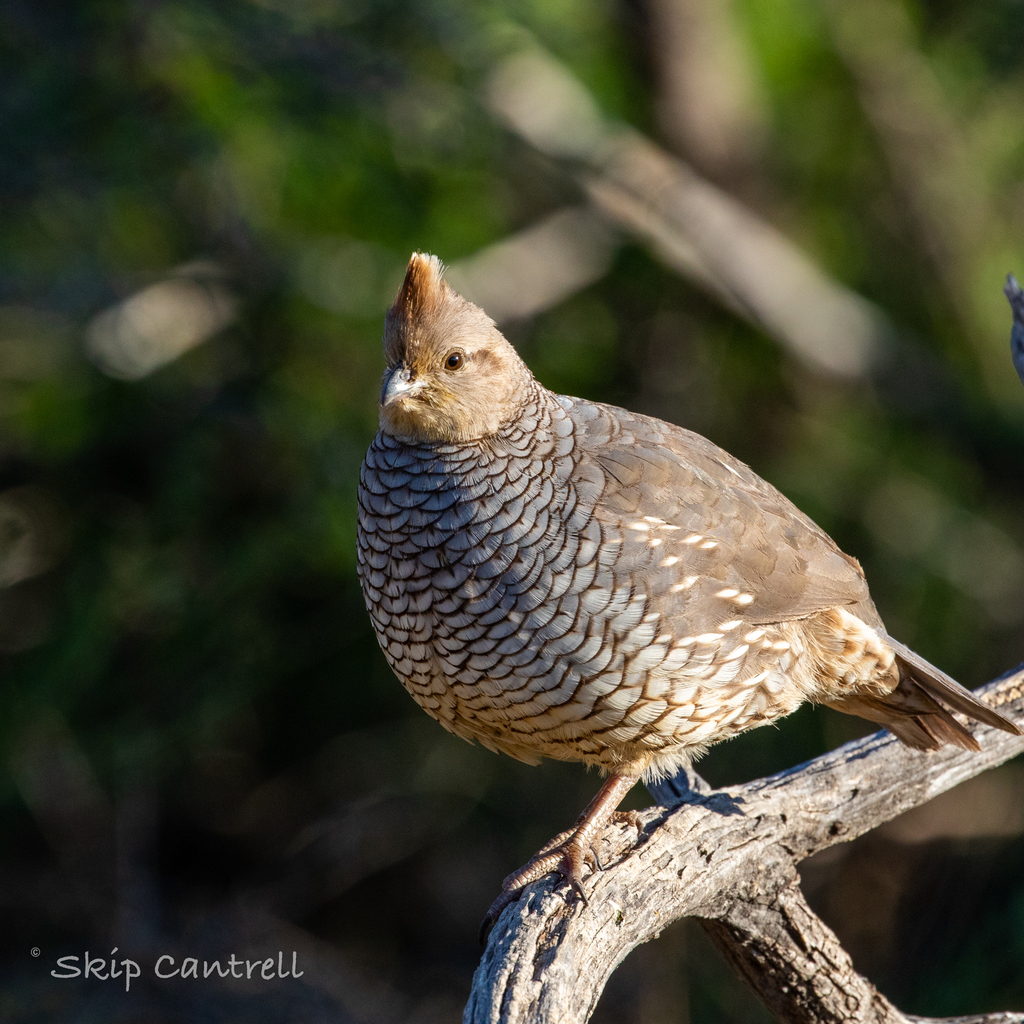
Scaled Quail
Photo © tcantrell52
Photo © tcantrell52 — CC BY 4.0 — Source: iNaturalist #124489912Identification
The scaled quail is named for the distinctive scaly appearance of its breast and back feathers, which provide an instantly recognisable field mark. Most striking is its white crest, which resembles a tuft of cotton—earning it the alternative common name "cottontop." The bird's overall plumage is bluish-grey, though colouration varies by subspecies. A small quail, it typically measures 25.4–30.5 cm in length with a wingspan of 38 cm and weighs 177–191 g, making it a compact but easily identifiable resident of arid landscapes.
Range & Habitat
The scaled quail inhabits the arid regions from south-central Arizona, northern New Mexico, east-central Colorado, and southwestern Kansas south through western Oklahoma and western and central Texas into Mexico, reaching northeastern Jalisco, Guanajuato, Queretaro, Hidalgo, and western Tamaulipas. Four subspecies exist, with three occurring in the USA: the paler northern scaled quail (the most common), the palest Upper Sonoran form found where Colorado, Kansas, and Oklahoma meet, and the darker chestnut-bellied subspecies of southern Texas and adjacent Mexico.
This species favours dry, open valleys, plains, foothills, and rocky slopes with sparse vegetation. Its distribution largely coincides with mesquite, condalia, and cholla. In different regions, scaled quail occupy sand sagebrush-grasslands, pinyon-juniper woodlands, shortgrass High Plains, dense cholla-grassland, and dryland farmland, preferring rough or rolling terrain where sagebrush, cactus, yucca, juniper, and rocks provide shelter.
Behaviour & Diet
Scaled quail are fairly sedentary birds, maintaining stable winter territories from September to November in coveys averaging around 30 birds, though groups of up to 150 have been recorded. Winter home ranges vary from 24 to 84 acres, with little overlap between separate coveys. When disturbed, these birds prefer to run rather than fly—a characteristic behaviour that makes them more challenging to observe directly.
The species is moderately productive, with females laying 9–16 eggs (typically 12–14) in grass-lined hollows. Incubation lasts 21–23 days and is performed by the female. Double-brooding is common in some regions, with males occasionally rearing the first brood while females begin a second clutch. Precocial chicks leave the nest shortly after hatching and fledge rapidly, reaching adult size within 11–15 weeks.
Best Time & Places to See It
The scaled quail is widespread and common throughout its range, evaluated as Least Concern on the IUCN Red List. Breeding activity varies geographically: in Arizona, pairing peaks by mid-June with nesting from early July onward; in Oklahoma, egg-laying typically begins in late April; while in Texas and New Mexico, laying occurs from March to June and April to September respectively. To observe these birds, visit arid regions of the southwestern USA or central Mexico, focusing on dry valleys, mesquite scrubland, and sagebrush-grassland habitats where cover is sparse but adequate.
Photography Tips
Photographing scaled quail requires patience and stealth, as these birds are inclined to run rather than flush. Dawn and early morning are optimal times when birds are most active and light is favourable. Focus on capturing the distinctive white crest and scaly breast markings that define the species. Work the edges of mesquite thickets, sagebrush patches, and rocky foothills where birds feed and shelter. During breeding season, watching for family groups accompanied by adults may yield intimate behavioural shots. Use a telephoto lens to maintain distance and avoid flushing these wary runners.
Big Bend National Park
Brewster County, United States
+345 birds+34 mammals
Where the Chisos Mountains rise abruptly from the Sonoran Desert floor, Big Bend National Park spans over 7,300 square kilometers of one of North America's most…
VIEW NATIONAL PARKSaguaro National Park
Rincon Valley, United States
+354 birds+40 mammals
Where the Sonoran Desert meets sky-island mountains, two geographically separated districts of Saguaro National Park sprawl across nearly two thousand square kilometers of Arizona's most iconic…
VIEW NATIONAL PARKCarlsbad Caverns National Park
Eddy County, United States
+309 birds+18 mammals
Beneath the Chihuahuan Desert floor of southern New Mexico lies one of North America's most spectacular subterranean landscapes. Carlsbad Caverns National Park encompasses over 518 square…
VIEW NATIONAL PARKGuadalupe Mountains National Park
Culberson County, United States
+262 birds+14 mammals
Where fossil-laden limestone ridges thrust skyward above the Chihuahuan Desert floor, Guadalupe Mountains National Park reveals a landscape sculpted by ancient seas and relentless aridity. These…
VIEW NATIONAL PARKPetrified Forest National Park
Apache County, United States
+206 birds+23 mammals
Across the high desert plateau of northeastern Arizona, where the climate swings between scorching summer days and frost-laden winters, badlands of raw earth and timber-turned-to-stone dominate…
VIEW NATIONAL PARKWhite Sands National Park
Otero County, United States
+178 birds+6 mammals
Across the Tularosa Basin in south-central New Mexico sprawls an otherworldly landscape of gypsum dunes—the largest gypsum field on Earth and a stark desert playground shaped…
VIEW NATIONAL PARKBosque del Apache National Wildlife Refuge
Socorro County, United States
+345 birds+17 mammals
Where the Rio Grande emerges from its desert canyon in central New Mexico, a narrow ribbon of riparian woodland defies the arid landscape that surrounds it.…
VIEW WILDLIFE SANCTUARYBitter Lake National Wildlife Refuge
Chaves County, United States
+284 birds+10 mammals
Across the high desert floor of southeastern New Mexico, where elevation and aridity shape every living thing, shallow alkaline lakes and marshes form an unexpected oasis…
VIEW WILDLIFE SANCTUARYNo community photos yet. Log in to add the first one.
No community observations of this species yet.