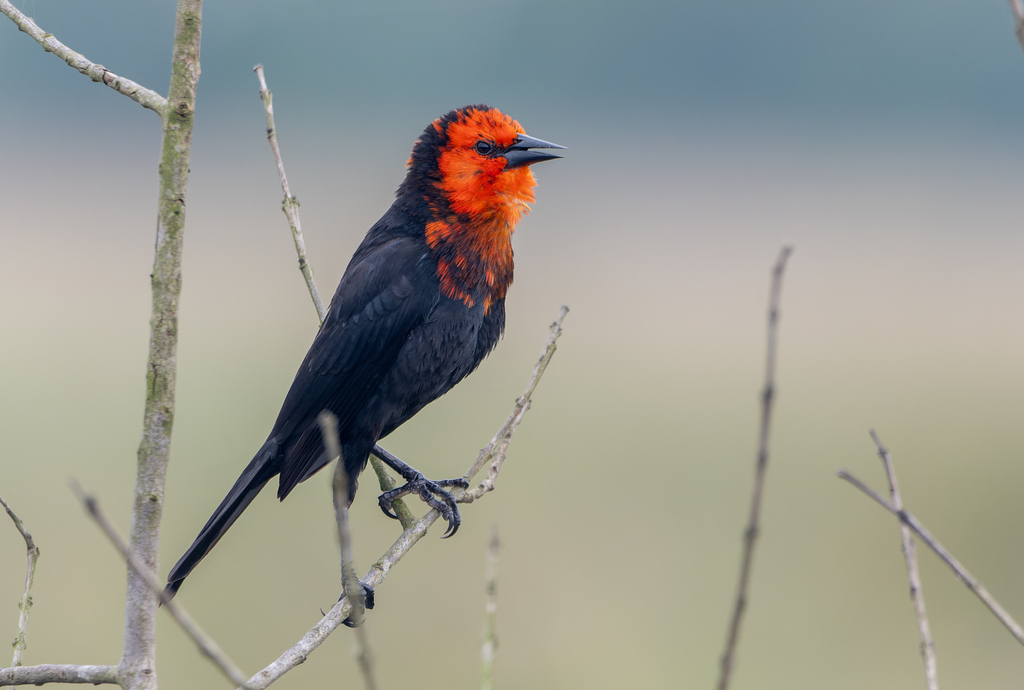
Scarlet-headed Blackbird
Photo © David F. Belmonte
Photo © David F. Belmonte — CC BY 4.0 — Source: iNaturalist photo #445222422The scarlet-headed blackbird (Amblyramphus holosericeus) is an icterid found in the South American wetlands. == Description == This species is about 24 cm long. The bill is oddly shaped: long, slender, and very sharp, looking almost upturned. Adults of both sexes are described by their name. Juveniles have entirely black plumage; orange-red feathers first appear on their breast and throat, later spreading to the neck, head, and thighs. The song is given as "loud, clear, and melodic, a ringing 'cleer-cleer-clur, clulululu'." Calls are simpler but have a similar quality. Scarlet-headed blackbirds occur in pairs in large reed beds in Argentina, Paraguay, Uruguay and southern Brazil; Bolivia has an isolated population living at an altitudes of about 600 m. They often perch conspicuously on top of stems. They are uncommon, particularly away from the coast. They eat mainly fruit, supplementing it with seeds and invertebrates, especially insects. They use their bill as a hammer to open food items. Scarlet-headed blackbirds are monogamous, and territories are grouped together. The nest is an open cup placed in the crotch of a shrub or woven into vegetation, in which they lay two eggs. == Gallery ==
Peixe National Park Lagoon
Brazil
+293 birds+4 mammals
Where the coastal plains of Rio Grande do Sul meet the Atlantic, Peixe National Park Lagoon sprawls across nearly 2,200 square kilometres of shallow waters, reed…
VIEW NATIONAL PARKPantanal Matogrossense National Park
Brazil
+322 birds+17 mammals
Where the flooded forests of central Brazil meet vast seasonally inundated grasslands, Pantanal Matogrossense National Park sprawls across nearly 2,900 square kilometers of one of the…
VIEW NATIONAL PARKEl Palmar National Park
Distrito Sexto, Argentina
+244 birds+14 mammals
Across the Paraná River floodplain in northeastern Argentina, palms rise from wetland and grassland in a landscape shaped by water and time. El Palmar National Park…
VIEW NATIONAL PARKCampos del Tuyú National Park
Argentina
+169 birds+5 mammals
Subtropical forest graces the borderlands where Misiones Province meets Paraguay, a landscape shaped by the Paraná Plateau's weathered topography and the warm, humid climate of northeastern…
VIEW NATIONAL PARKRío Pilcomayo National Park
Argentina
+271 birds+13 mammals
Where the Río Pilcomayo cuts through northeastern Argentina's subtropical lowlands, a sprawling mosaic of wetlands, grasslands, and seasonally flooded forests creates one of South America's most…
VIEW NATIONAL PARKParque Provincial Pampa del Indio
Laguna Limpia, Argentina
+231 birds+4 mammals
Across the flat horizons of Chaco Province, where the Paraná River system spills into vast wetlands and grasslands, Parque Provincial Pampa del Indio protects one of…
VIEW NATURE RESERVEChaco National Park
Municipio de Presidencia de la Plaza, Argentina
+258 birds+7 mammals
Across the humid subtropical lowlands of northeastern Argentina, where the Paraná River basin feeds vast seasonal wetlands and gallery forests, Chaco National Park protects one of…
VIEW NATIONAL PARKNo community photos yet. Log in to add the first one.
No community observations of this species yet.