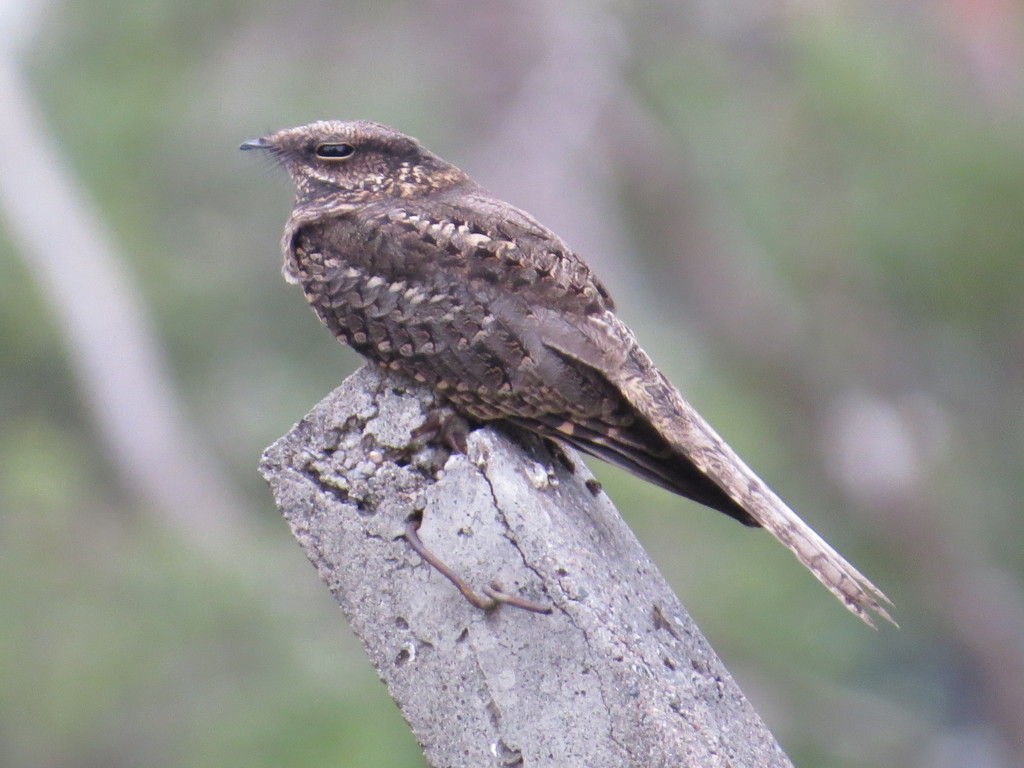
Scissor-tailed Nightjar
Photo © Leonel Roget
Photo © Leonel Roget — CC BY 4.0 — Source: iNaturalist photo #37825398Identification
The scissor-tailed nightjar is instantly recognizable by the male's extraordinarily elongated outer tail feathers, which are almost twice as long as its body. Males reach up to 66 cm in length when these dramatic feathers are included, though the body itself measures only 25 to 30 cm. Females lack these extended tail feathers and are substantially shorter overall. Both sexes weigh around 47 to 63 grams.
Males of the nominate subspecies display brown upperparts with grayish-white speckles and blackish streaks down the middle of the back. A distinctive broad tawny collar adorns the hindneck. The tail feathers are brown with broad white tips on the elongated outer pair. The underparts grade from a buffy chin through a spotted throat to a barred breast and flanks. The wings are generally brown with tawny or buff streaks and notably lack the white wing band seen in many other nightjar species. Females are duller overall with tawnier wings and no white on the tail.
Range & Habitat
This species is distributed across much of eastern South America in two recognized subspecies. The nominate subspecies ranges from east-central Peru across central Brazil, with an isolated population in Suriname. The southern subspecies, H. t. furcifer, is found from southern Peru through Bolivia and southern Brazil, extending south to Paraguay, northern and central Argentina, and Uruguay.
Scissor-tailed nightjars favour open and semi-open landscapes including second growth, arid scrub, grasslands, acacia groves, pastures, and surprisingly, urban parks. They are commonly spotted along roadsides, particularly those bordering sugar cane fields. Elevation ranges typically from sea level to 1,100 metres, though they have been recorded as high as 2,700 metres in Bolivia. Northern populations are generally resident, while southerly populations are thought to be migratory, wintering in southern Amazonia.
Behaviour & Diet
The scissor-tailed nightjar is strictly nocturnal, foraging by sallying from the ground or a low perch to snatch insects from the air. Its diet is remarkably diverse, encompassing insects from at least twelve different orders, with beetles being particularly favoured. At least thirteen beetle families have been identified in their diet. During daylight hours, they roost inconspicuously on the ground in shaded spots.
Males perform distinctive wing-clapping displays during breeding. The species produces a prolonged sequence of sharp tsips, sometimes continuing for minutes on end, delivered at dusk and dawn from a perch or in flight. They also utter an extremely high tsig flight call and low clucking sounds. Though their exact nesting season remains undefined, breeding appears to occur at least from September to December, with pairs laying two eggs directly on the ground or bare rock.
Best Time & Places to See It
The scissor-tailed nightjar is fairly common to common throughout most of its range and shows remarkable tolerance of human activity. Early morning and dusk are the best times to observe this nocturnal species. Urban parks within its range offer surprisingly good opportunities, as do roadsides bordering open habitats and agricultural areas. Look along roads flanking sugar cane fields, particularly in central Brazil and surrounding regions.
The species' stability and adaptability to modified landscapes mean it is more accessible to travellers than many nightjar species. Listen for the distinctive prolonged tsipping song, which can help locate roosting or perched individuals during twilight hours.
Photography Tips
Photographing males in flight is essential to capture the species' most striking feature—those impossibly long scissor-like tail feathers. Use fast shutter speeds to freeze the rapid wing beats during sallying flights. Patience and early morning or late evening light will yield the best results, as the bird is most active during twilight hours.
Ground-roosting birds can be challenging to locate during the day, but nocturnal spotlighting techniques may reveal perched individuals. The male's white-tipped tail feathers and tawny collar provide good focal points for composition. For daytime shots, focus on the intricate plumage patterns and the distinctive collar marking that distinguishes this species from other nightjars.
Tijuca National Park
Brazil
+317 birds+13 mammals
Where the Atlantic forest rises steeply from Rio de Janeiro's urban edge, Tijuca National Park encompasses a landscape of dramatic granite peaks, cascading waterfalls, and closed-canopy…
VIEW NATIONAL PARKEmas National Park
Brazil
+333 birds+23 mammals
Across the high plateaux of central Brazil, where the cerrado grasslands roll toward distant horizons under an immense sky, Emas National Park anchors one of South…
VIEW NATIONAL PARKSerra do Cipó National Park
Brazil
+379 birds+5 mammals
Where granite escarpments rise above the Atlantic Forest transition zone in southeastern Brazil, Serra do Cipó National Park unfolds across a landscape of dramatic ridges, cascading…
VIEW NATIONAL PARKItatiaia National Park
Brazil
+519 birds+12 mammals
Where granite peaks pierce the Atlantic rainforest canopy in southeastern Brazil, Itatiaia National Park rises as one of the country's oldest and most ecologically vital protected…
VIEW NATIONAL PARKPeixe National Park Lagoon
Brazil
+293 birds+4 mammals
Where the coastal plains of Rio Grande do Sul meet the Atlantic, Peixe National Park Lagoon sprawls across nearly 2,200 square kilometres of shallow waters, reed…
VIEW NATIONAL PARKSerra da Bocaina National Park
Brazil
+441 birds+5 mammals
Where the escarpment of the Serra da Bocaina rises sharply from the Atlantic coastal plain, tropical rainforest cloaks steep mountainsides that climb toward peaks exceeding 2,000…
VIEW NATIONAL PARKIguaçu National Park
Brazil
+387 birds+17 mammals
Where the Paraná Plateau plunges toward the Atlantic watershed, six thousand square kilometers of subtropical rainforest cling to steep gorges and river valleys in this corner…
VIEW NATIONAL PARKIlha Grande National Park
Brazil
+233 birds
Across the subtropical plateaus and Atlantic forest remnants of southern Brazil, a vast protected landscape spanning nearly 4,600 square kilometers safeguards one of the continent's most…
VIEW NATIONAL PARKSerra do Teixeira National Park
Brazil
+160 birds+5 mammals
Rugged plateaus and deep escarpments define this 3,112-square-kilometre sweep of the Brazilian Northeast, where the crystalline bedrock of the Borborema Plateau rises abruptly from the surrounding…
VIEW NATIONAL PARKSerra da Capivara National Park
Brazil
+156 birds+6 mammals
Across the semi-arid plateaus and deeply incised canyons of northeastern Brazil, where Piauí's ancient sandstone formations rise and fall in weathered waves, Serra da Capivara National…
VIEW NATIONAL PARKSão Joaquim National Park
Brazil
+222 birds+9 mammals
Where the southern Brazilian highlands rise above the Atlantic Forest, São Joaquim National Park protects nearly 1,000 square kilometers of montane terrain that shifts between temperate…
VIEW NATIONAL PARKSerra dos Órgãos National Park
Brazil
+446 birds+13 mammals
Granite peaks thrust skyward through the Atlantic Forest canopy in the mountains immediately north of Rio de Janeiro, their bare rock faces rising above a landscape…
VIEW NATIONAL PARKSete Cidades National Park
Brazil
+125 birds+1 mammals
Sete Cidades sprawls across 113 square kilometres of northeastern Brazil's interior plateau, where weathered sandstone formations rise dramatically from the cerrado landscape. The park's geology tells…
VIEW NATIONAL PARKChapada dos Guimarães National Park
Brazil
+450 birds+1 mammals
Where weathered sandstone plateaus rise above the cerrado grasslands of central Brazil, Chapada dos Guimarães National Park protects 624 square kilometres of ecological transition zone that…
VIEW NATIONAL PARKChapada dos Veadeiros National Park
Brazil
+324 birds+6 mammals
Where granite plateaus rise above the cerrado savanna in central Brazil, Chapada dos Veadeiros National Park unfolds across 6,665 square kilometres of some of the world's…
VIEW NATIONAL PARKPantanal Matogrossense National Park
Brazil
+322 birds+17 mammals
Where the flooded forests of central Brazil meet vast seasonally inundated grasslands, Pantanal Matogrossense National Park sprawls across nearly 2,900 square kilometers of one of the…
VIEW NATIONAL PARKChapada Diamantina National Park
Brazil
+346 birds+5 mammals
Where granite peaks and sandstone cliffs rise abruptly from the Brazilian interior, Chapada Diamantina National Park sprawls across 4,215 square kilometers of some of Brazil's most…
VIEW NATIONAL PARKSerra do Gandarela National Park
Brazil
+333 birds+3 mammals
Where granite massifs rise through Atlantic Forest in southeastern Brazil's highlands, Serra do Gandarela National Park protects nearly 1,000 square kilometres of montane terrain that few…
VIEW NATIONAL PARKCatimbau National Park
Brazil
+118 birds+6 mammals
Where sandstone plateaus rise from the semi-arid scrublands of northeastern Brazil, Catimbau National Park unfolds across more than 1,000 square kilometres of geological drama and surprising…
VIEW NATIONAL PARKBrasília National Park
Plano Piloto, Brazil
+338 birds+15 mammals
Cerrado grassland and scattered woodland sweep across the central Brazilian plateau where this national park sprawls across more than a thousand square kilometres of the Federal…
VIEW NATIONAL PARKAraucárias National Park
Brazil
+231 birds+3 mammals
Where the southern Brazilian highlands rise into cool temperate forest, Araucárias National Park protects one of the Atlantic Forest's most distinctive ecosystems across 506 square kilometres…
VIEW NATIONAL PARKMapinguari National Park
Brazil
+354 birds
Vast tracts of western Amazonian rainforest blanket the remote terrain of this 56,827 square kilometre national park in Amazonas state, where seasonal rivers wind through dense…
VIEW NATIONAL PARKEl Palmar National Park
Distrito Sexto, Argentina
+244 birds+14 mammals
Across the Paraná River floodplain in northeastern Argentina, palms rise from wetland and grassland in a landscape shaped by water and time. El Palmar National Park…
VIEW NATIONAL PARKRío Pilcomayo National Park
Argentina
+271 birds+13 mammals
Where the Río Pilcomayo cuts through northeastern Argentina's subtropical lowlands, a sprawling mosaic of wetlands, grasslands, and seasonally flooded forests creates one of South America's most…
VIEW NATIONAL PARKIguazú National Park
Puerto Iguazú, Argentina
+346 birds+15 mammals
Where the Paraná Plateau plunges toward the Atlantic watershed, nearly 800 square kilometers of subtropical rainforest drape across Misiones Province in a landscape carved by millennia…
VIEW NATIONAL PARKEl Rey National Park
Municipio de Las Lajitas, Argentina
+317 birds+4 mammals
Where the eastern slopes of the Andes descend into northwestern Argentina's subtropical transition zone, El Rey National Park unfolds across 841 square kilometers of dramatically varied…
VIEW NATIONAL PARKCalilegua National Park
Municipio de Calilegua, Argentina
+288 birds+8 mammals
Where the eastern Andean slopes plunge into northwestern Argentina's humid subtropics, nearly 2,645 square kilometers of steep terrain and luxuriant forest compose one of South America's…
VIEW NATIONAL PARKSierra de las Quijadas National Park
Argentina
+168 birds+5 mammals
Sandstone cliffs and deeply incised canyons define this 1,137-square-kilometre expanse in San Luis Province, where the dry Chacoan landscape of central Argentina reveals an unexpected ecological…
VIEW NATIONAL PARKChaco National Park
Municipio de Presidencia de la Plaza, Argentina
+258 birds+7 mammals
Across the humid subtropical lowlands of northeastern Argentina, where the Paraná River basin feeds vast seasonal wetlands and gallery forests, Chaco National Park protects one of…
VIEW NATIONAL PARKNo community photos yet. Log in to add the first one.
No community observations of this species yet.