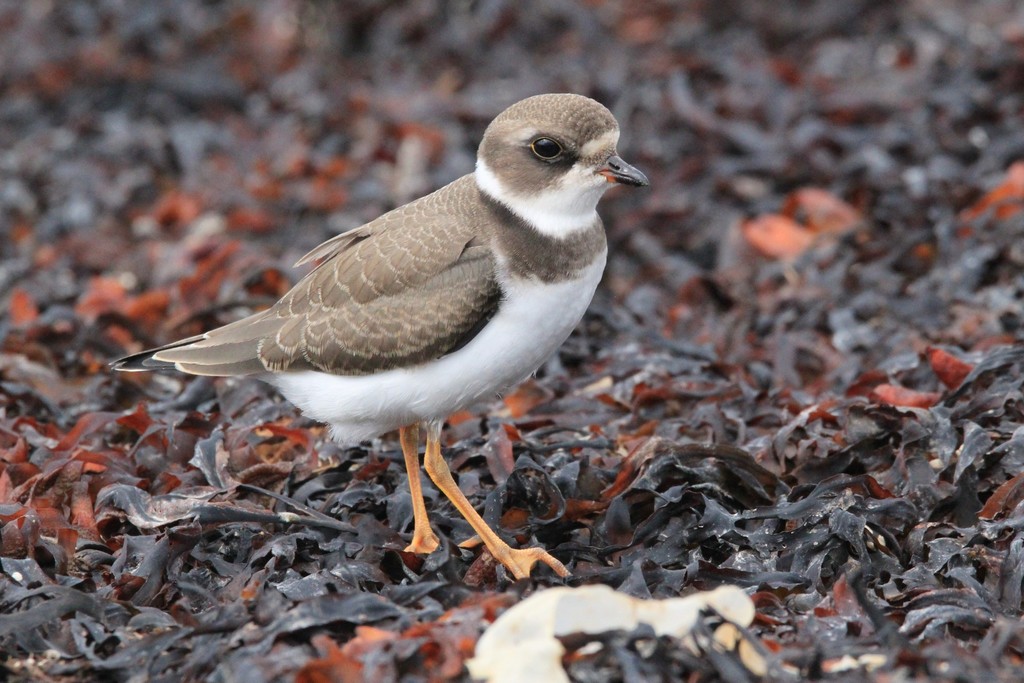
Semipalmated Plover
Photo © Quinten Wiegersma
Photo © Quinten Wiegersma — CC BY 4.0 — Source: iNaturalist photo #23981362Identification
The semipalmated plover is a diminutive shorebird, weighing just 37.6–54.7 g (1.3–1.9 oz) and measuring 17–19 cm (6.7–7.5 in) in length. Adults are instantly recognizable by their distinctive plumage: a grey-brown back and wings contrast sharply with a white belly and breast, marked by a single bold black neckband. The face features a brown cap, white forehead, and striking black eye mask, while the short bill is cleverly two-toned in orange and black. The species name "semipalmatus" refers to the bird's only partially webbed feet, an adaptation perfectly suited to its shorebird lifestyle.
The semipalmated plover bears a superficial resemblance to the larger killdeer, but the plover's smaller size and single neckband (versus two) make identification straightforward for observers familiar with both species.
Range & Habitat
This highly migratory species breeds across open ground on beaches and flats throughout northern Canada and Alaska, where it nests in minimal vegetation on bare ground. Following the breeding season, semipalmated plovers undertake impressive migrations to winter in coastal regions of the southern United States, the Caribbean, and much of South America. The species is an extremely rare vagrant to western Europe, with occasional records from locations as remote as Tierra del Fuego and the Isles of Scilly.
Identification challenges persist where their range potentially overlaps with the Eurasian ringed plover, to which the semipalmated plover was once considered a subspecies, potentially obscuring its true distribution in some regions.
Behaviour & Diet
Semipalmated plovers are visual foragers that hunt across beaches, tidal flats, and grasslands, displaying the characteristic plover feeding style of alert pauses and quick pecking. Their diet is remarkably diverse, encompassing insects such as fly larvae, mosquitoes, and grasshoppers; small arthropods including spiders, crustaceans, and beetles; marine worms; and molluscs ranging from snails to bivalves. These opportunistic feeders also supplement their diet with berries and seeds from grasslands and cultivated fields.
Like their larger relative the killdeer, semipalmated plovers employ the dramatic "broken-wing" distraction display to protect ground nests from predators and intruders, feigning injury to lead threats away from their vulnerable eggs and chicks.
Best Time & Places to See It
Timing your search for semipalmated plovers requires understanding their migratory cycle. During breeding season, seek them across the open tundra and coastal flats of northern Canada and Alaska. For those in southern regions, winter months offer the best viewing opportunities on coastal beaches and mudflats throughout the southern United States, Caribbean islands, and South American coastlines. Migration periods in spring and autumn provide additional opportunities to observe them in stopover habitats along coastal routes.
Photography Tips
The semipalmated plover's small size and alert, skittish nature demand patience and a telephoto lens. Photograph plovers on their coastal habitats during calm light conditions, when their subtle grey-brown and white plumage photographs true to life. Capture them in their characteristic foraging posture—paused alertly before quick feeding pecks—or during flight when their wing patterns become visible. Early morning or late afternoon light best highlights their facial markings and neckband, the key field marks for identification.
Tombstone Territorial Park
Acadia National Park
Alaska Maritime National Wildlife Refuge
Algonquin Provincial Park
Alligator River National Wildlife Refuge
Antisana National Park
Arctic National Wildlife Refuge
Arenal Volcano National Park
Arrecifes de Cozumel National Park
Nothing matches these filters.
No community photos yet. Log in to add the first one.
No community observations of this species yet.