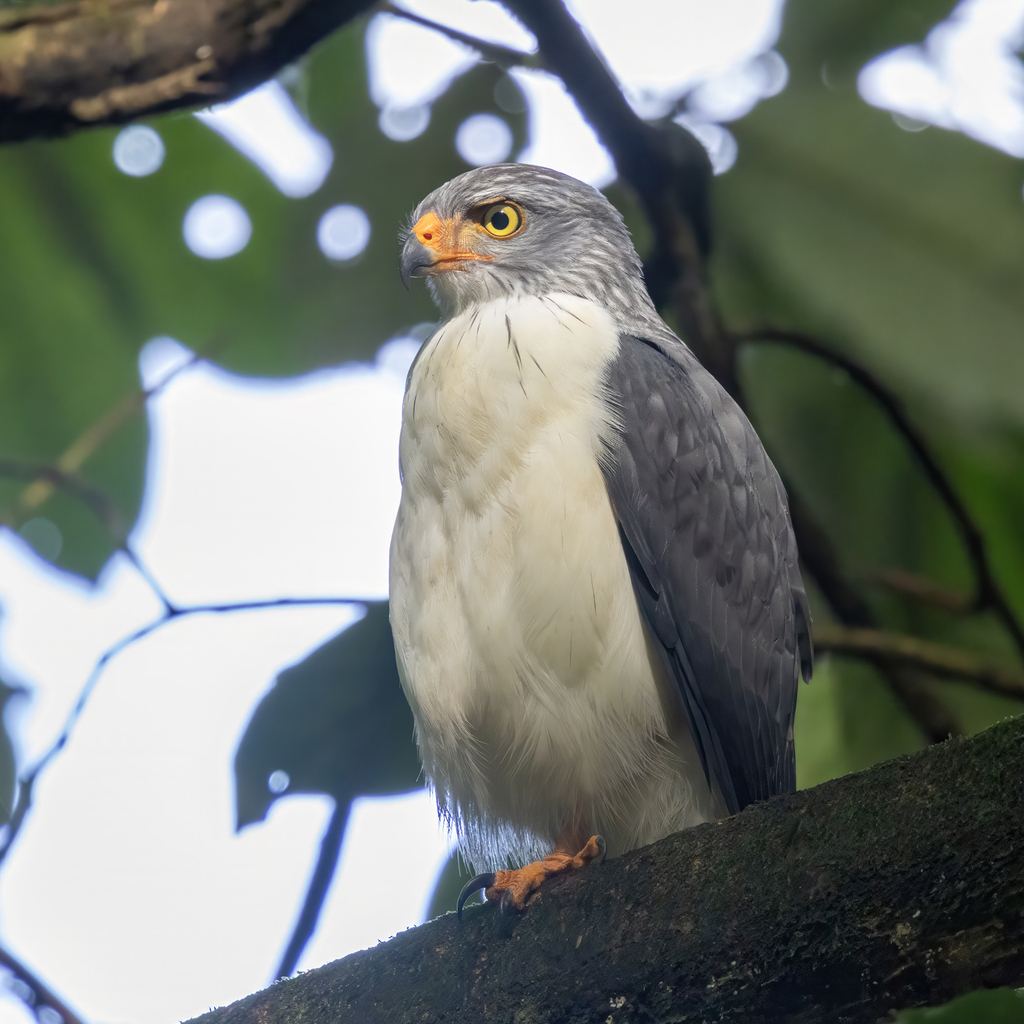
Semiplumbeous Hawk
Photo © Dan Vickers
Photo © Dan Vickers — CC BY 4.0 — Source: iNaturalist #255879823Identification
The Semiplumbeous Hawk is a small raptor, averaging 12–13 inches in length—roughly the size of a kestrel or merlin. Despite its modest proportions, it is unmistakable in appearance. The bird displays dark gray plumage on its upper parts contrasting sharply with pure white underparts and a white throat. Most striking are its facial features: a bold black face mask frames bright yellow eyes, while an orange cere (the fleshy area at the base of the bill) and orange-red legs and feet add vivid color to this otherwise subdued raptor.
Range & Habitat
This Central and South American species inhabits a fragmented range spanning Honduras, Costa Rica, Panama, Colombia, and Ecuador, with recent unconfirmed reports from Peru. The hawk favors subtropical and tropical moist lowland forests, typically at elevations below 500 metres, though it occasionally ranges up to 1,000 metres and exceptionally to 1,600 metres. It adapts well to forest edges, forest fragments, and tall second-growth areas, making it a resilient species in moderately disturbed habitats. Despite its ability to tolerate various forest types, its global range covers less than 300,000 square kilometres.
Behaviour & Diet
The Semiplumbeous Hawk employs a characteristic sit-and-wait hunting strategy, perching silently on high branches for extended periods before striking at prey. It has a specialized hunting technique: following swarms of army ants to capture flushed antbirds. Small songbirds form the bulk of its diet, supplemented by bats, lizards, and snakes. During breeding season, this otherwise quiet raptor becomes surprisingly vocal, producing a distinctive series of loud, piercing upslurred whistles described as "kwee...wee...wee...wee...wee." Outside the breeding season, it falls mostly silent, though it may occasionally utter high-pitched, thin upslurred whistles at intervals.
Best Time & Places to See It
Finding a Semiplumbeous Hawk requires patience and good timing. The breeding season, when birds become vocal and more conspicuous, offers the best opportunity to locate this elusive raptor. Primary forest areas where it is locally common represent your best bet, though it can also be found in tall second-growth forest throughout its range. Listening for its distinctive whistling calls during breeding season may prove more effective than visual searching, given the bird's preference for silent perching high in the canopy.
Photography Tips
Photographing this small, retiring hawk presents considerable challenges. Its tendency to remain motionless on high branches demands patience, telephoto lenses, and good light. Early morning hours often provide the clearest visibility. Since the bird rarely flies, expect to photograph it perched; focus on capturing its striking facial markings, bright yellow eyes, and contrasting plumage. During breeding season, listening for its loud whistles can help you pinpoint individuals before attempting photography. Given the species' small global population and conservation status, remember that observation and photography must never disturb nesting birds.
Arenal Volcano National Park
Peñas Blancas, Costa Rica
+551 birds+21 mammals
Straddling the border between Alajuela and Guanacaste in northwestern Costa Rica, this national park rises dramatically around one of Central America's most active volcanic systems. The…
VIEW NATIONAL PARKTortuguero National Park
Roxana, Costa Rica
+420 birds+23 mammals
Canals and lagoons thread through a labyrinth of lowland rainforest where the Caribbean coast of Costa Rica meets the wetland frontier. This is terrain shaped by…
VIEW NATIONAL PARKBraulio Carrillo National Park
Las Horquetas, Costa Rica
+547 birds+18 mammals
Where the Caribbean slope descends from the central volcanic cordillera toward the humid lowlands of Heredia, Braulio Carrillo National Park preserves one of Costa Rica's most…
VIEW NATIONAL PARKGuanacaste National Park
Santa Elena, Costa Rica
+461 birds+17 mammals
Where the Pacific slopes of northwestern Costa Rica rise toward the Continental Divide, dry tropical forest gives way to cloud-laden peaks and misty ridges—a landscape that…
VIEW NATIONAL PARKNatural Utría National Park
Alto Baudó (Pie de Pató), Colombia
+372 birds+11 mammals
Where the Chocó's coastal mountains plunge toward the Pacific, Utría National Park preserves one of Colombia's most biodiverse and least-visited wilderness expanses. Sprawling across 1,287 square…
VIEW NATIONAL PARKNatural Farallones de Cali National Park
Buenaventura, Colombia
+733 birds+27 mammals
Where the Pacific coastal plain meets the western slopes of the Andes, Farallones de Cali National Park sprawls across nearly 3,500 square kilometers of dramatic topography…
VIEW NATIONAL PARKNatural Uramba Bahía Málaga National Park
Buenaventura, Colombia
+308 birds+15 mammals
Where the Pacific coastal rainforest descends to mangrove estuaries and rocky headlands, Uramba Bahía Málaga National Park unfolds across nearly 1,000 square kilometres of Colombia's Valle…
VIEW NATIONAL PARKGeneral de División Omar Torrijos Herrera National Park
La Pintada, Panama
+401 birds+2 mammals
Across the highlands of central Panama, where the continental divide funnels moisture-laden trade winds into steep river valleys, the terrain rises and falls in a landscape…
VIEW NATIONAL PARKSoberanía National Park
Cristóbal, Panama
+495 birds+34 mammals
Rainforest and riverine woodland blanket the rolling terrain of this 714-square-kilometre national park in Colón Province, where the Caribbean watershed feeds a maze of streams and…
VIEW NATIONAL PARKChagres National Park
Caimitillo, Panama
+486 birds+19 mammals
Where the Chagres River carves through the humid tropics of central Panama, a vast montane and lowland forest sprawls across more than 2,300 square kilometers, anchoring…
VIEW NATIONAL PARKDarién National Park
Tucutí, Panama
+534 birds+13 mammals
Where the spine of Central America crumbles into wetland and rainforest, Darién National Park sprawls across more than 20,000 square kilometres of some of the tropics'…
VIEW NATIONAL PARKCahuita National Park
Talamanca, Costa Rica
+359 birds+15 mammals
Where the Caribbean shoreline dissolves into mangrove creeks and coral gardens, Cahuita's mosaic of habitats unfolds across the Limón coast. The park's signature feature—a living coral…
VIEW NATIONAL PARKLa Amistad International Park
Crorina, Costa Rica
+532 birds+20 mammals
Where the Caribbean slopes of Costa Rica's Talamanca Mountains rise steeply inland from Limón, the boundary between two nations dissolves into an unbroken expanse of rainforest.…
VIEW NATIONAL PARKVolcán Tenorio National Park
Guatuso, Costa Rica
+480 birds+12 mammals
Where volcanic slopes rise through Costa Rica's northwestern borderlands, Volcán Tenorio National Park sprawls across terrain shaped by ancient lava flows and mineral-rich springs. The park's…
VIEW NATIONAL PARKCaño Negro National Wildlife Refuge
Caño Negro District, Costa Rica
+486 birds+16 mammals
Where the San Juan River's seasonal floodplain opens into expansive wetlands, Caño Negro Wildlife Sanctuary sprawls across one of Central America's most productive freshwater ecosystems. This…
VIEW WILDLIFE SANCTUARYGandoca-Manzanillo National Wildlife Refuge
Manzanillo, Costa Rica
+394 birds+18 mammals
Where the Caribbean coastal plain surrenders to water-logged forest and mangrove tangles, Gandoca-Manzanillo Wildlife Sanctuary shelters one of Costa Rica's most biodiverse lowland wetland ecosystems. The…
VIEW WILDLIFE SANCTUARYBarra del Colorado National Wildlife Refuge
Tortuguero, Costa Rica
+462 birds+36 mammals
Where the Caribbean's restless waters meet the Limón Province coastline, Barra del Colorado National Wildlife Sanctuary unfolds across a landscape of extraordinary ecological complexity. This equatorial…
VIEW WILDLIFE SANCTUARYNo community photos yet. Log in to add the first one.
No community observations of this species yet.