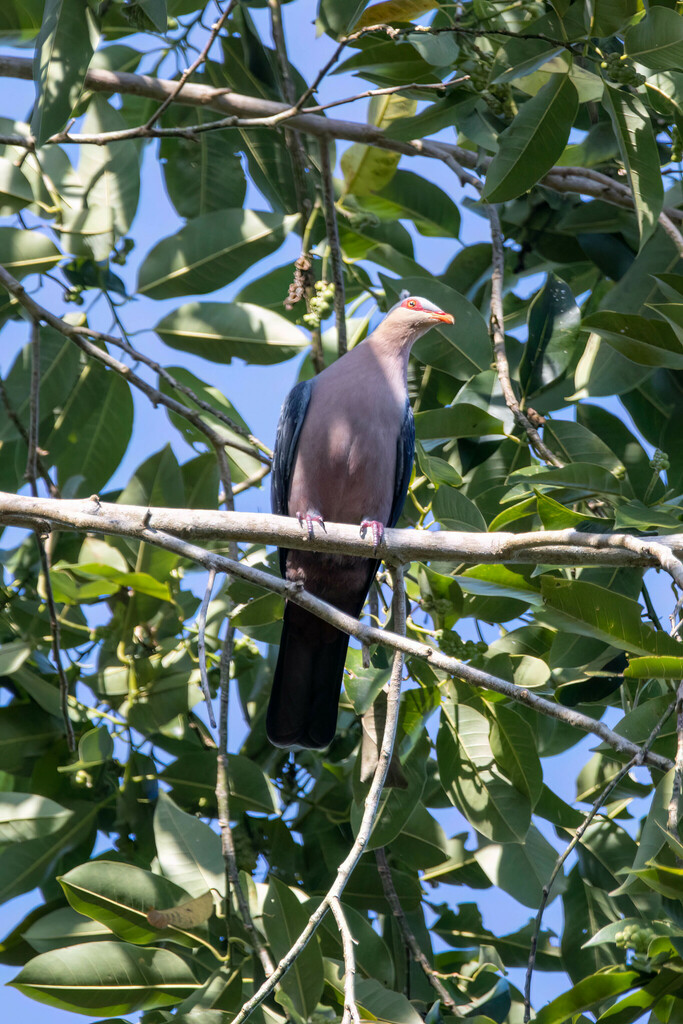
Seram Mountain Pigeon
Photo © Jesse Long
Photo © Jesse Long — CC BY 4.0 — Source: iNaturalist #153643544Identification
The Seram mountain pigeon is a medium-sized pigeon, measuring 33–38.5 cm in length and weighing 330–338 g. It is highly distinctive with a deep buff-pink face and breast that pales toward the chin, transitioning to wine-pink on the underparts. The thighs are grey, while the nape, crown, and back of neck display a pale, pure blue-grey. The belly and underside of the tail are dark chestnut with wine-grey fringes. Adults have scarlet to yellow eyes with purplish-red to scarlet orbital skin, a yellow bill with purple cere, and purple legs. Juveniles are noticeably darker and browner overall, with dull red orbital skin and legs, and a white-tipped grey bill with a dull red cere.
Range & Habitat
This species is endemic to Seram in the Maluku Islands of Indonesia. It primarily inhabits hill forest at elevations between 400 and 2,300 m, though it is typically more common above 1,200 m. The species shows a preference for primary montane forest, particularly in the upper elevation zones, though occasional records exist of individuals at much lower elevations near sea level.
Behaviour & Diet
The Seram mountain pigeon is highly social, regularly observed in flocks exceeding 20 birds, with some aggregations reaching up to 50 individuals. It feeds exclusively on fruit, foraging in these large groups through the forest canopy. During the breeding season, males perform a distinctive display flight in February, launching themselves upward from a perch before descending in a lower, less steep trajectory than related species, continuing forward flight rather than immediately returning to the perch.
Best Time & Places to See It
To encounter this species, visit Seram's montane forests at elevations between 1,200 and 2,300 m, where the pigeon is especially common. The breeding season in February offers opportunities to observe the spectacular display flights of males. The species' social nature and tendency to forage in flocks make it relatively approachable compared to solitary forest pigeons, though early morning visits to fruiting trees will yield the best viewing opportunities.
Photography Tips
The Seram mountain pigeon's striking coloration—particularly the contrast between buff-pink facial markings and blue-grey crown—makes it photogenic in suitable light. Shoot from forest clearings or forest edges where flocking birds are most visible. The species' preference for higher elevations and montane primary forest means you'll need patience and good hiking fitness. Overcast montane conditions are common, so bring a fast lens and consider higher ISO settings. Capturing the male's display flight in February would be a remarkable achievement; position yourself in open forest areas where these flights are most visible.
No community photos yet. Log in to add the first one.
No community observations of this species yet.