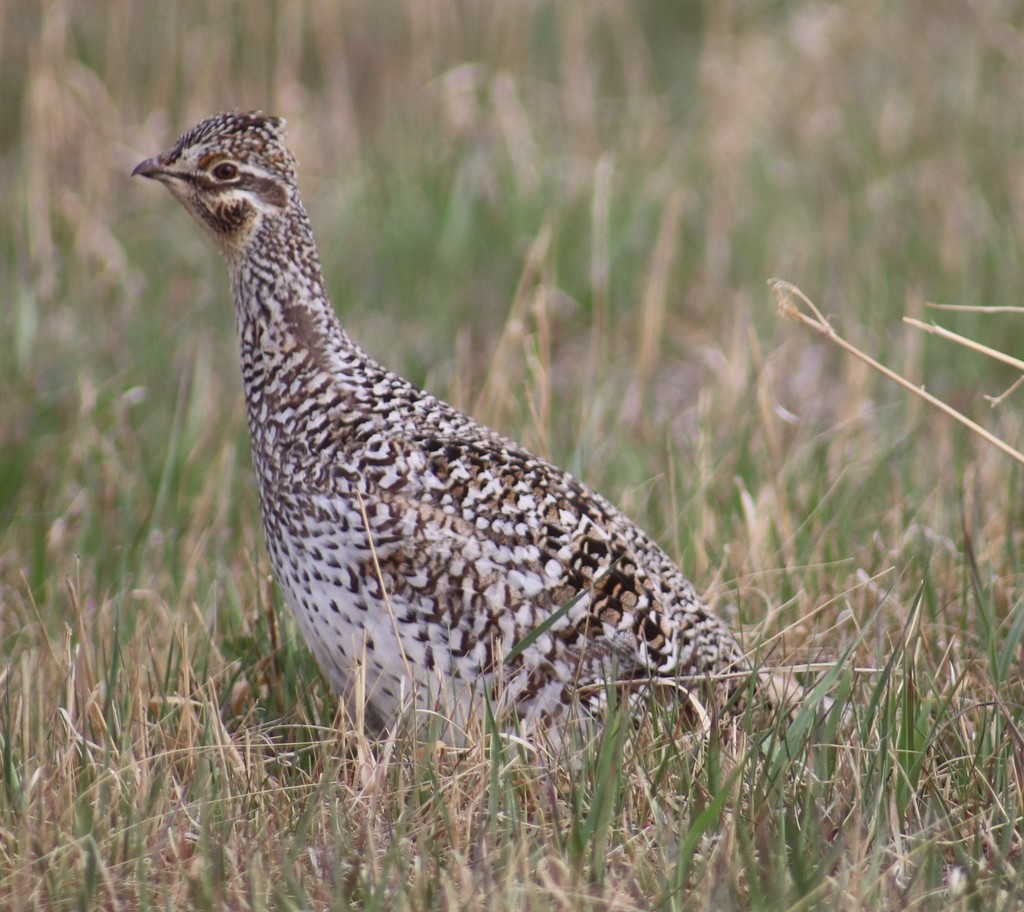
Sharp-tailed Grouse
Photo © Sean Frey
Photo © Sean Frey — CC BY 4.0 — Source: iNaturalist #78996192Identification
The sharp-tailed grouse is a medium-sized prairie grouse measuring 15–19 inches in length with a wingspan of 24–26 inches. Its most distinctive feature is a relatively short tail with square-tipped central feathers that are somewhat longer than the lighter outer tail feathers—the characteristic that gives the species its name. The plumage is mottled dark and light brown against a white background, lighter on the underparts with a white belly uniformly covered in faint V-shaped markings. These markings distinguish it from prairie chickens, which are heavily barred on their underparts. Adult males display a yellow comb over their eyes and a distinctive violet display patch on their neck, quite different from the yellow or orange air sacs of prairie chickens. Females are smaller than males and have less obvious combs, with regular horizontal markings across the deck feathers compared to the irregular, shaft-parallel markings on males.
Range & Habitat
Sharp-tailed grouse are found throughout Alaska, much of Northern and Western Canada, and parts of the Western and Midwestern United States. They are the provincial bird of Saskatchewan. Historically, they occupied eight Canadian provinces and 21 U.S. states, ranging from Alaska south to California and New Mexico and east to Quebec. Following European settlement, they have been extirpated from California, Kansas, Illinois, Iowa, Nevada, and New Mexico. Different subspecies occupy distinct habitats: the Columbian race inhabits isolated sagebrush and bunchgrass plains, while the plains race prefers mixed-grass prairie with a mosaic of native grasslands, cropland, and brushy riparian areas.
Behaviour & Diet
Sharp-tailed grouse are ground foragers in summer and arboreal feeders in winter, consuming seeds, buds, berries, forbs, leaves, and insects—particularly grasshoppers in summer. These birds are lekking species, gathering in open display areas where males perform elaborate courtship rituals. A single lek may contain anywhere from one male to over 20, typically averaging 8–12 birds. During spring, males attend leks from March through July, with peak activity in late April and early May, though timing varies with weather. Males display by stamping their feet rapidly—about 20 times per second—while rattling their tail feathers, turning in circles or dancing forward. They inflate and deflate their purple neck sacs and use cooing calls to attract females and compete with rivals.
Best Time & Places to See It
The best opportunity to observe sharp-tailed grouse is during the spring lekking season, particularly in late April and early May, when males are most active in displaying areas. In Canada, Saskatchewan offers excellent chances as the provincial bird. The northern Great Plains, including southern Alberta and Saskatchewan, eastern Montana, and the Dakotas, are prime locations for the plains subspecies. Observers should seek open prairie habitats and mixed-grass areas where leks traditionally occur. Early morning visits to known lek sites significantly increase viewing success during peak season.
Photography Tips
Photographing sharp-tailed grouse during lek displays offers dramatic opportunities, particularly when capturing males in full display with inflated neck sacs and raised tail feathers. Early morning light during peak lekking season (late April to early May) provides ideal conditions. Use a long telephoto lens to maintain distance and avoid disturbing these sensitive birds. The contrast between their mottled brown plumage and white underparts, along with the distinctive violet neck patch on males, makes for compelling subject matter. Patience at a reliable lek site will reward you with action shots of their rapid foot-stamping and dynamic movement.
Manitoba Owls
Nothing matches these filters.
Badlands National Park
Denali National Park
Glacier National Park
Grand Teton National Park
Isle Royale National Park
Kluane National Park and Reserve
National Elk Refuge
Red Rock Lakes National Wildlife Refuge
Theodore Roosevelt National Park
Nothing matches these filters.
No community photos yet. Log in to add the first one.
No community observations of this species yet.