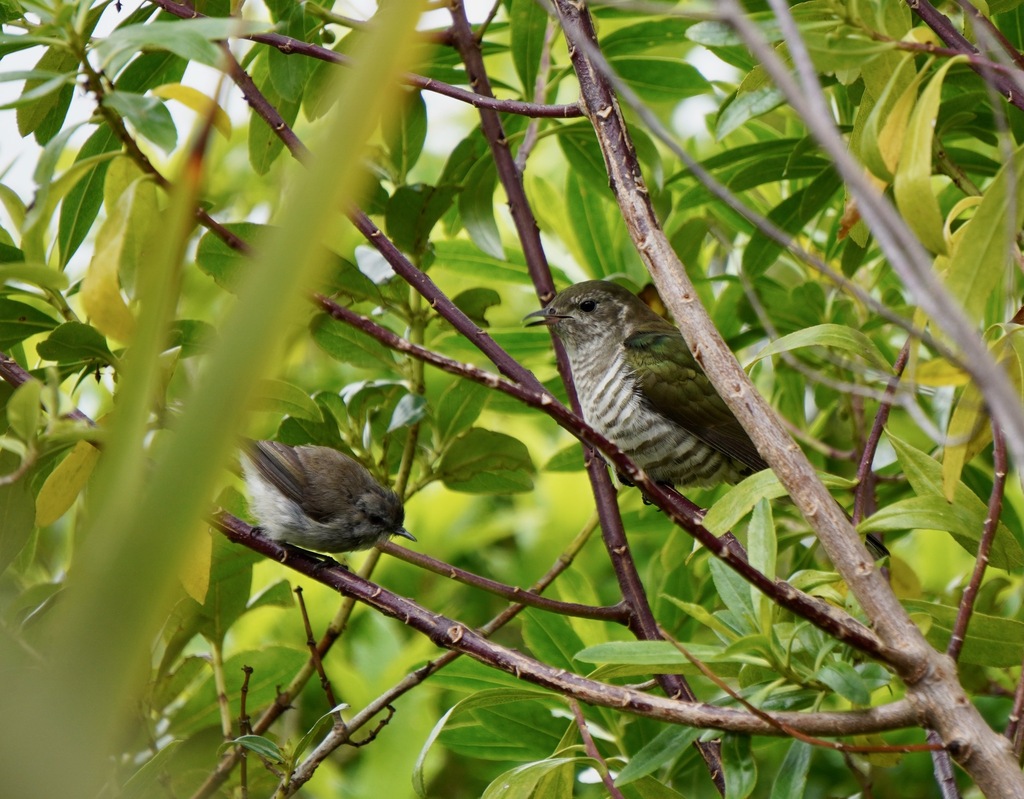
Shining Bronze Cuckoo
Photo © strewick
Photo © strewick — CC BY 4.0 — Source: iNaturalist #146251169Identification
The shining bronze cuckoo is a very small cuckoo, measuring only 13–18 cm (5.1–7.1 in) in length with a wingspan of 25–32 cm (9.8–12.6 in) and weighing around 25 g. Despite its diminutive size, it is slightly larger than Horsfield's bronze cuckoo. The species is far easier to hear than to spot in the field.
The upperparts display striking metallic golden or coppery green plumage, while the cheeks and underparts are white with dark green barring. Females are similar but show a more purplish sheen on the crown and nape, with bronze-tinged barring on the belly. The bill is black, and the feet are black with distinctive yellow undersoles—a useful field mark when visible.
Range & Habitat
This species is found across a vast geographical range spanning Australia, Indonesia, New Caledonia, New Zealand, Papua New Guinea, Solomon Islands, and Vanuatu. In eastern Australia, it is a summer visitor from Cape York Peninsula in Queensland south to South Australia's Eyre Peninsula, Kangaroo Island, and Tasmania, as well as parts of Western Australia. New Zealand populations arrive from mid-August, though they do not become common until October, spreading to Stewart and Chatham Islands and reaching altitudes up to 4,000 ft (1,220 m). The shining bronze cuckoo is notably the most southerly-ranging brood parasitic bird species in the world, extending to at least 46°S in New Zealand. Some island races in New Caledonia, Vanuatu, and the Solomon Islands are non-migratory residents.
Behaviour & Diet
The shining bronze cuckoo is an obligate brood parasite, laying a single egg in the dome-shaped nests of various Gerygone species and other members of the Acanthizidae family. Upon hatching, the young cuckoo ejects the host nestlings from the nest. In New Zealand, the grey warbler is a common host, with cuckoos parasitizing heavily the second brood of the season. Studies near Kaikōura have shown that the dark coloration of cuckoo eggs serves primarily to protect them from removal by other parasitic females rather than from host rejection, as the dark matte eggs are difficult to see in the shadows of warbler nests.
The appearance and coloration of cuckoo eggs vary geographically and are thought to match the nesting ecology of local hosts. Eggs are olive brown in Western Australia and range from green to olive to dark brown elsewhere. The dark pigment on eggs rubs off easily, and the dark coloration is particularly pronounced in thornbill and gerygone nests, minimizing the risk of ejection by a second female cuckoo visitor to an already-parasitized nest. Several other Acanthizidae species serve as occasional hosts, and introduced species such as house sparrows and song thrushes have been recorded as hosts in New Zealand.
Best Time & Places to See It
In eastern Australia, the best time to encounter shining bronze cuckoos is during the breeding season when they are summer visitors. In New Zealand, birds begin arriving in mid-August, with numbers increasing significantly through October. Look for them in areas with suitable host species, particularly habitats supporting grey warblers, gerygones, and thornbills. Chatham Island warbler nests also attract this species in the Chatham Islands. The non-migratory island populations of New Caledonia, Vanuatu, and the Solomon Islands offer year-round opportunities in those regions.
Photography Tips
The shining bronze cuckoo's small size and cryptic habits make it challenging to photograph. Listen for its distinctive calls to locate birds, as it is far easier to hear than to see. When photographing, pay particular attention to the metallic golden-green upperparts and the contrasting white underparts with dark barring, which are key field marks. The yellow undersoles of the feet are worth capturing if the bird perches openly, though this is uncommon. Early morning light will best render the metallic sheen of the plumage. Patience and knowledge of host species distributions will increase your chances of productive encounters.
Abel Tasman National Park
Alpine National Park
Aoraki / Mount Cook National Park
Arthur’s Pass National Park
Bald Rock National Park
Barrington Tops National Park
Belair National Park
Ben Boyd National Park
Blue Mountains National Park
Nothing matches these filters.
No community photos yet. Log in to add the first one.
No community observations of this species yet.