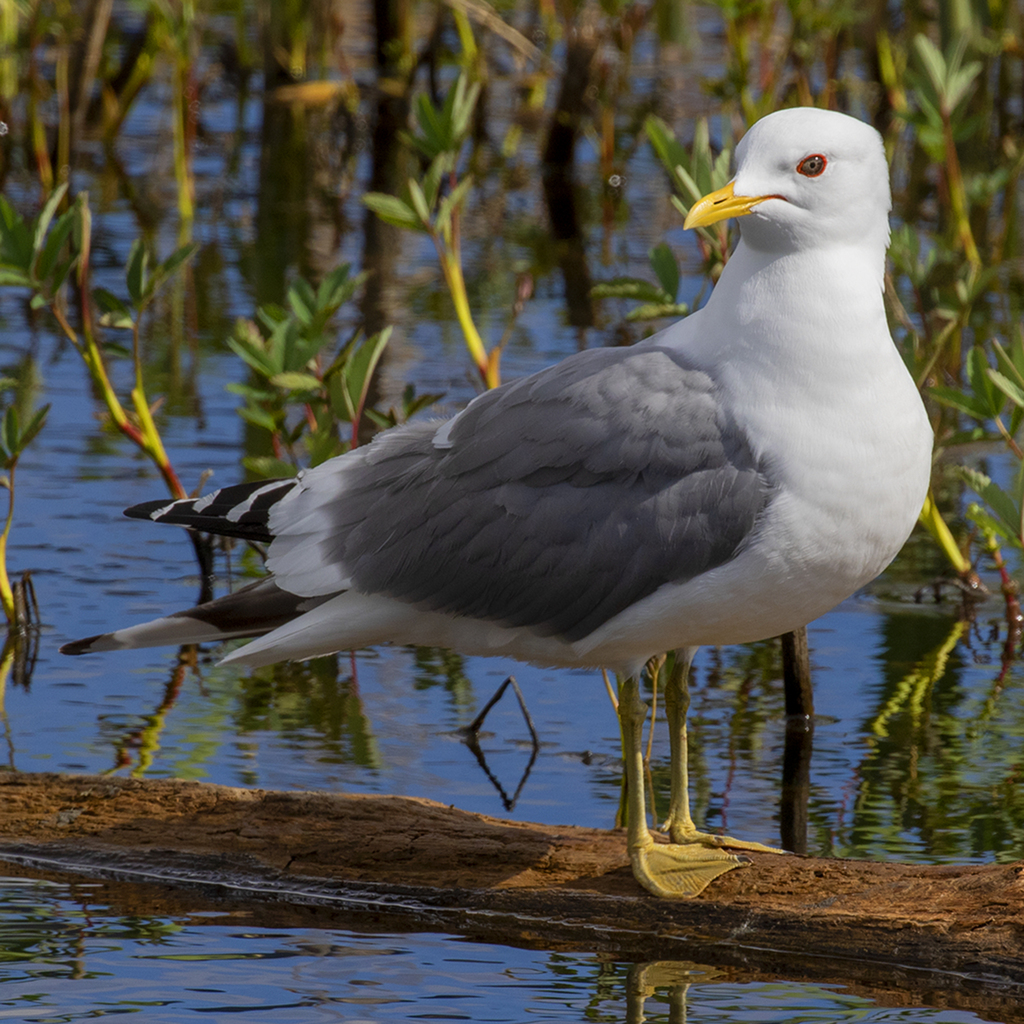
Short-billed Gull
Photo © Dan Vickers
Photo © Dan Vickers — CC BY 4.0 — Source: iNaturalist #256103376Identification
The short-billed gull is a small gull measuring 40–45 cm in length with a wingspan of 100–120 cm. Its most distinctive feature is its relatively short bill and notably long, narrow wings, which give it an elegant, streamlined appearance in flight compared to other gulls. Breeding adults display a clean white head, pale eyes ringed with red orbital skin, and bright yellow legs and bill unmarked by any dark coloration. In winter plumage, brown mottling appears on the head, the orbital skin becomes grayish, and the bill dulls with a faint dark marking.
In flight, look for conspicuous white spots or "mirrors" on the two outermost primary feathers. Between the inner primaries, white "tongue tips" create a distinctive 'string of pearls' pattern leading to a broad white trailing edge. These field marks separate it from the common gull, which has a larger bill, shorter wings, more extensive black wingtips, and typically lacks the prominent white tongue tips. Young birds take three years to acquire full breeding plumage, passing through various intermediate stages with brownish tones and gradually acquiring white head and body plumage.
Range & Habitat
The short-billed gull breeds in colonies throughout coastal areas and inland wetlands, with its range concentrated in Alaska and Northwest Canada. During winter, most birds migrate south along the Pacific coast, reaching the Sacramento Valley and occasionally venturing as far as Baja California, the Northern Rockies, and Ontario. The species is a very rare visitor to eastern North America and only occasionally reaches east Asia as a vagrant.
This gull favors both coastal and interior wetland habitats during the breeding season, showing flexibility in habitat choice. While sightings in Europe remain extraordinary rarities, the species occasionally appears far from its normal range.
Behaviour & Diet
Short-billed gulls are colonial breeders, gathering in groups along the coasts and wetlands of northwestern North America. The species is migratory, with distinct breeding and wintering ranges. Their long wings and streamlined build suggest active, agile flight compared to stockier gull species, enabling them to forage effectively across their varied habitats. Like other gulls, they are opportunistic feeders, though specific dietary details remain less documented than for larger gull species.
Best Time & Places to See It
To observe short-billed gulls, visit Alaska and Northwest Canada during the breeding season when birds gather in coastal and inland colonies. Winter birding along the Pacific coast from British Columbia south to California offers the best opportunities, particularly around the Sacramento Valley where populations concentrate. Pacific coast harbors, bays, and wetlands are reliable locations during these months.
Photography Tips
Photograph breeding adults to capture the striking contrast of white plumage, red orbital skin, and bright yellow bill and legs. In flight, focus on capturing the white mirrors on the outer primaries and the distinctive 'string of pearls' pattern on inner primaries—these diagnostic field marks make compelling subjects. The species' proportionally longer wings and shorter bill compared to common gulls photograph distinctively; capture side-by-side comparisons if possible. Winter birds with mottled heads and duller bills offer different photographic interest from pristine breeding plumage.
Tombstone Territorial Park
Alaska Maritime National Wildlife Refuge
Arctic National Wildlife Refuge
Banff National Park
Bear River Migratory Bird Refuge
Becharof National Wildlife Refuge
Channel Islands National Park
Denali National Park
Don Edwards San Francisco Bay National Wildlife Refuge
Nothing matches these filters.
No community photos yet. Log in to add the first one.
No community observations of this species yet.