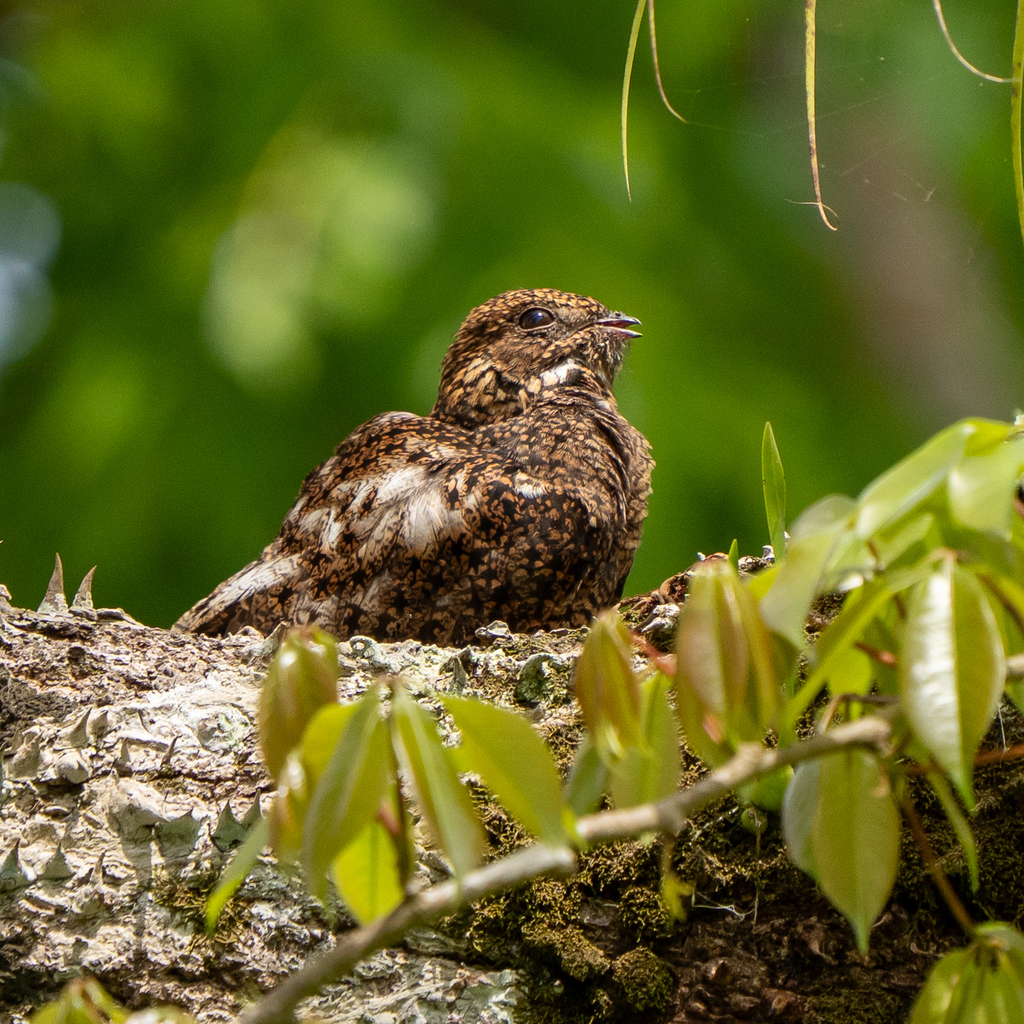
Short-tailed Nighthawk
Photo © Anthony Batista
Photo © Anthony Batista — CC BY 4.0 — Source: iNaturalist photo #503862003Identification
The Short-tailed Nighthawk is a relatively large nightjar, measuring 19 to 21 cm in length, distinguished by its notably short tail—unusual among nighthawks. Its upperparts are dark brown to blackish, heavily marked with rufous and buff spots and speckles. Unlike most nighthawks, it lacks bold white wing markings, instead displaying muted, colored spots on dark brown wings. The tail is brown with tawny or grayish barring and a narrow buffy or whitish terminal band. The throat is white, contrasting with a dark brown chin and upper breast, while the lower breast is buff with brown barring, and the belly and flanks are tawny-buff with brown bars.
Most subspecies produce a distinctive vocalization described as constantly repeated, well-spaced calls—either a sharp "g'wik" or "gweek" sound, or an "ewIT...ewIT...ewIT" pattern, given both when perched and in flight.
Range & Habitat
This species is widely distributed across Central America and northern South America, occurring from Mexico through every Central American country except El Salvador, and across every mainland South American country except Chile and Uruguay. It is also found in Trinidad and Tobago. The species primarily inhabits lowland evergreen forests but also frequents more open landscapes including forest clearings, river edges, old cacao plantations, and middle-aged secondary forest.
Northern populations are generally resident year-round, though the seasonal movements of Amazonian populations remain poorly documented. Southern populations are migratory, with some individuals traveling as far north as Venezuela during the austral winter.
Behaviour & Diet
The Short-tailed Nighthawk is an aerial insectivore that forages primarily at dusk, hunting with rapid, erratic flight compared to that of a bat. Its diet includes beetles and true bugs, though detailed dietary studies are limited. The species is typically encountered singly or in pairs, though it occasionally forages in small flocks. It roosts lengthwise on thick tree branches during the day.
Notably, this species and its close relative the Rufous-bellied Nighthawk are unique within their family in nesting in trees. They lay a single egg directly on a large horizontal branch without constructing any nest structure or adding nesting material.
Best Time & Places to See It
The Short-tailed Nighthawk is best observed at dusk during its active foraging period. While widely distributed throughout its range, it favors lowland evergreen forests and forest edges. The species may be more readily encountered in areas with open clearings and river edges, which provide ideal hunting grounds. Early evening is the optimal time for observation, as the bird becomes active as light fades.
Visitors to Central America and the Amazon basin have good opportunities to encounter this species, particularly in countries such as Costa Rica, Panama, Colombia, Ecuador, Peru, and Venezuela. Forest lodges and reserves in lowland tropical regions are likely locations.
Photography Tips
Photographing the Short-tailed Nighthawk presents a significant challenge due to its crepuscular habits and erratic flight behavior. Fast film speeds or high ISO settings are essential for dusk light conditions. A fast, telephoto lens will help capture this agile flier in its natural habitat. Patience is critical—position yourself near likely roosting branches or forest edges at dusk and wait for activity to begin as light diminishes.
The bird's dark plumage and lack of bold white markings (unlike many other nighthawks) mean that subtle detail in spotting and barring patterns becomes important for identification in photographs. Its distinctive short tail is a key field mark that should be emphasized in any image. Capturing the bird in flight against the dimming sky, or perched lengthwise on a branch, will showcase its characteristic posture and silhouette.
Amazônia National Park
Anavilhanas National Park
Araucárias National Park
Arenal Volcano National Park
Barra del Colorado National Wildlife Refuge
Braulio Carrillo National Park
Cahuita National Park
Calilegua National Park
Campos Amazónicos National Park
Nothing matches these filters.
No community photos yet. Log in to add the first one.
No community observations of this species yet.