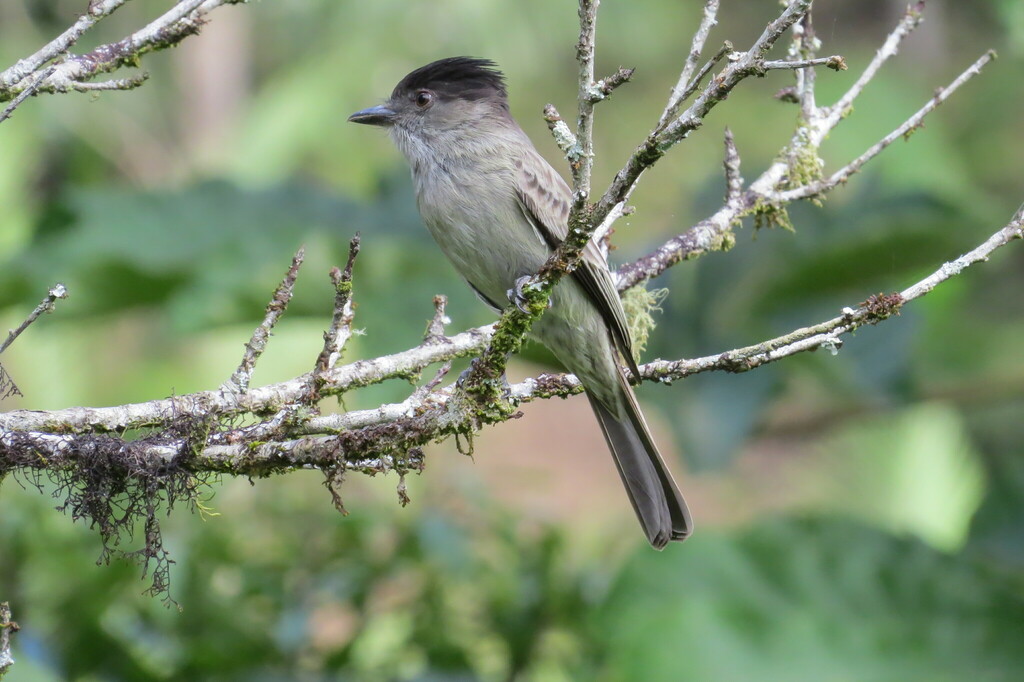
Sibilant Sirystes
Photo © Jonathan Lorencetti Ehlert
Photo © Jonathan Lorencetti Ehlert — CC BY-SA 4.0 — Source: iNaturalist photo #438957493Identification
The sibilant sirystes is a small tyrant flycatcher, measuring 18 to 18.5 cm in length. Both sexes are identical in plumage. The nominate subspecies features a distinctive black crown with a slight crest, slate-gray face, and mottled gray-olive back. The wings are blackish with wide gray edges, and the long tail has a square tip. The throat and breast are gray, fading to grayish white on the belly. The subspecies S. s. atimastus shows subtle differences, including yellowish rump tips and a whiter breast. All individuals have a characteristic dark reddish-brown iris, black bill, and blackish legs.
Range & Habitat
The sibilant sirystes is found across central and southeastern South America, including Brazil, Bolivia, Paraguay, and Argentina. The nominate subspecies has the larger range, extending from central Amazonas through the Atlantic Forest region to northern Rio Grande do Sul, with populations in eastern Paraguay and northeastern Argentina. The subspecies S. s. atimastus is restricted to the Chapada dos Guimarães region in Mato Grosso. The species is a year-round resident across most of its range, though it withdraws from Rio Grande do Sul in the austral winter and visits Bolivia only seasonally.
This species is a canopy specialist, nearly always remaining in the treetops of primary and mature secondary forests, riparian woodland, and dry cerradão. It occurs from 1,000 m elevation, and occasionally up to 1,400 m in Brazilian highlands.
Behaviour & Diet
The sibilant sirystes feeds primarily on large insects supplemented with fruit, employing an active foraging style from high perches. It typically sallies out to snatch prey and fruit from vegetation, sometimes hovering briefly. Usually found in pairs, it readily joins mixed-species feeding flocks and often leads these associations, ranging widely across its territory.
The species is highly vocal, with a distinctive loud, ringing "wheer-péw" call that is sometimes extended into excited series. Both subspecies also produce a long, flat whistling alarm call and a rapid trill. Little is known about its breeding biology beyond the August–October breeding season recorded in far southern Brazil.
Best Time & Places to See It
The sibilant sirystes is generally uncommon to fairly common, and locally common in parts of its range. Year-round residents provide the best viewing opportunities in central and southeastern Brazil, Paraguay, and northern Argentina. Many populations occur within national parks and protected areas. However, the species is notably susceptible to forest loss and fragmentation, with local extinctions reported in southeastern Brazil, particularly following forest fires and habitat degradation.
Photography Tips
This canopy dweller requires patience and good optics. Look for it high in the forest, often as part of mixed feeding flocks. Its loud vocalization makes it easier to locate than many canopy birds. Early morning hours when flocks are most active provide the best light for photography. Use a sturdy tripod and telephoto lens to capture details of the crest, facial pattern, and rump markings from distance. The bird's habit of perching prominently while foraging offers brief opportunities for clean shots against open sky.
Araucárias National Park
Brasília National Park
Carlos Botelho State Park
Chapada Diamantina National Park
Chapada dos Guimarães National Park
Chapada dos Veadeiros National Park
Emas National Park
Encontro das Águas State Park
French Guiana Amazonian Park
Nothing matches these filters.
No community photos yet. Log in to add the first one.
No community observations of this species yet.