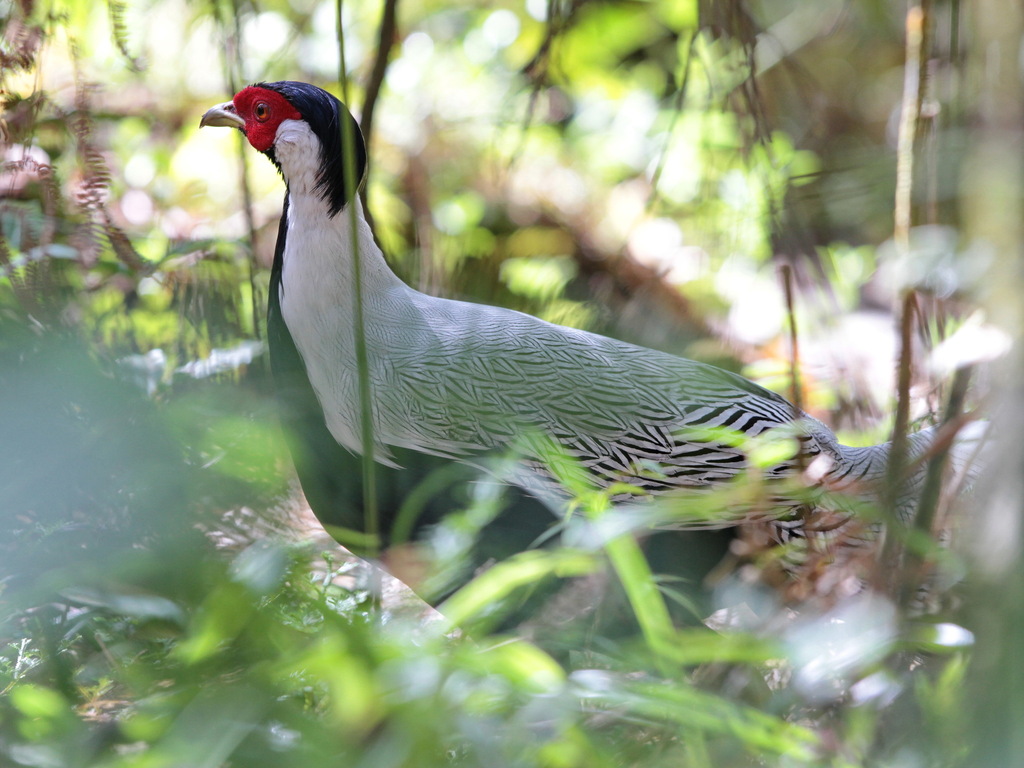
Silver Pheasant
Photo © Ian Dugdale
Photo © Ian Dugdale — CC BY 4.0 — Source: iNaturalist photo #546783283Identification
The silver pheasant is a relatively large pheasant with striking sexual dimorphism. Males of the largest subspecies reach 120–125 cm in total length, including a tail up to 75 cm, while smaller subspecies males barely exceed 70 cm. Females are notably smaller at 55–90 cm in total length. Both sexes share distinctive bare red faces and red legs, which separate the silver pheasant from the similar kalij pheasant, whose legs are greyish.
Males display dramatic variation by subspecies. Northern subspecies males have white upperparts and tails (with some black markings), contrasting with glossy bluish-black underparts and crests. Southern subspecies males are considerably darker, with greyer upperparts and tails extensively marked with black. Females are brown overall and notably shorter-tailed than males. Some subspecies females have whitish underparts heavily patterned with black, a pattern particularly pronounced in the Hainan subspecies. Males reach their adult plumage in their second year.
Range & Habitat
The silver pheasant is found in forests, primarily in mountainous regions, across mainland Southeast Asia and eastern and southern China. Its range extends from southwestern China through Myanmar, Thailand, Laos, Vietnam, and Cambodia. The species has also been introduced to Victoria Island in Nahuel Huapi Lake, Neuquén, Argentina, and to Vancouver Island, Canada.
While overall common in the wild and widespread in aviculture, several subspecies face conservation concerns. The Hainan subspecies, the southern Laotian subspecies, and the southern Vietnamese subspecies are all rare and threatened, highlighting the importance of protecting specific populations across the species' range.
Behaviour & Diet
Limited specific information is provided in available sources regarding the silver pheasant's detailed behaviour and dietary preferences. However, like other pheasants, they are forest-dwelling birds adapted to mountainous terrain, likely foraging on the ground for seeds, insects, and vegetation typical of their habitat.
Of note is that the silver pheasant is closely related to the kalij pheasant, and the two species are known to hybridize. Interestingly, the imperial pheasant, once considered a very rare species, is actually a naturally occurring hybrid between the silver pheasant and Edward's pheasant.
Best Time & Places to See It
The silver pheasant can be encountered throughout its range in mainland Southeast Asia and China, particularly in montane forest habitats. Birdwatchers and wildlife travellers should focus on forested, mountainous regions across Myanmar, Thailand, Laos, Vietnam, Cambodia, and China's southern and eastern provinces. The species remains common in many areas, making sightings reasonably achievable for patient observers in suitable habitat.
Travellers visiting the species' range should note that certain subspecies are significantly rarer than others. Those specifically seeking threatened populations, such as the Hainan subspecies, the southern Laotian subspecies, or the southern Vietnamese subspecies, should prepare for more challenging searches in protected or remote mountainous regions.
Photography Tips
The stark plumage contrast in males—particularly the white-and-black patterning in northern subspecies or the darker grey-and-black of southern subspecies—makes them visually striking photographic subjects. The glossy bluish-black underparts and crests of males are best captured in good light to convey their iridescent quality. The red face and red legs are diagnostic features worth emphasizing in photographs.
Females present a different challenge, as their brown plumage and patterned underparts require careful exposure metering to retain detail in both highlights and shadows. The species' forest habitat and ground-foraging behaviour mean that patience and early morning or late afternoon light will yield the best results. The dramatic sexual dimorphism makes photographing both sexes worthwhile for comprehensive field documentation.
Khao Yai National Park
Prachantakham District, Thailand
+377 birds+46 mammals
Evergreen dipterocarp forest blankets the rolling terrain of this national park in eastern Thailand, where limestone hills rise abruptly from the forest floor and seasonal streams…
VIEW NATIONAL PARKMount Nanling Forest Park
Ruyang Forest Farm, China
+179 birds+3 mammals
Granite ridges and weathered peaks rise through a canopy of subtropical montane forest where Ruyang Forest Farm anchors one of southern China's most biodiverse landscapes. Across…
VIEW FOREST & JUNGLEPoyang Lake National Nature Reserve
Shangrao, China
+270 birds+7 mammals
Where the Yangtze River's massive floodplain spreads across central China, Poyang Lake National Nature Reserve encompasses one of the continent's most dynamic and water-rich wetland systems.…
VIEW NATURE RESERVEXishuangbanna National Nature Reserve
Xishuangbanna Dai Autonomous Prefecture, China
+173 birds+2 mammals
Where subtropical monsoon forests meet the margins of the Yunnan plateau, Xishuangbanna National Nature Reserve sprawls across a landscape of dramatic relief—deep river valleys carved by…
VIEW NATURE RESERVEGaoligong Mountain National Nature Reserve
Nujiang Lisu Autonomous Prefecture, China
+443 birds+13 mammals
VIEW NATURE RESERVENo community photos yet. Log in to add the first one.
No community observations of this species yet.