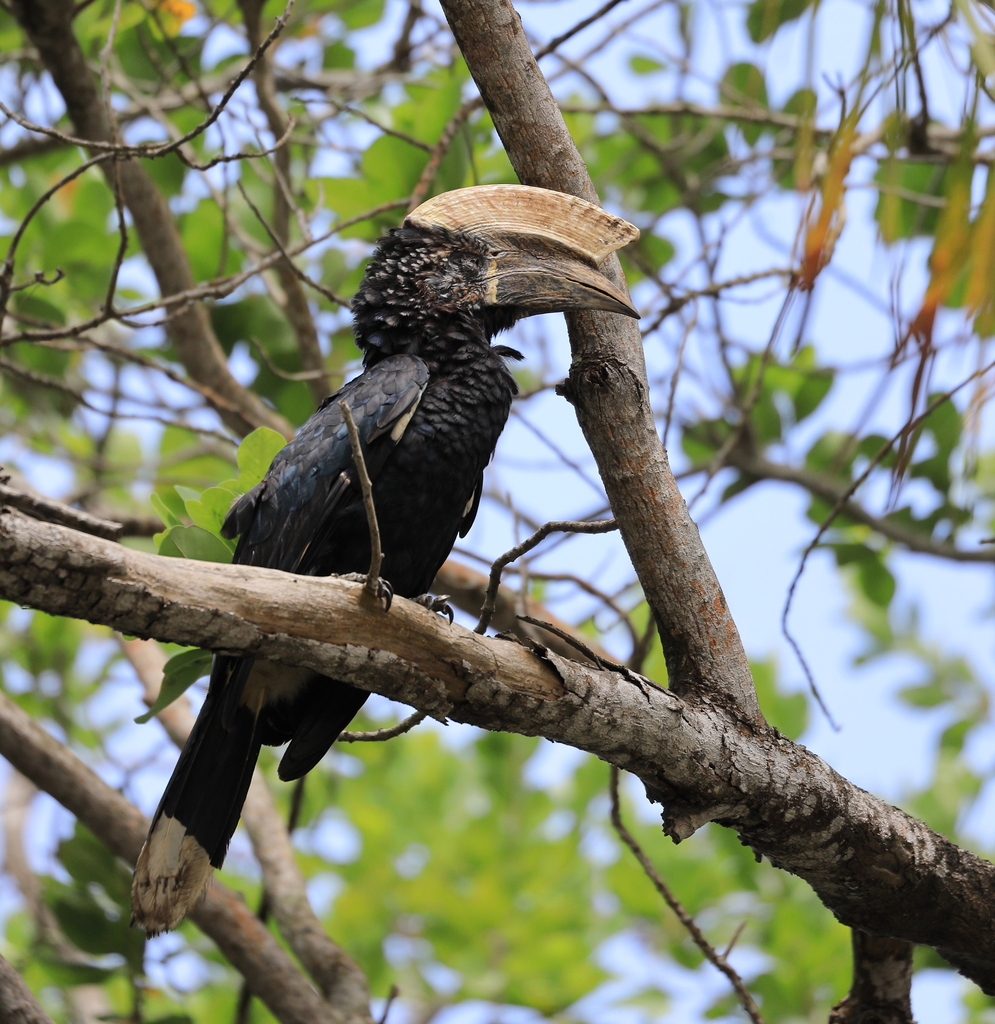
Silvery-cheeked Hornbill
Photo © Darren Obbard
Photo © Darren Obbard — CC BY 4.0 — Source: iNaturalist photo #356533441Identification
The silvery-cheeked hornbill is a large and unmistakable bird, measuring 75 to 80 centimetres in length. Its most striking feature is the very large cream-coloured casque that crowns its beak, giving it an imposing and distinctive silhouette. The head is covered in silver-grey plumage, while the rest of the body is iridescent black, creating a striking contrast. Close inspection reveals white patches on the rump, lower back, thighs, vent, and the tips of the outer tail-feathers—distinctive field marks that aid in identification.
Sexual dimorphism is subtle but observable in the field. Females are slightly smaller and sport a noticeably smaller casque than their male counterparts. Additionally, females display reddish skin around the eyes, which is absent in males, providing a useful identification feature for birdwatchers able to observe birds at close range.
Range & Habitat
The silvery-cheeked hornbill is found exclusively in Africa, inhabiting the tall evergreen forests of East Africa. Its range extends from Ethiopia in the north down through the continent to South Africa in the south. The species remains locally fairly common throughout much of this range, particularly in the northern and central portions where suitable habitat persists.
However, distribution is not uniform across its range. In Zimbabwe, the species faces significant threats from habitat destruction and has become scarcer. Its presence in South Africa is marginal, indicating that the southern limits of its range are populated only sporadically. For travellers seeking this species, the healthier populations are found in the core of its East African distribution.
Behaviour & Diet
Silvery-cheeked hornbills are typically social birds, usually living in pairs but sometimes congregating in spectacular flocks of hundreds of individuals when roosting. This gregarious behaviour, particularly during roosting periods, makes them conspicuous despite their forest habitat. The breeding season occurs in spring, during September and October in at least parts of the range. Females lay clutches of one to three white eggs, which are incubated for 40 days. The young remain dependent on both parents for approximately 80 days before fledging.
As omnivorous foragers, these hornbills have a diverse diet encompassing fruits, insects, small birds, rodents, small reptiles, and centipedes. This varied diet allows them to exploit multiple food sources throughout the year, though their preference for fruits ties them strongly to evergreen forest habitats where fruiting trees provide reliable sustenance.
Best Time & Places to See It
The breeding season in September and October offers excellent opportunities to observe silvery-cheeked hornbills, as breeding birds are more active and visible. Travellers should focus their efforts on the northern and central portions of the species' East African range, where populations remain locally fairly common. Tall evergreen forests are essential habitat, so seeking out protected forest reserves and national parks with intact evergreen forest will maximize encounter chances.
Photography Tips
The silvery-cheeked hornbill's large size and striking plumage make it a rewarding photographic subject. The cream-coloured casque and iridescent black plumage create excellent contrast, particularly in dappled forest light. Photography is most productive during the breeding season when birds are more active. Since these hornbills sometimes roost in large flocks, early morning light at communal roost sites can provide exceptional opportunities for capturing multiple birds. The white patches on the rump and tail-feathers are distinctive field marks worth capturing to document the species' identification features.
Serengeti National Park
Tanzania
+558 birds+57 mammals
Across Tanzania's northern plateau, where volcanic soils meet acacia woodland and open grassland, unfolds one of Earth's most dynamic ecosystems. The Serengeti National Park sprawls across…
VIEW NATIONAL PARKArusha National Park
Tanzania
+555 birds+16 mammals
Where the slopes of Mount Mawenzi rise above the Arusha region, a compact yet ecologically rich national park unfolds across montane forest, moorland, and alpine zones.…
VIEW NATIONAL PARKKilimanjaro National Park
Kenya
+207 birds+16 mammals
Africa's highest mountain rises not in isolation but as the centerpiece of a vast national park that sweeps across the borderlands of northern Tanzania, where savanna…
VIEW NATIONAL PARKMount-Kenya National Park
Abothuguchi west ward, Kenya
+334 birds+11 mammals
Where the slopes of Kenya's second-highest mountain rise steeply from the Meru County foothills, a landscape of profound ecological richness unfolds across Mount Kenya National Park.…
VIEW NATIONAL PARKTarangire National Park
Tanzania
+527 birds+50 mammals
Acacia woodland and grassland sweep across the Manyara Region where the Tarangire River carves through low hills and volcanic soils, creating one of East Africa's most…
VIEW NATIONAL PARKKitulo National Park
Tanzania
+59 birds+1 mammals
Where the southern highlands of Tanzania rise above two thousand metres, rolling grasslands and montane meadows create a landscape rarely encountered in East Africa—a sweeping plateau…
VIEW NATIONAL PARKNgorongoro Conservation Area
Tanzania
+626 birds+55 mammals
Volcanic calderas and open grassland dominate this high plateau in northern Tanzania, where the landscape rises above 2,000 metres and ancient geological forces have shaped both…
VIEW WILDLIFE MANAGEMENT AREAAbijata-Shalla Lakes National Park
Ethiopia
+438 birds+7 mammals
Two crater lakes of contrasting chemistry define this remote corner of Ethiopia's Rift Valley, where soda lakes and freshwater basins create a mosaic of distinct aquatic…
VIEW NATIONAL PARKBale Mountains National Park
Ethiopia
+397 birds+20 mammals
Where the Ethiopian highlands rise above 4,000 metres, the Bale Mountains create a landscape of stunning ecological extremes—from afroalpine grasslands swept by wind and mist to…
VIEW NATIONAL PARKMago National Park
Ethiopia
+128 birds+3 mammals
Where the Omo River cuts through southern Ethiopia's arid borderlands, Mago National Park sprawls across a landscape of dramatic escarpments, riverine forests, and semi-arid savanna that…
VIEW NATIONAL PARKOmo National Park
Ethiopia
+61 birds+4 mammals
Where the Omo River carves through southwestern Ethiopia, a landscape of riverine woodland, acacia savanna, and scattered grassland unfolds across one of East Africa's most remote…
VIEW NATIONAL PARKNech Sar National Park
Arba Minch, Ethiopia
+191 birds+10 mammals
Where the East African Rift Valley plateaus drop dramatically toward the shore of Lake Abaya, a mosaic of habitats unfolds across sun-scorched savanna and acacia woodland.…
VIEW NATIONAL PARKYabelo Wildlife Sanctuary
Bedewera, Ethiopia
+359 birds+5 mammals
Where acacia woodlands meet volcanic plateaus in southern Ethiopia, a landscape of austere beauty unfolds across nearly 2,500 square kilometers. Yabelo Wildlife Sanctuary sprawls across semi-arid…
VIEW WILDLIFE SANCTUARYNairobi National Park
Nairobi, Kenya
+515 birds+35 mammals
Just minutes from Kenya's capital, where the Nairobi River winds through acacia woodland and open grassland, lies one of Africa's most paradoxical wildlife sanctuaries. The park's…
VIEW NATIONAL PARKLake Nakuru National Park
Nakuru West, Kenya
+494 birds+32 mammals
Alkaline waters ringed by acacia woodland and grassland create one of East Africa's most distinctive wetland ecosystems, where the interplay of geology and climate sustains a…
VIEW NATIONAL PARKAberdare National Park
Mweiga ward, Kenya
+394 birds+30 mammals
Where the central highlands of Kenya rise to their elemental grandeur, the Aberdare range unfolds across Nyeri County as a montane stronghold of cool, misty forest…
VIEW NATIONAL PARKMeru National Park
Igembe Central, Kenya
+408 birds+38 mammals
Granite outcrops and acacia woodland rise across the northern reaches of Meru, where semi-arid savanna transitions into drier scrubland under the fierce equatorial sun. The park's…
VIEW NATIONAL PARKChyulu Hills National Park
Kibwezi East, Kenya
+232 birds+30 mammals
Volcanic cones rise abruptly from the Kenyan savanna floor, their flanks clothed in dense acacia woodland and grassland that transforms the Chyulu Hills into an ecological…
VIEW NATIONAL PARKOl Donyo Sabuk National Park
Matungulu North ward, Kenya
+200 birds
Granite peaks rise abruptly from the highland plateau of Matungulu North, their weathered slopes clothed in scattered woodland and montane grassland that shifts between verdant and…
VIEW NATIONAL PARKArabuko Sokoke Forest Reserve
Kilifi, Kenya
+383 birds+29 mammals
Coastal forest rises from the Indian Ocean plains of Kilifi County, where sandy soils and seasonal rainfall have sculpted a woodland ecosystem unlike anywhere else on…
VIEW NATURE RESERVEWatamu Marine National Park
Dabaso ward, Kenya
+328 birds+12 mammals
Where mangrove channels meet coral gardens and sandy shallows blend into the warm waters of the Indian Ocean, Watamu Marine National Park unfolds across the Kilifi…
VIEW NATIONAL PARKNo community photos yet. Log in to add the first one.
No community observations of this species yet.