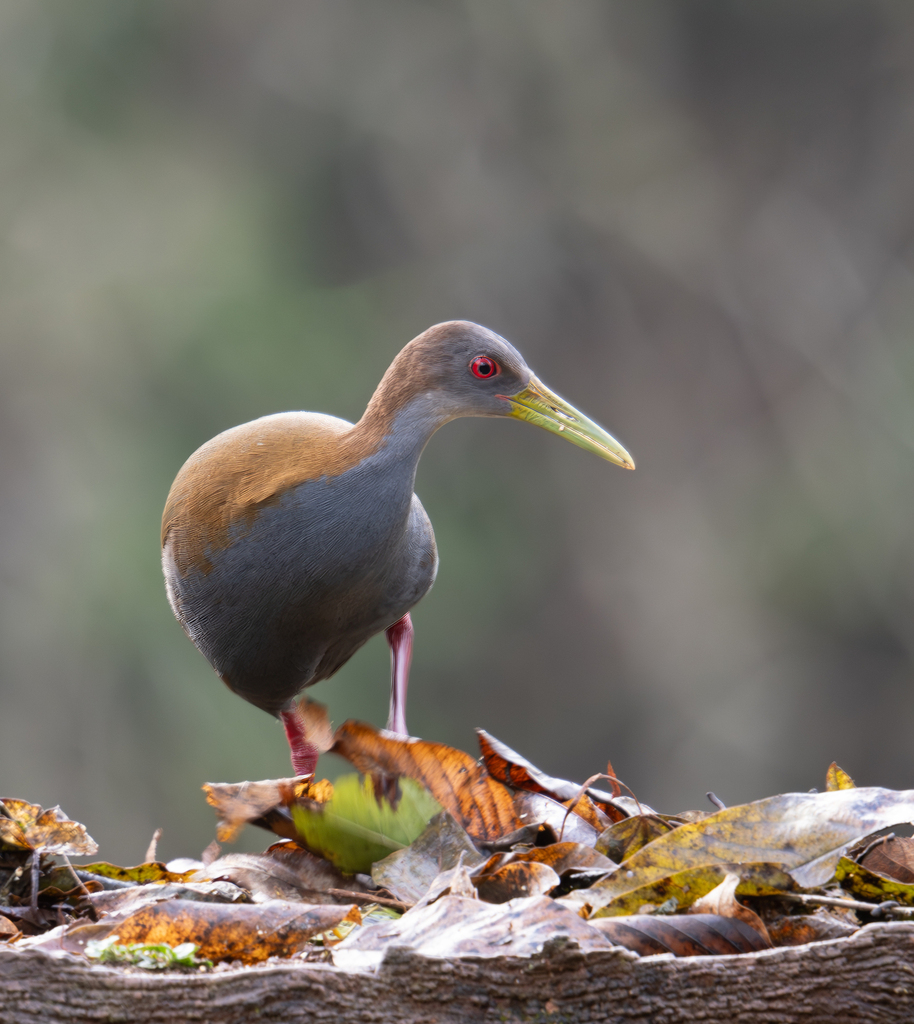
Slaty-breasted Wood Rail
Photo © Gabriel Brachetti
Photo © Gabriel Brachetti — CC BY 4.0 — Source: iNaturalist photo #560113270Identification
The slaty-breasted wood rail is a medium-sized rail, measuring 34 to 37 cm in length. Adults are distinctive and unmistakable in the field: the head, throat, breast, and belly are slate gray, contrasting sharply with a chestnut nape and shoulders. The back is olive, and the tail is black. The bird has a green bill with a bluish base, a striking red eye, and reddish- to yellowish-brown legs and feet. The sexes are alike in plumage. Immatures and juveniles remain undescribed in the literature, making young birds difficult to identify with certainty.
Range & Habitat
This species is found in southeastern Brazil, from southern Minas Gerais and Espírito Santo south and west into eastern Paraguay and northeastern Argentina. It prefers somewhat wet forests and woodlands, often inhabiting swampy areas or locations along streams. However, it typically avoids open marshes, showing a preference for more densely vegetated wetland habitats where it can move through dense cover.
Behaviour & Diet
The slaty-breasted wood rail is a year-round resident throughout its range, remaining in the same areas across all seasons. It typically forages on or near the ground, feeding primarily on earthworms, beetle larvae, and other small invertebrates. The species is vocal and conspicuous, particularly during daylight hours. It produces a variety of loud, resounding calls, including distinctive phrases such as 'po-quit kwaa kwaa kwaa', 'po-peek', and 'po-pereek', often delivered for many minutes and typically as duets between pairs. Another vocalization consists of an irritated, rapidly repeated series of 'quir' notes.
Best Time & Places to See It
Because the slaty-breasted wood rail is a permanent resident, it may be encountered year-round throughout its range in southeastern Brazil, Paraguay, and northeastern Argentina. The breeding season appears to occur at least between November and February, during which time birds may be more vocal and active. Look for this species in wet forests, swampy woodlands, and along forested streams in the appropriate geographic range. Its loud, distinctive calls often betray its presence before the bird is seen, making vocal survey an effective detection method.
Photography Tips
Photographing the slaty-breasted wood rail presents challenges due to its preference for dense, swampy habitats. Early morning hours are ideal, as the species is most vocal and active during the day. Position yourself quietly near suitable habitat—wet woodlands and stream-side vegetation—and listen for its loud, distinctive calls to locate birds. The bird's striking plumage, with contrasting slate-gray underparts and chestnut nape, provides good photographic subjects once found. Patience and a telephoto lens are essential, as the species tends to remain within dense cover. Recording its vocalizations may also help attract birds closer for photography.
Tijuca National Park
Brazil
+317 birds+13 mammals
Where the Atlantic forest rises steeply from Rio de Janeiro's urban edge, Tijuca National Park encompasses a landscape of dramatic granite peaks, cascading waterfalls, and closed-canopy…
VIEW NATIONAL PARKSerra do Cipó National Park
Brazil
+379 birds+5 mammals
Where granite escarpments rise above the Atlantic Forest transition zone in southeastern Brazil, Serra do Cipó National Park unfolds across a landscape of dramatic ridges, cascading…
VIEW NATIONAL PARKItatiaia National Park
Brazil
+519 birds+12 mammals
Where granite peaks pierce the Atlantic rainforest canopy in southeastern Brazil, Itatiaia National Park rises as one of the country's oldest and most ecologically vital protected…
VIEW NATIONAL PARKPeixe National Park Lagoon
Brazil
+293 birds+4 mammals
Where the coastal plains of Rio Grande do Sul meet the Atlantic, Peixe National Park Lagoon sprawls across nearly 2,200 square kilometres of shallow waters, reed…
VIEW NATIONAL PARKSuperagui National Park
Brazil
+246 birds+2 mammals
Where the Atlantic rainforest meets the subtropical coast of Paraná, Superagui National Park sprawls across more than 1,000 square kilometres of one of Brazil's most biodiverse…
VIEW NATIONAL PARKSaint-Hilaire/Lange National Park
Brazil
+225 birds
Subtropical Atlantic forests rise and fall across the plateaus of inland Paraná, where Saint-Hilaire/Lange National Park protects nearly 578 square kilometres of Brazil's most biodiverse woodland…
VIEW NATIONAL PARKSerra do Itajaí National Park
Brazil
+227 birds+2 mammals
Where the Atlantic rainforest rises steeply from the coastal plains of Santa Catarina, Serra do Itajaí National Park spreads across 1,136 square kilometres of montane wilderness…
VIEW NATIONAL PARKSerra da Bocaina National Park
Brazil
+441 birds+5 mammals
Where the escarpment of the Serra da Bocaina rises sharply from the Atlantic coastal plain, tropical rainforest cloaks steep mountainsides that climb toward peaks exceeding 2,000…
VIEW NATIONAL PARKIguaçu National Park
Brazil
+387 birds+17 mammals
Where the Paraná Plateau plunges toward the Atlantic watershed, six thousand square kilometers of subtropical rainforest cling to steep gorges and river valleys in this corner…
VIEW NATIONAL PARKIlha Grande National Park
Brazil
+233 birds
Across the subtropical plateaus and Atlantic forest remnants of southern Brazil, a vast protected landscape spanning nearly 4,600 square kilometers safeguards one of the continent's most…
VIEW NATIONAL PARKSão Joaquim National Park
Brazil
+222 birds+9 mammals
Where the southern Brazilian highlands rise above the Atlantic Forest, São Joaquim National Park protects nearly 1,000 square kilometers of montane terrain that shifts between temperate…
VIEW NATIONAL PARKSerra dos Órgãos National Park
Brazil
+446 birds+13 mammals
Granite peaks thrust skyward through the Atlantic Forest canopy in the mountains immediately north of Rio de Janeiro, their bare rock faces rising above a landscape…
VIEW NATIONAL PARKSerra do Gandarela National Park
Brazil
+333 birds+3 mammals
Where granite massifs rise through Atlantic Forest in southeastern Brazil's highlands, Serra do Gandarela National Park protects nearly 1,000 square kilometres of montane terrain that few…
VIEW NATIONAL PARKAraucárias National Park
Brazil
+231 birds+3 mammals
Where the southern Brazilian highlands rise into cool temperate forest, Araucárias National Park protects one of the Atlantic Forest's most distinctive ecosystems across 506 square kilometres…
VIEW NATIONAL PARKSerra Geral National Park
Brazil
+211 birds+2 mammals
Where basalt cliffs and sandstone escarpments rise above the subtropical forests of southern Brazil, Serra Geral National Park preserves one of the Atlantic region's most dramatic…
VIEW NATIONAL PARKCampos Gerais National Park
Brazil
+143 birds
Where rolling plateaus rise above the Atlantic forest escarpment in Paraná's interior, Campos Gerais National Park unfolds across 539 square kilometers of highland grassland and forest…
VIEW NATIONAL PARKIguazú National Park
Puerto Iguazú, Argentina
+346 birds+15 mammals
Where the Paraná Plateau plunges toward the Atlantic watershed, nearly 800 square kilometers of subtropical rainforest drape across Misiones Province in a landscape carved by millennia…
VIEW NATIONAL PARKNo community photos yet. Log in to add the first one.
No community observations of this species yet.