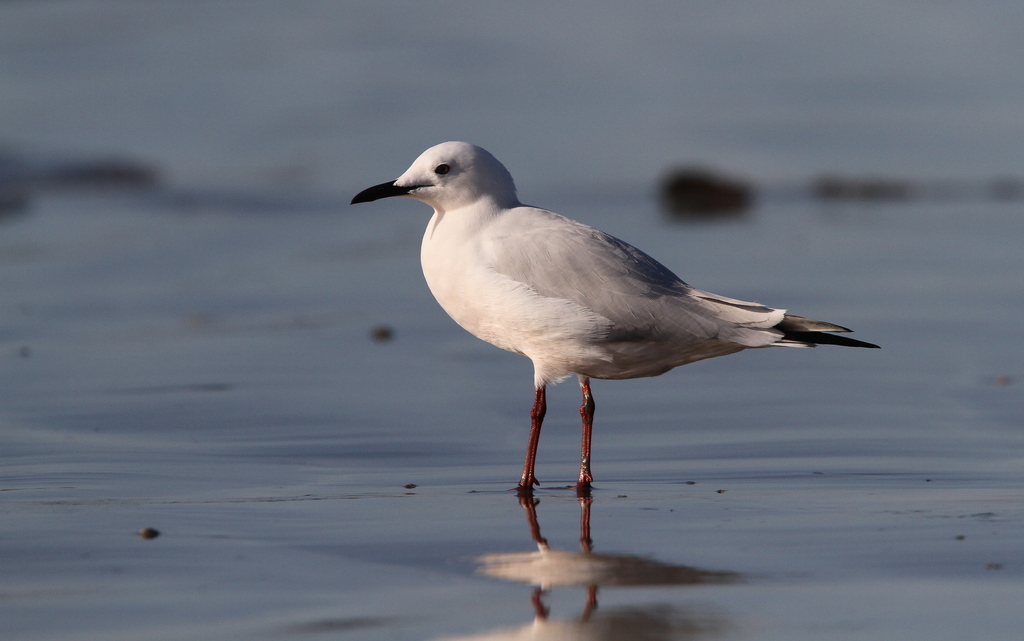
Slender-billed Gull
Photo © Christoph Moning
Photo © Christoph Moning — CC BY 4.0 — Source: iNaturalist photo #95584589Identification
The slender-billed gull is a mid-sized gull measuring 37 to 40 cm in length with a wingspan of 90 to 102 cm, making it slightly larger than the familiar black-headed gull. Its most distinctive feature is its elongated, tapering head and notably slender dark red bill, which give the bird a characteristically stretched appearance enhanced by its long neck. The plumage is predominantly pale grey on the body, with a white head and breast, black tips to the primary wing feathers, and dark red legs. The iris is yellow, and in summer breeding plumage, the breast shows a faint pink colouration. Unlike the black-headed gull, this species does not develop a black hood in summer. Immature birds in their first year can be distinguished by a black terminal tail band and dark areas on the wings; the species takes two years to reach full maturity.
Range & habitat
The slender-billed gull breeds very locally around the Mediterranean Sea and in lagoons and lakes bordering the northwestern Indian Ocean, with populations found in countries including Pakistan. Breeding sites favour islands and coastal lagoons with minimal human disturbance and predators—conditions that enabled a successful colony discovered in a mountain lake in Algeria in 2010 to achieve exceptional hatching success. Most of the population is migratory, wintering further south along the coasts of North Africa, the Middle East, and India in estuaries and bays. The species feeds in deltas, marshes, grasslands, and occasionally on landfill sites. It is not pelagic and is rarely seen far from land, preferring coastal and inland waterway habitats throughout its range.
Behaviour & diet
The slender-billed gull is an adaptable forager, with approximately half its diet consisting of fish. It hunts by flying a few metres above the water surface and diving when suitable prey is spotted. The bird also probes in mud with its slender bill to capture marine invertebrates and occasionally catches insects in flight. This species is colonial, nesting on the ground in loose groups and laying up to three brown-spotted white eggs in simple scrapes sparsely lined with feathers and vegetation. Incubation lasts approximately 25 days, with young fledging after another 25 days. Like most gulls, it is highly gregarious in winter, gathering both at feeding sites and at evening roosts, though it maintains its non-pelagic character throughout the year.
Best time & places to see it
Breeding birds can be found around Mediterranean lagoons and islands during the breeding season, with the species present year-round in some locations. Winter months offer the best opportunity to observe larger concentrations as migratory populations gather in estuaries and bays across North Africa and India. The species remains uncommon throughout its range, making sightings a rewarding find for dedicated birdwatchers. Coastal wetlands, river deltas, and sheltered bays are the most reliable habitats to search.
Photography tips
The slender-billed gull's elegant proportions and distinctive bill shape reward careful photography. The bird's pale plumage and yellow iris stand out clearly in good light, while the delicate pink wash on the breeding bird's breast is a subtle detail worth capturing during summer visits. Photographing birds in flight reveals the black primary tips effectively. Patience is essential given the species' uncommon status and wariness—position yourself discreetly at roost sites or feeding areas during winter gatherings for the best opportunities to document this elegant but elusive gull.
S’Albufera Natural Park
Platja de Muro, Spain
+253 birds+6 mammals
Where Mediterranean lagoons meet the Balearic coast, S'Albufera stretches across nearly 1,600 hectares of wetland and dune systems that rank among Europe's most ecologically vital shallow-water…
VIEW NATURAL PARKMarjal Pego-Oliva Natural Park
Molinell, Spain
+219 birds+2 mammals
Where the Valencian littoral flattens into wetland and reed-bed, Marjal Pego-Oliva straddles the boundary between the Mediterranean and its inland margins, a mosaic of shallow lagoons,…
VIEW NATURAL PARKL’Albufera Natural Park
València, Spain
+321 birds+18 mammals
Where shallow lagoons meet Mediterranean coastal marshland, L'Albufera Nature Park unfolds as one of Spain's most vital wetland complexes. This protected landscape, designated under IUCN Category…
VIEW NATURAL PARKDoñana National Park
Hinojos, Spain
+300 birds+13 mammals
Where the Guadalquivir River delta spreads into the Atlantic, vast marshes, cork woodlands, and coastal dunes converge to create one of southwestern Europe's most biodiverse wetland…
VIEW NATIONAL PARKMurchison Falls National Park
Uganda
+608 birds+33 mammals
Where the Victoria Nile compresses through a narrow gorge and explodes across a 45-meter precipice, the landscape speaks in thunder. Murchison Falls National Park sprawls across…
VIEW NATIONAL PARKCabo de Gata-Níjar Natural Park
San José, Spain
+274 birds+11 mammals
Where volcanic ridges plunge toward the Mediterranean, Cabo de Gata-Níjar Nature Park unfolds across one of Europe's most arid coastlines, a landscape sculpted by tectonic violence…
VIEW NATURAL PARKParcial C Marina de les Medes Nature Reserve
Torroella de Montgrí, Spain
+93 birds
Where the Costa Brava's limestone cliffs plunge into crystalline Mediterranean waters, the Parcial C section of Marina de les Medes Nature Reserve protects one of Catalonia's…
VIEW NATURE RESERVEDelta de l’Ebre Natural Park
Eucaliptus, Spain
+341 birds+18 mammals
Where the Ebro River spreads into a vast labyrinth of shallow lagoons, reed beds, and brackish marshes before surrendering to the Mediterranean, one of southern Europe's…
VIEW NATURAL PARKCap de Creus Natural Park
Roses, Spain
+245 birds+23 mammals
Where the Pyrenees tumble into the Mediterranean, Cap de Creus Nature Park unfolds across 300 square kilometres of one of northeastern Spain's most dramatic coastal wilderness…
VIEW NATURAL PARKQueen Elizabeth National Park
Uganda
+672 birds+30 mammals
Across the southwestern escarpment of Uganda, where the Western Rift Valley descends through ancient volcanic terrain, Queen Elizabeth National Park sprawls across more than 8,300 square…
VIEW NATIONAL PARKMabamba Swamp
Memere, Uganda
+464 birds+2 mammals
Across the Central Region of Uganda spreads one of Africa's most biodiverse freshwater wetlands, a sprawling nature reserve of roughly 283 square kilometres where papyrus swamps…
VIEW NATURE RESERVEDanube Delta Biosphere Reserve
Tulcea, Romania
+277 birds+27 mammals
Where the Danube surrenders to the Black Sea, a vast labyrinth of channels, reed beds, and freshwater lakes sprawls across nearly 13,400 square kilometers of eastern…
VIEW NATIONAL PARKHortobágy National Park
Hortobágy, Hungary
+260 birds+17 mammals
Across the North Great Plain of Hungary stretches one of Europe's most expansive semi-natural grassland systems, where horizon-wide vistas of steppe and wetland create a landscape…
VIEW NATIONAL PARKEspacio Natural Remolar-Filipinas
El Prat del Llobregat, Spain
+297 birds+7 mammals
Where the Llobregat River delta meets the Mediterranean, a patchwork of salt marshes, reed beds, and shallow lagoons creates one of Catalonia's most dynamic wetland ecosystems.…
VIEW NATURE RESERVECamargue Regional Nature Park
Saintes-Maries-de-la-Mer, France
+378 birds+48 mammals
Where the Rhône Delta sprawls into the Mediterranean, a landscape of stark and haunting beauty emerges—vast salt marshes punctuated by shallow lagoons, reed beds, and scrubland…
VIEW NATURAL PARKKolkheti National Park
Nigvziani, Georgia
+60 birds+1 mammals
Where the Caucasus descends to meet the Black Sea, a mosaic of wetlands, reed beds, and coastal lagoons creates one of the Mediterranean's most biodiverse refuges.…
VIEW NATIONAL PARKJavakheti National Park
Bozali, Georgia
+138 birds
Dawn breaks over a high-altitude plateau where volcanic peaks pierce the Caucasian sky, their slopes cloaked in alpine meadows that stretch toward horizons of impossible clarity.…
VIEW NATIONAL PARKRegional Park of the Catalan Pyrenees
Olette, France
+244 birds+63 mammals
Where granite peaks thrust skyward above cloud-laden valleys, a wild tapestry of Mediterranean and alpine ecosystems interweaves across the Franco-Spanish frontier. These Pyrenean slopes harbour extraordinary…
VIEW NATURE RESERVEStrandzha Nature Park
Kondolovo, Bulgaria
+215 birds+19 mammals
Where the Rhodope Mountains descend toward the Black Sea coast, ancient forests rise above limestone plateaus in a tapestry of ecological richness rarely found elsewhere in…
VIEW NATURAL PARKEstrecho Natural Park
Pedro Valiente, Spain
+281 birds+20 mammals
Where Mediterranean pine forests meet wind-sculpted coastal cliffs, one of Europe's most dynamic ecological crossroads unfolds across the Strait of Gibraltar. Spanning 686 square kilometers of…
VIEW NATURAL PARKCirceo National Park
Italy
+232 birds+6 mammals
Where limestone headlands plunge toward the Tyrrhenian Sea, Circeo National Park preserves a rare mosaic of Mediterranean coastal habitats that few Italian reserves can match. The…
VIEW NATIONAL PARKLa Maddalena Archipelago National Park
La Maddalena, Italy
+86 birds+1 mammals
Crystalline waters lap against granite islands scattered across the Tyrrhenian Sea, where Dell'Arcipelago di la Maddalena unfolds as a Mediterranean archipelago of raw geological beauty and…
VIEW NATIONAL PARKTuscan Archipelago National Park
Rio, Italy
+174 birds+8 mammals
Where the Tyrrhenian Sea fragments into granite and schist islands, the Arcipelago Toscano National Park protects one of the Mediterranean's most biodiverse maritime realms. Scattered across…
VIEW NATIONAL PARKGargano National Park
Cagnano Varano, Italy
+219 birds+7 mammals
Where the Gargano Peninsula's limestone plateaus descend toward the Adriatic, Cagnano Varano sits at the threshold of one of southern Italy's most ecologically vital landscapes. The…
VIEW NATIONAL PARKCilento, Vallo di Diano and Alburni National Park
Campora, Italy
+145 birds+12 mammals
Where the southern Apennines descend toward the Tyrrhenian coast, the landscape transforms into a mosaic of limestone plateaus, deep ravines, and Mediterranean scrubland that defines Cilento,…
VIEW NATIONAL PARKAbijata-Shalla Lakes National Park
Ethiopia
+438 birds+7 mammals
Two crater lakes of contrasting chemistry define this remote corner of Ethiopia's Rift Valley, where soda lakes and freshwater basins create a mosaic of distinct aquatic…
VIEW NATIONAL PARKKerkini Lake National Park
Serres, Greece
+291 birds+18 mammals
Where the Strymon River widens into a sprawling freshwater lake hemmed by the Rhodope Mountains, Kerkini National Park unfolds across northern Greece as one of southeastern…
VIEW NATIONAL PARKCabo Peñas
Susacasa, Spain
+303 birds+21 mammals
Where sea cliffs rise sheer from the Bay of Biscay, Susacasa's observation point commands one of Asturias's most dramatic coastal vistas. The landscape here is defined…
VIEW OBSERVATION POINTPort-Cros National Park
Hyères, France
+271 birds+29 mammals
Where Mediterranean granite islands rise from crystalline waters off the Provençal coast, Port-Cros National Park protects one of Europe's most intact marine and terrestrial ecosystems. The…
VIEW NATIONAL PARKCalanques National Park
Bouches-du-Rhône, France
+233 birds+42 mammals
Where limestone cliffs plunge dramatically into crystalline Mediterranean waters, Calanques National Park preserves one of Europe's most striking coastal landscapes. These steep-sided inlets, carved by erosion…
VIEW NATIONAL PARKCinque Terre National Park
Riomaggiore, Italy
+135 birds+1 mammals
Steep terraced cliffs plunge toward the Ligurian Sea where five villages cling to a Csb-climate coastline shaped by centuries of viticulture and stone masonry. Riomaggiore, the…
VIEW NATIONAL PARKLake Nakuru National Park
Nakuru West, Kenya
+494 birds+32 mammals
Alkaline waters ringed by acacia woodland and grassland create one of East Africa's most distinctive wetland ecosystems, where the interplay of geology and climate sustains a…
VIEW NATIONAL PARKNo community photos yet. Log in to add the first one.
No community observations of this species yet.