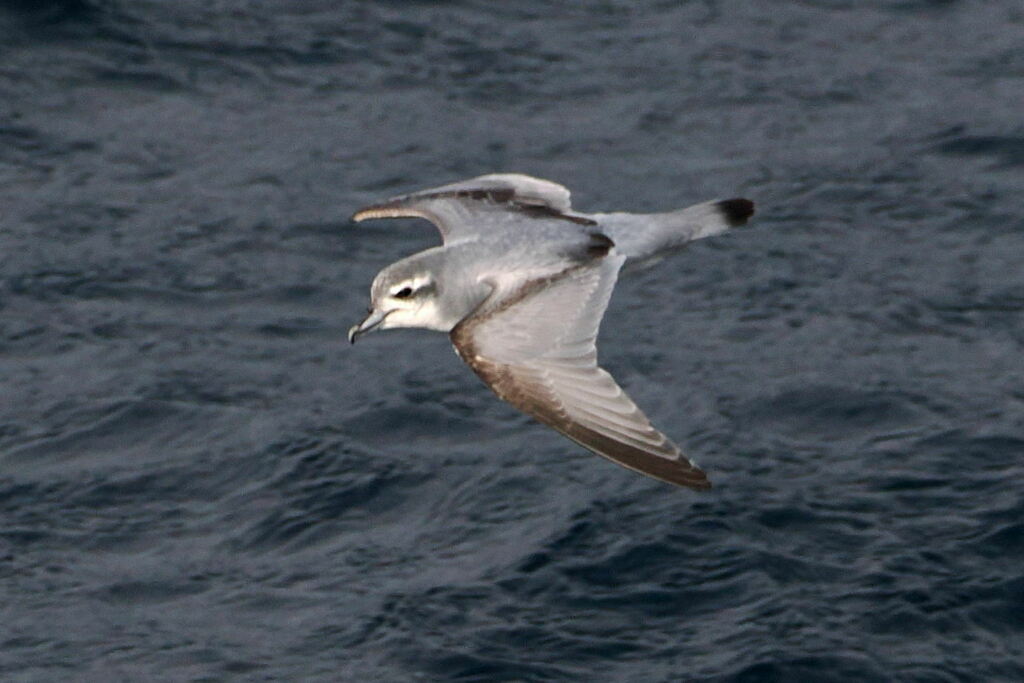
Slender-billed Prion
Photo © steve b
Photo © steve b — CC0 1.0 — Source: iNaturalist photo #354465171Identification
The slender-billed prion is a small petrel easily recognised by its distinctive plumage pattern: blue-grey upperparts contrasting with white underparts, and a striking dark "M" marking running across the back and onto the wingtips. A white eyebrow stripe and dark line extending from below the eye toward the neck complete the facial pattern. The tail is wedge-shaped, grey with a black tip, while the slender bill itself is blue-grey and the feet are pale blue. Like all prions, this species possesses a serrated, saw-like bill adapted for filter-feeding, and characteristic naricorns (nasal passages) atop the upper bill.
Range & Habitat
The slender-billed prion is a denizen of the southern oceans, spending the non-breeding season entirely at sea across vast ocean waters. During breeding season, the species is restricted to a handful of islands: the Crozet Islands, Kerguelen Islands, Falkland Islands, and Noir Island off southern Chile's coast. With a very large range and an estimated population of 7,000,000 individuals, the species is classified as Least Concern.
Behaviour & Diet
These small petrels are specialists in zooplankton feeding, using their distinctive serrated bills to filter prey directly from seawater as they forage at the ocean surface. The slender-billed prion is an annual breeder, with pairs laying a single egg per season. Both parents share incubation duties and cooperate in rearing the chick through to fledging. Like other procellariiformes, they produce stomach oil—a nutrient-rich mixture of wax esters and triglycerides—which serves multiple purposes: as a defence against predators, as supplementary food for chicks, and as an energy source for adults undertaking long oceanic flights.
Best Time & Places to See It
Encounters with slender-billed prions are possible year-round over the southern oceans, though the breeding islands offer the most reliable viewing opportunities during the breeding season. The Falkland Islands and Kerguelen Islands are accessible to wildlife travellers and represent prime locations for observing this species in its natural habitat. Pelagic boat trips in southern ocean waters may also yield sightings of birds engaged in their characteristic low, fast flight over the waves.
Photography Tips
The slender-billed prion's small size and oceanic habits present challenges for photographers. When breeding, birds are most active during twilight hours and at night, requiring fast film speeds and stable positioning near burrows. At sea, photograph from the bow or stern of research or tourist vessels during calm conditions. The bird's white and blue-grey plumage contrasts well against dark ocean waters, but backlighting can obscure the facial markings. Capture the diagnostic dark "M" on the back and wings, and the distinctive facial stripe pattern, which are key field marks.
Cabo de Hornos National Park
Cape Dolphin
Cooper Bay
Elsehul Bay
Fortuna Bay
Kidney Island
Murrell Farm
Prion Island
Salisbury Plain
Nothing matches these filters.
No community photos yet. Log in to add the first one.
No community observations of this species yet.