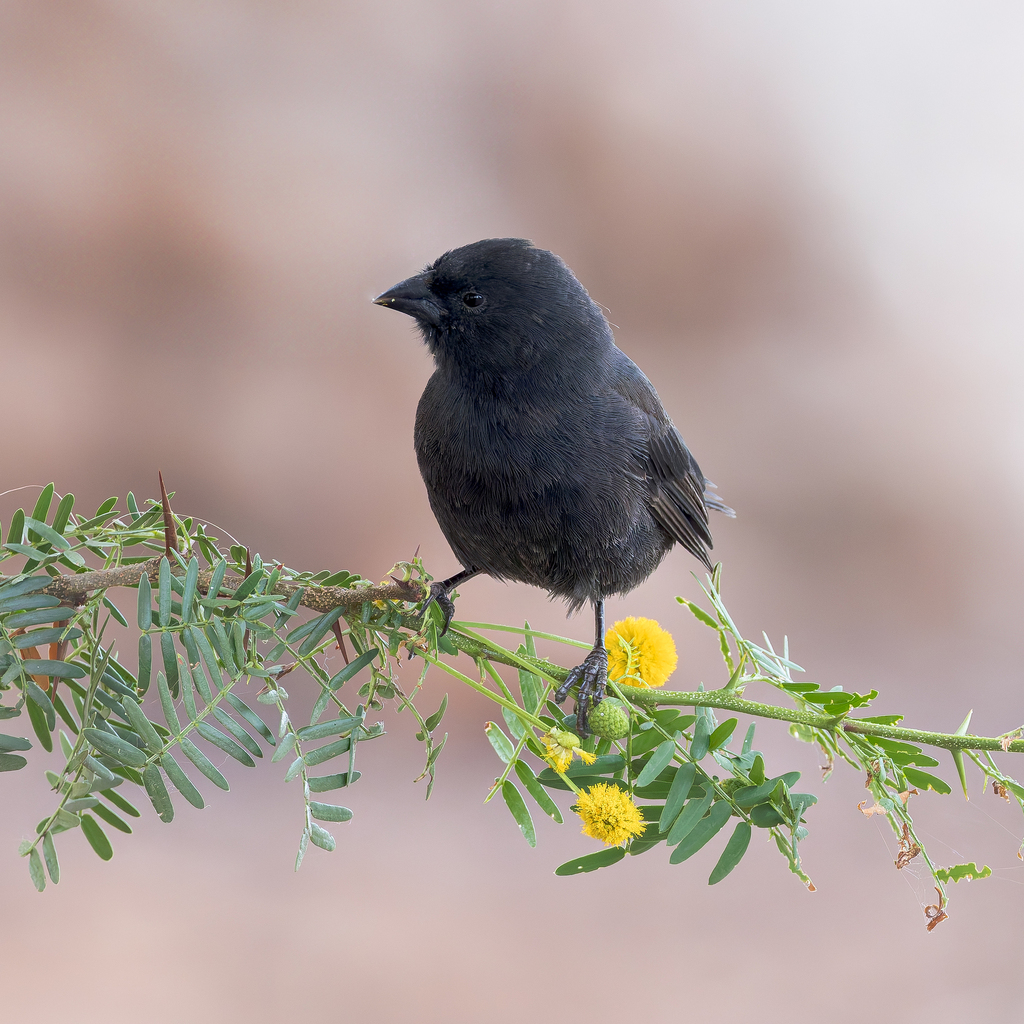
Small Ground Finch
Photo © Chris Kirby-Lambert
Photo © Chris Kirby-Lambert — CC BY 4.0 — Source: iNaturalist #332166366Identification
The small ground finch is the smallest of the Galápagos ground finches, measuring just 11 cm in length. It has a short, pointed beak with a slightly curved culmen, noticeably smaller on average than its relative, the medium ground finch, though size overlap occurs on islands where they don't compete directly. Males are striking black with white-tipped undertail coverts, while females and juveniles are brown with streaked underparts.
Fascinatingly, these finches show observable phenotypic variation linked to elevation: highland birds possess larger, more pointed beaks and smaller feet and claws compared to lowland populations. This represents a cline across the Galápagos landscape, with intermediate traits visible in hybrid zones—a textbook example of adaptation and parapatric speciation driven by an elevation gradient of 560 meters.
Range & Habitat
Endemic to the Galápagos Islands, the small ground finch is abundant and widespread across the archipelago, found on every island except Genovesa, Wolf, and Darwin. It thrives in arid coastal and transition zones, though it regularly moves into highland areas following the breeding season, making it a dynamic species to track seasonally.
Behaviour & Diet
This omnivorous finch feeds primarily on the ground or in low vegetation, foraging for seeds, buds, flowers, leaves, and occasional insects. Most remarkably, it has evolved a symbiotic relationship with Galápagos tortoises and both marine and land iguanas, carefully gleaning parasites from their skin—a behavior that rewards both parties and offers wonderful photographic opportunities.
Best Time & Places to See It
The small ground finch is common across most of the Galápagos Islands. Post-breeding season visits to highland areas offer excellent viewing, as birds move upslope following nesting. Its abundance and widespread distribution make it reliably observable on most island visits, particularly in arid and transitional habitats.
Photography Tips
Look for males in open areas for their dramatic black plumage; females and juveniles blend into brown vegetation, requiring patience and attention to movement. The bird's symbiotic foraging behavior with large reptiles provides compelling compositional opportunities. Early morning light in arid coastal zones will showcase the male's contrasting plumage. Keep your lens ready for rapid, weak song bursts transcribed as "twichooo-twichooo" or "teur-weee"—these vocalizations often precede active foraging periods.
No community photos yet. Log in to add the first one.
No community observations of this species yet.