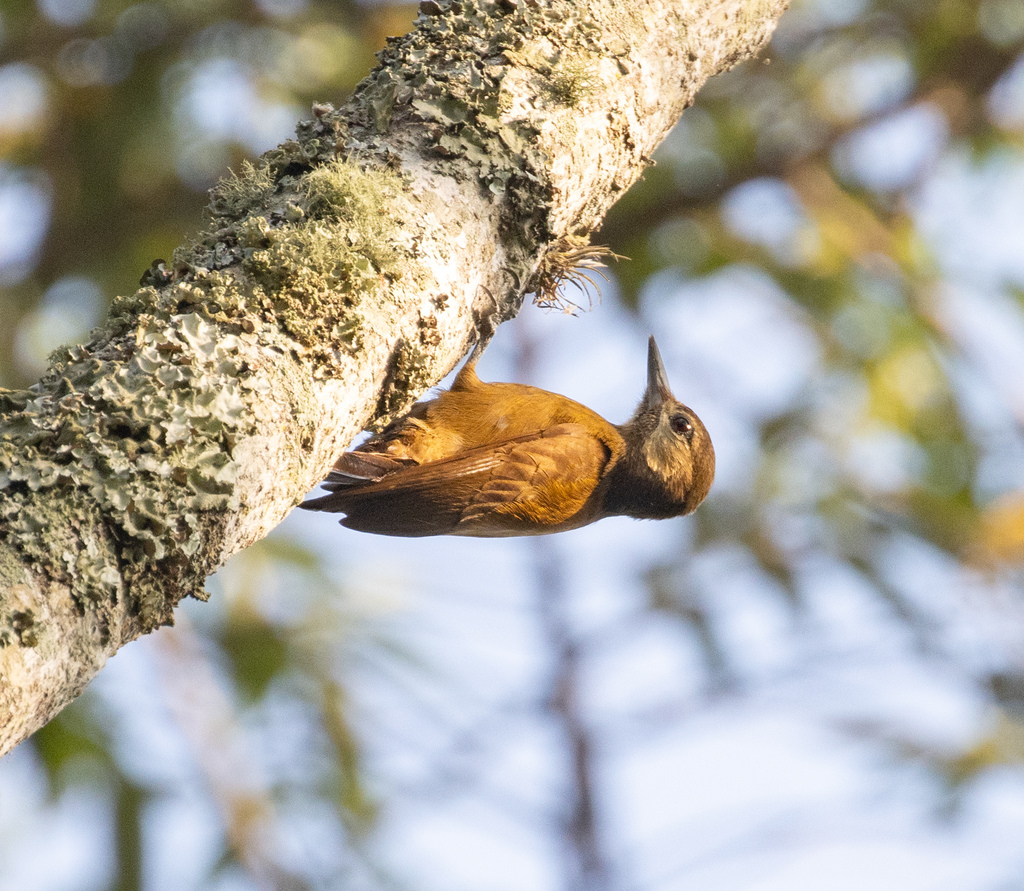
Smoky-brown Woodpecker
CC BY 4.0
CC BY 4.0 — Source: iNaturalist photo #479330365The smoky-brown woodpecker (Leuconotopicus fumigatus) is a species of bird in subfamily Picinae of the woodpecker family Picidae. It is found in Argentina, Belize, Bolivia, Colombia, Costa Rica, Ecuador, El Salvador, Guatemala, Honduras, Mexico, Nicaragua, Panama, Peru, and Venezuela. == Taxonomy and systematics == The species was first described by the French naturalist Alcide d'Orbigny as Picus fumigatus, based on individuals observed in the Province of Corrientes in Argentina, and later in Santa Cruz de la Sierra in Bolivia. Since its original description it has successively been placed in genus Leuconotopicus and Picoides and then returned to Leuconopticus. The International Ornithological Committee and BirdLife International's Handbook of the Birds of the World retain it in that genus. However, starting in 2018, the American Ornithological Society and the Clements taxonomy moved all species of genus Leuconotopicus into genus Dryobates. The genus name Leuconotopicus derives from the Ancient Greek leukos (white), noton (back) and pikos (woodpecker). The specific epithet fumigatus is Latin for smoked. The taxonomic systems recognize these five subspecies: L. f. oleagineus (Reichenbach, 1854) L. f. sanguinolentus (Sclater, P.L., 1859) L. f. reichenbachi (Cabanis & Heine, 1863) L. f. fumigatus (D'Orbigny, 1840) L. f. obscuratus (Chapman, 1927) == Description ==…
Arenal Volcano National Park
Tortuguero National Park
Braulio Carrillo National Park
Guanacaste National Park
Volcán Poás National Park
Podocarpus National Park
Natural Farallones de Cali National Park
Natural Sumapaz National Park
Yanachaga–chemillén National Park
Baru Volcano National Park
Parque Internacional la Amistad
Calilegua National Park
Sian Ka’an
Montes Azules
Tikal National Park
Laguna del Tigre National Park
Sierra del Lacandón National Park
Caño Negro National Wildlife Refuge
No community photos yet. Log in to add the first one.
No community observations of this species yet.