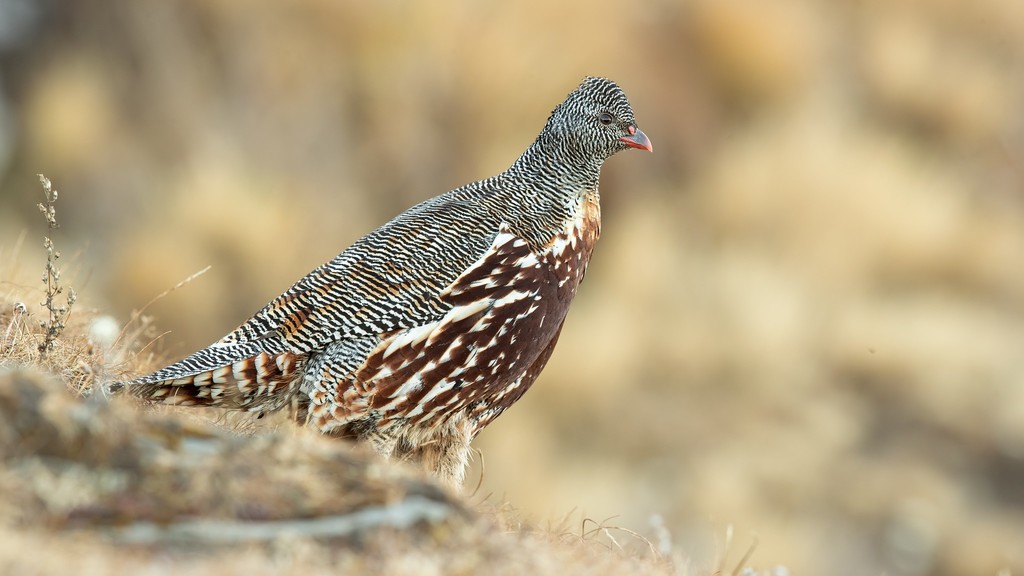
Snow Partridge
Photo © Pramod CL
Photo © Pramod CL — CC BY 4.0 — Source: iNaturalist photo #76842644Identification
The snow partridge is a compact gamebird measuring 38–40 cm in length, instantly recognizable by its striking plumage and vivid facial markings. The upperparts are grey with fine black-and-white barring, while the underparts are deep chestnut, creating a distinctive contrast. The bright red bill and legs are particularly eye-catching and help separate this species from other high-altitude birds. In flight, dark brown primaries and secondaries with narrow white trailing margins are visible, somewhat resembling the much larger Tibetan snowcock. The 14-feathered tail is dark and barred with white.
Males and females are remarkably similar in plumage—an unusual trait among gamebirds—though males can be distinguished by a blunt spur on the tarsus (leg), which females lack. Some individuals show variation in crown coloration, with certain birds displaying a nearly black crown. The breast is deep chestnut, while the abdomen is predominantly white with brown-and-white barring on the lower flanks. Young birds are more mottled below with less distinct barring than adults. Females typically weigh 450–580 g, while males are heavier at 550–700 g.
Range & Habitat
The snow partridge is found throughout the high Himalayan ranges from Pakistan eastward to Arunachal Pradesh in India, occurring at elevations mainly between 3,000 and 5,000 metres, though occasionally descending below 2,000 metres. It occupies alpine pastures and open grassy hillsides above the treeline, preferring terrain with grass, lichens, moss, ferns, and rhododendrons interspersed with small snow patches. Unlike the more wary Himalayan snowcock, the snow partridge avoids the barest and stoniest terrain, instead favouring slightly more vegetated alpine environments. However, the species is notably local in distribution, and populations may be patchily distributed across its overall range.
Behaviour & Diet
Snow partridges are gregarious outside the breeding season, typically gathering in groups of 6 to 8 birds, though flocks may reach 30 individuals during winter. When flushed, they take flight with rapid, noisy wing beats before scattering away, executing a stirring, energetic flight pattern. During midday hours, they exhibit a characteristic behaviour of sunning themselves on rocks. Their breeding season extends from May to July, during which males are believed to be monogamous. Nests are simple scrapes on hillsides, sheltered by rocks and concealed with vegetation, sometimes lined with moss. Females typically lay 3 to 5 pale yellow eggs marked with reddish-brown spots and incubate them while males stand guard. Parent birds employ distraction displays to divert predators from their young.
The diet consists primarily of mosses, lichens, berries, and plant shoots. Like other gamebirds, they swallow grit to aid digestion. Their breeding-season call resembles that of the grey francolin, and parents communicate with young using soft, low notes to which chicks respond with chicken-like cheeping.
Best Time & Places to See It
Snow partridges are most easily observed during the breeding season from May to July, when males are vocal and more conspicuous while defending territories and attending to nesting duties. Outside this period, locating them can be challenging due to their local distribution and preference for remote alpine terrain. The species is generally approachable compared to the wary snowcock, making patient observation more feasible. Early morning and late afternoon are typically the most productive times for viewing, when birds are actively feeding and moving across alpine pastures.
Photography Tips
Photographing snow partridges requires patience and acclimatization to high-altitude terrain. The birds' preference for sitting on rocks during midday sunning provides excellent opportunities for portrait photography, with their bright red bills and legs contrasting beautifully against grey plumage. Wide-angle environmental shots capturing the alpine habitat context add narrative value. The striking flight silhouette, with dark primaries and white trailing margins visible, should be pursued whenever flushes occur. Early morning light on the high slopes will illuminate the subtle barring and chestnut underparts effectively, while the red facial markings are most vibrant in bright conditions. A sturdy tripod is essential given the elevation and thin air, and approaching slowly and quietly through alpine pastures maximizes success without causing disturbance during sensitive breeding periods.
Langtang National Park
Helambu, Nepal
+364 birds+14 mammals
Where the southern slopes of the Himalayan highlands descend toward the subtropical valleys of central Nepal, Langtang National Park sprawls across one of the subcontinent's most…
VIEW NATIONAL PARKSagarmatha National Park
Khumjung, Nepal
+219 birds+7 mammals
Soaring peaks and deep glacial valleys define this alpine wilderness in northeastern Nepal, where the terrain rises from forested foothills into a realm of high-altitude tundra…
VIEW NATIONAL PARKKhangchendzonga National Park
Sakkyong, India
+290 birds+1 mammals
Where the eastern Himalayas surge toward their crowning peaks, Khangchendzonga National Park embraces a landscape of almost overwhelming vertical drama. Rising from subtropical river valleys into…
VIEW NATIONAL PARKGiant Panda National Park
Mianyang, China
+447 birds+47 mammals
Where the eastern slopes of China's Sichuan plateau descend into cloud-wrapped valleys, one of Asia's most biodiverse landscapes unfolds across more than 350,000 square kilometres. This…
VIEW NATIONAL PARKHuanglong Scenic and Historic Interest Area
Ngawa Tibetan and Qiang Autonomous Prefecture, China
+194 birds+7 mammals
Across the high plateau of northwestern Sichuan, a geological wonder unfolds where limestone terraces and mineral-rich springs have sculpted one of China's most distinctive natural monuments.…
VIEW NATURAL MONUMENTNanda Devi National Park
Garpak, India
+218 birds+5 mammals
Where the Himalayas surge into their most dramatic alpine amphitheater, a wilderness of raw geological power unfolds across 624 square kilometers of pristine terrain. Nanda Devi,…
VIEW NATIONAL PARKWolong National Nature Reserve
Wenchuan County, China
+333 birds+17 mammals
Where the Qingyi River cuts through the eastern flanks of the Minshan Range, a temperate montane forest cloaks steep valleys in dense canopy that thins dramatically…
VIEW NATURE RESERVENo community photos yet. Log in to add the first one.
No community observations of this species yet.