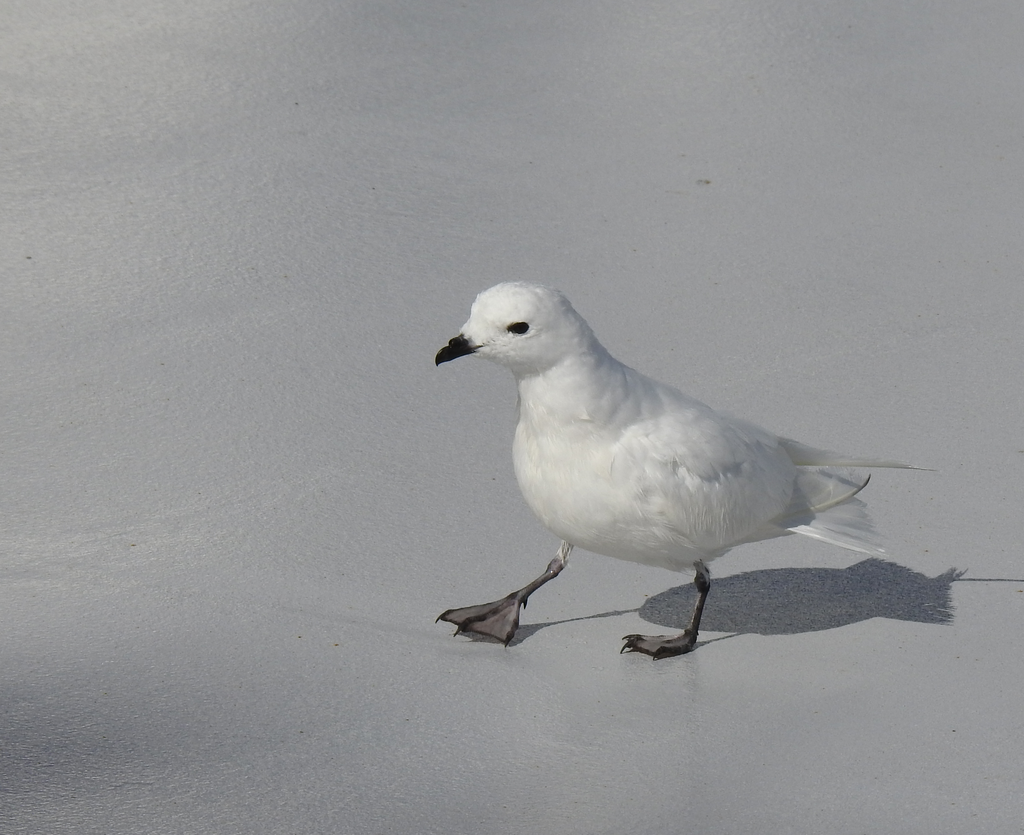
Snow Petrel
Photo © Peter Shanks
Photo © Peter Shanks — CC0 1.0 — Source: iNaturalist #247868156Identification
The snow petrel is unmistakable: a small, pure white seabird with coal-black eyes, a diminutive black bill, and bluish-gray feet. Measuring 30–40 cm in body length with a wingspan of 75–95 cm, it is slightly larger than a pigeon. The snow petrel's entirely white plumage makes it one of the most distinctive birds of the polar south. In flight, watch for its characteristically erratic pattern with frequent changes of direction.
Two subspecies are recognized, varying significantly in size, though the larger and smaller forms hybridize extensively and can be difficult to distinguish in the field. The snow petrel belongs to the family Procellariidae, which shares distinctive features including nasal passages called naricorns and the ability to produce and spray stomach oil as a defense mechanism or energy source.
Range & Habitat
The snow petrel is almost entirely restricted to cold Antarctic waters and has the most southerly breeding sites of any bird. It is one of only three bird species recorded at the Geographic South Pole, alongside the Antarctic petrel and south polar skua. Two subspecies breed in different regions: the nominate subspecies breeds on the Antarctic Peninsula, South Georgia Islands, and other islands of the Scotia Arc, while the larger subspecies breeds on the South Sandwich Islands and Géologie Archipelago.
These birds breed colonially on the Antarctic continent and various Antarctic islands, nesting in exposed rocks usually near the sea but also on inland mountain ranges more than 400 kilometers from open water. During winter, they disperse to pack ice, ice floes, and the open sea, and are only very rarely observed north of the pack ice.
Behaviour & Diet
Snow petrels feed primarily on fish, supplemented by cephalopods, mollusks, and krill. They also scavenge on seal placentas, dead or stillborn seals, whale carcasses, and dead penguin chicks. Flocks are characteristically seen perched on icebergs, where they rest and, at inland colonies far from the sea, bathe in snow to maintain their plumage.
Breeding occurs from mid-September to early November, with single white eggs laid between late November and mid-December. Eggs are incubated for 41–49 days, chicks are brooded for 8 days, and fledging occurs 7 weeks later between late February and mid-May. Snow petrels are notably long-lived, with partners remaining faithful for approximately 20 years.
Best Time & Places to See It
The main breeding season occurs from mid-September through early November, when the largest influx of birds arrives at colonies. However, some birds remain at breeding sites year-round. To observe snow petrels, travelers must venture to Antarctica itself—the Antarctic Peninsula, South Georgia Islands, and the Scotia Arc islands offer the most accessible viewing opportunities for the nominate subspecies, while the larger subspecies can be found at the South Sandwich Islands and Géologie Archipelago.
During winter months, snow petrels disperse across the pack ice and open sea. With a global population estimated at 4 million adult birds distributed across a range of 35.9 million square kilometers, encounters are possible throughout Antarctic waters, particularly around icebergs where they congregate.
Photography Tips
The snow petrel's pure white plumage presents both opportunities and challenges for photographers. The bird's brilliant white coloration can fool camera meters, so use exposure compensation to avoid underexposure and ensure the white plumage retains detail rather than appearing as a blown-out highlight. The contrast between the white body and black bill and eyes will help your camera focus accurately.
Capture the snow petrel's erratic flight pattern with a fast shutter speed—at least 1/1000th of a second—to freeze the frequent directional changes. When photographing birds perched on icebergs, position yourself to capture both the petrel and its striking ice habitat, which provides a compelling environmental context. Early morning and late afternoon light during the Antarctic summer will add dimension to your images while managing the challenges of photographing in such bright, white-dominated environments.
Deception Island
Gabriel de Castilla Base, Antarctica
+26 birds+10 mammals
Steaming geothermal vents pierce a landscape of blackened volcanic sand and ice, where the earth's raw power still trembles beneath your feet. This horseshoe-shaped caldera, flooded…
VIEW ISLAND & ARCHIPELAGOCuverville Island
Cuverville Island, Antarctica
+19 birds+10 mammals
Granite peaks and sculpted ice define this windswept archipelago off the Antarctic Peninsula, where steep rocky shores plunge into waters thick with drifting brash ice. Cuverville…
VIEW ISLAND & ARCHIPELAGONeko Harbour
Neko Harbour, Antarctica
+18 birds+10 mammals
Towering peaks of fractured ice rise abruptly from gunmetal waters, their faces scarred by millennia of glacial advance and retreat. This pocket of the Antarctic Peninsula…
VIEW PROTECTED LANDSCAPEParadise Bay
Brown Station, Antarctica
+18 birds+9 mammals
Where the Antarctic Peninsula's rugged coastline meets the Southern Ocean, Brown Station stands sentinel over Paradise Bay—a protected landscape of ice-carved inlets, towering glacial faces, and…
VIEW PROTECTED LANDSCAPEBrown Bluff
Brown Bluff, Antarctica
+23 birds+9 mammals
Where rust-colored volcanic peaks pierce the Antarctic Peninsula's icy realm, a geologist's dreamscape unfolds beneath towering cliffs of iron oxide and ancient lava. Brown Bluff rises…
VIEW PROTECTED LANDSCAPEPort Lockroy
Port Lockroy, Antarctica
+19 birds+9 mammals
Towering peaks of black rock pierce through Antarctic pack ice on the Gerlache Strait, where one of the continent's most accessible harbors cradles a living microcosm…
VIEW PROTECTED LANDSCAPEHalf Moon Island
Cámara Base, Antarctica
+25 birds+8 mammals
Jagged volcanic peaks rise from the cobalt waters of the South Shetland Islands, their slopes carpeted in moss and lichen where hardy vegetation clings to windswept…
VIEW ISLAND & ARCHIPELAGOPetermann Island
Petermann Island, Antarctica
+16 birds+9 mammals
Icebound cliffs rise dramatically from the Bellingshausen Sea, their weathered faces sculpted by millennia of Antarctic wind and tide. This slender wedge of rock and ice,…
VIEW ISLAND & ARCHIPELAGOPaulet Island
Paulet Island, Antarctica
+20 birds+6 mammals
Windswept ice and weathered rock converge at this remote Antarctic outcrop, where jagged peaks pierce through perpetual pack ice and glacial moraines descend toward cobalt waters.…
VIEW ISLAND & ARCHIPELAGODanco Island
Danco Island, Antarctica
+17 birds+10 mammals
Dramatic black rock pierces the Antarctic Peninsula's icy waters, crowned with permanent snow and ringed by calving glaciers that thunder into the sea. This volcanic outcrop…
VIEW ISLAND & ARCHIPELAGOWilhelmina Bay
Wilhelmina Bay, Antarctica
+20 birds+10 mammals
Sheer cliffs of black volcanic rock plunge into waters so pristine they reflect the Antarctic sky like polished obsidian. This remote western Antarctic inlet, ringed by…
VIEW PROTECTED LANDSCAPELemaire Channel
Orne Harbour, Antarctica
+25 birds+13 mammals
Where granite peaks plunge into steel-grey waters, the Lemaire Channel carves one of Antarctica's most dramatic passages. This narrow strait, squeezed between the Antarctic Peninsula and…
VIEW PROTECTED LANDSCAPESalisbury Plain
South Georgia, South Georgia and the South Sandwich Islands
+33 birds+4 mammals
Where tussock grasses bow to relentless Antarctic winds and glacial meltwater carves braided channels through obsidian volcanic soil, one of Earth's most remote wildlife sanctuaries reveals…
VIEW PROTECTED LANDSCAPESt. Andrews Bay
South Georgia, South Georgia and the South Sandwich Islands
+34 birds+6 mammals
Where windswept tundra dissolves into obsidian beaches, one of the planet's most extraordinary wildlife theaters unfolds across St. Andrews Bay. This remote corner of South Georgia…
VIEW PROTECTED LANDSCAPEFortuna Bay
Stromness, South Georgia and the South Sandwich Islands
+37 birds+5 mammals
Where tussock grasslands sweep down to black-sand beaches and elephant seals haul out in thunderous colonies, the raw sub-Antarctic landscape reveals itself in its most dramatic…
VIEW PROTECTED LANDSCAPEPrion Island
Prince Olav Harbour, South Georgia and the South Sandwich Islands
+36 birds+2 mammals
Windswept tussock grasslands rise sharply from boulder-strewn beaches where the Southern Ocean hurls its grey swells against black volcanic rock. This remote speck in South Georgia's…
VIEW ISLAND & ARCHIPELAGOElsehul Bay
Bird Island Station, South Georgia and the South Sandwich Islands
+33 birds+4 mammals
Granite peaks rise sheer from the Southern Ocean, their weathered faces streaked with cascading meltwater and cloaked in tussock grass that bends beneath relentless winds. This…
VIEW PROTECTED LANDSCAPENo community photos yet. Log in to add the first one.
No community observations of this species yet.