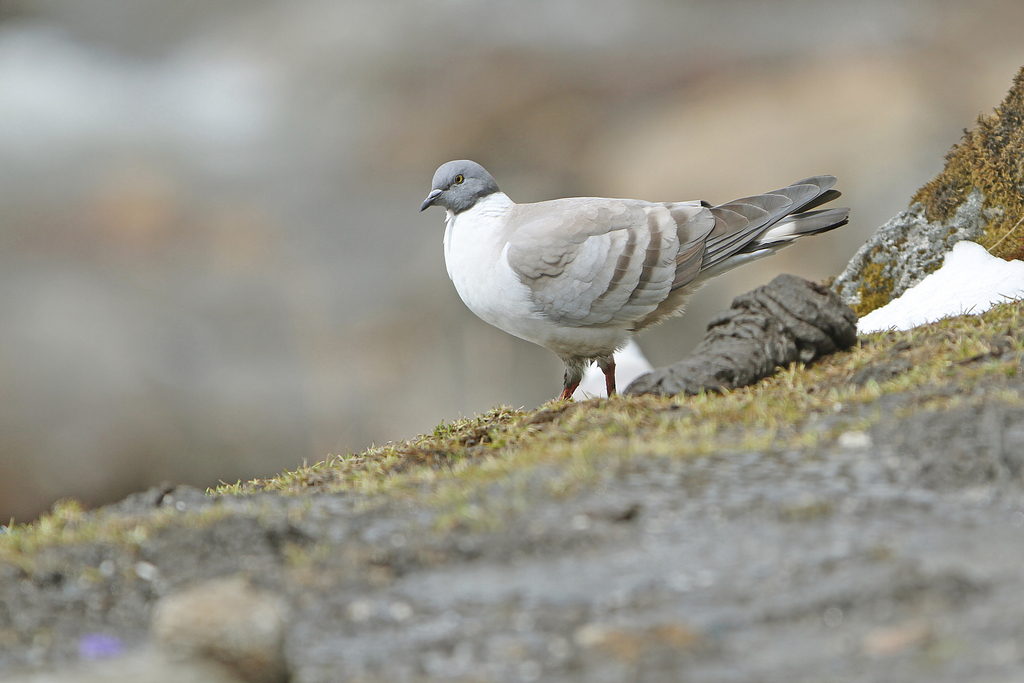
Snow Pigeon
Photo © James Eaton
Photo © James Eaton — CC0 1.0 — Source: iNaturalist photo #395651287Identification
The snow pigeon is a striking high-altitude dove with distinctive plumage that makes it relatively easy to identify in its mountainous range. The bird's most characteristic feature is its contrasting blackish head paired with a bright white neck collar and white underparts. The back is brownish-grey with a prominent white patch on the lower back, while the pale grey wings display three brown bands. The black tail carries a distinctive clear white band running through the middle that narrows and curves forward to the tip of the outermost feathers. Young birds appear somewhat duller, with narrow buff margins to their upper-part feathers and sullied white underparts.
Range & Habitat
Snow pigeons inhabit the rocky hills and mountainous regions of central Asia across an extremely large range. Two subspecies are recognized: the western Himalayan subspecies (C. l. leuconota) occurs from western Afghanistan through to Sikkim, while the eastern subspecies (C. l. gradaria) inhabits the mountains of eastern Tibet and extends from eastern Qinghai through Yunnan to extreme northern Myanmar. These birds are resident in Afghanistan, Bhutan, China, India, Kazakhstan, Myanmar, Nepal, Pakistan, Tajikistan, and Turkmenistan.
They favor rocky hillsides and sequestered valleys, frequently venturing up to the snow line. Though they forage in open country during daylight hours, they always return to cliff faces for roosting at night, showing a strong preference for these elevated rocky habitats.
Behaviour & Diet
Snow pigeons are generally shy and wary birds that forage in pairs or small groups during summer months, though winter gatherings can exceed 150 individuals, often mixing with hill pigeons and occasionally rock doves. They are ground feeders that consume grain, berries, buds, shoots, seeds, and bulbs from open country.
These pigeons breed in colonies within cliff crevices and rock ledges, constructing untidy stick nests that are typically reused and minimally repaired annually. They usually lay a clutch of two white eggs. The birds exhibit altitudinal migration, descending to lower elevations during summer months while remaining at higher altitudes during winter.
Best Time & Places to See It
Snow pigeons are common and widely distributed throughout their range, making them relatively reliable sightings for travelers visiting the high mountain regions of central Asia. Winter may offer opportunities to observe larger gatherings of 150 or more birds. The western Himalayas from Afghanistan to Sikkim and the mountains of eastern Tibet and Qinghai provide the most accessible locations for observing this species.
Photography Tips
The snow pigeon's striking black-and-white head pattern and contrasting white underparts make it an attractive photographic subject. Early morning or late afternoon light will emphasize the subtle browns and greys of the back and wings. Since these birds are shy and wary, patience and distance are essential—a telephoto lens will be invaluable. Look for them in open country during daylight hours, but remember they will return to cliff faces at dusk, offering dramatic backlit shooting opportunities against rocky outcrops.
Gangotri National Park
Giant Panda National Park
Hemis National Park
Huanglong Scenic and Historic Interest Area
Khangchendzonga National Park
Langtang National Park
Makalu Barun National Park
Nanda Devi National Park
Qinghai Lake National Nature Reserve
Nothing matches these filters.
No community photos yet. Log in to add the first one.
No community observations of this species yet.