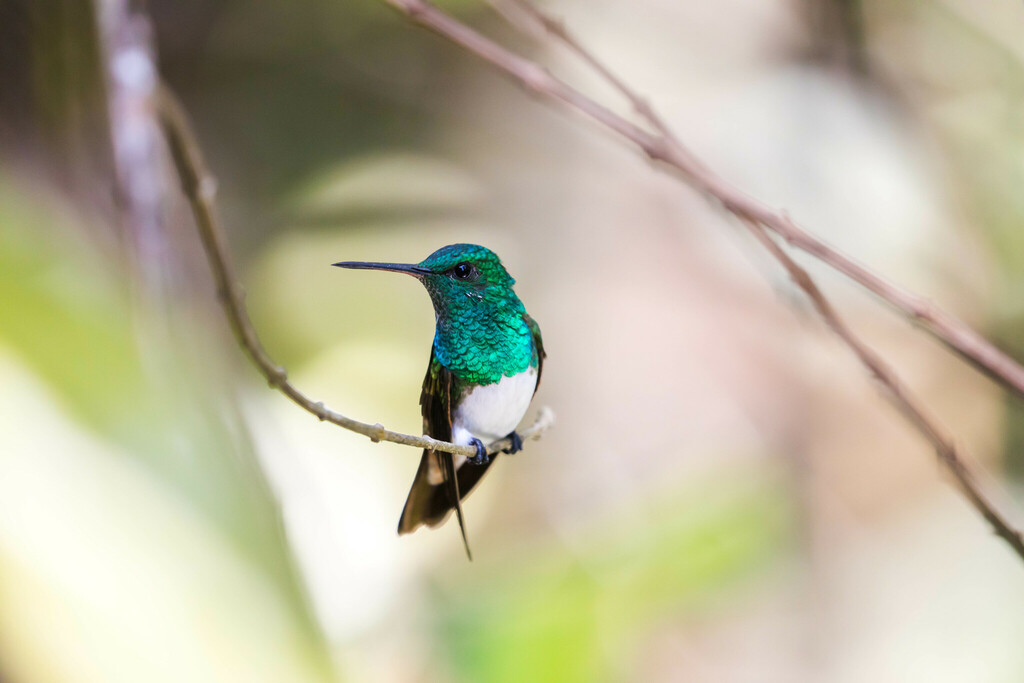
Snowy-bellied Hummingbird
Photo © Melissa McMasters
Photo © Melissa McMasters — CC BY 4.0 — Source: iNaturalist photo #259233520Identification
The snowy-bellied hummingbird is a small member of the "emeralds" group, measuring 8 to 11 cm long and weighing between 4.3 and 5.4 grams depending on sex. Both males and females sport a straight blackish bill with a reddish base on the mandible. Adult males of the nominate subspecies display bronze-green upperparts with especially coppery back and rump feathers, while their tail ranges from bronze to coppery with sometimes a purple sheen. The distinctive field mark is their white V-shaped belly patch set against a glittering golden-green throat and chest, with rufous undertail coverts. Females are similar but duller, with less intense green upperparts, a more whitish throat, and light green tips on outer tail feathers. Four subspecies exist, with variations including bluish-black tails, different levels of green-to-copper contrast, and varying undertail covert coloration.
Range & habitat
This species is primarily found in Costa Rica and Panama, with a few records in northwestern Colombia's Chocó Department. The four subspecies occupy distinct ranges: S. e. niveoventer inhabits southwestern Costa Rica into western and central Panama including Coiba Island; S. e. edward ranges through Panama from the Canal Zone east to Darién Province; S. e. collata is restricted to central Panama; and S. e. margaritarum occupies southwestern Darién, the Pearl Islands, and other Gulf of Panama islands. Across its range, the snowy-bellied hummingbird favors semi-open landscapes including savannas, scrublands with scattered trees, forest edges and clearings, secondary forest, coffee plantations, and gardens. It occurs from sea level to 1,600 meters elevation, though specific subspecies show different preferences: S. e. collata inhabits low herb and bush fields between 500 and 850 meters, while S. e. margaritarum frequents both rainforest on the mainland and mangroves and abandoned fields on islands.
Behaviour & diet
The snowy-bellied hummingbird is largely sedentary but makes local movements seasonally, shifting from arid areas during wet seasons to more humid zones during dry seasons, and also tracking flower availability. It forages for nectar at a wide variety of native and introduced plants, shrubs, and trees, typically feeding between 3 and 6 meters above ground. Beyond nectar, it supplements its diet with small arthropods, capturing them by hawking from a perch and gleaning from foliage. Birds sometimes defend feeding territories against competitors.
Western populations breed between September and January with a peak in December and January. The female constructs a tiny cup nest from downy fibers decorated with lichen and moss, placing it on a branch or in a bush or small tree fork up to 9 meters high. She lays a clutch of two eggs and incubates them herself, though specific incubation and fledging periods remain undocumented. The species produces a soft song described as "bebeebee, d'beebee" or "tseer tir tir," along with sharp "tip" or "tsip" calls.
Best time & places to see it
The snowy-bellied hummingbird is locally common to common throughout most of its range, including on islands, making it a reliable sighting for visitors to appropriate habitats. It is considered uncommon only in eastern Panama. For the best viewing experience, focus on semi-open areas such as scrubland, forest edges, clearings, secondary forest, and gardens in Costa Rica and Panama, particularly in regions with abundant flowering plants. The breeding season from September through January, especially December and January in western populations, may offer opportunities to observe territorial behavior and nesting activity. Look for the species feeding in the middle story of vegetation, typically between 3 and 6 meters high.
Photography tips
The snowy-bellied hummingbird's small size and typical feeding height of 3 to 6 meters above ground present moderate challenges for photographers. Focus on semi-open habitats where birds are more accessible and lighting conditions are favorable. The male's glittering golden-green throat and distinctive white belly patch are key field marks that should be captured clearly; approaching from below or at eye level will help showcase these features. Since birds often defend feeding territories, locating a productive flowering plant or feeder may allow for repeated photographic opportunities. The species' relatively sedentary nature and tendency to return to favored feeding spots increase the likelihood of successful shots compared to more mobile hummingbird species.
Corcovado National Park
Puerto Jiménez, Costa Rica
+444 birds+48 mammals
Where the Osa Peninsula juts into the Pacific, rainforest descends almost to the tide line, and Corcovado National Park protects one of Central America's most intact…
VIEW NATIONAL PARKManuel Antonio National Park
Quepos, Costa Rica
+426 birds+22 mammals
Where tropical rainforest descends steeply to a rocky Pacific coastline, Manuel Antonio National Park distills Central American biodiversity into one of Costa Rica's most compressed and…
VIEW NATIONAL PARKChirripó National Park
Rivas, Costa Rica
+274 birds+6 mammals
Where the volcanic spine of Costa Rica's Central Cordillera reaches its apex, Chirripó National Park encompasses a landscape that shifts dramatically with elevation, from montane cloud…
VIEW NATIONAL PARKPiedras Blancas National Park
Golfito, Costa Rica
+386 birds+24 mammals
Where the Golfo Dulce meets the southwestern Pacific coast of Costa Rica, Piedras Blancas National Park protects a dramatic transition zone where lowland rainforest descends toward…
VIEW NATIONAL PARKCoiba National Park
Montijo, Panama
+260 birds+10 mammals
An archipelago of volcanic and sedimentary islands rises from the Pacific waters off Panama's southwestern coast, its densest rainforest canopy unbroken for millennia. Coiba National Park…
VIEW NATIONAL PARKBaru Volcano National Park
Cerro Punta, Panama
+402 birds+6 mammals
Where the land rises sharply toward the Caribbean's western spine, Baru Volcano National Park sprawls across roughly 220 square kilometres of southwestern Panama, anchored by the…
VIEW NATIONAL PARKGeneral de División Omar Torrijos Herrera National Park
La Pintada, Panama
+401 birds+2 mammals
Across the highlands of central Panama, where the continental divide funnels moisture-laden trade winds into steep river valleys, the terrain rises and falls in a landscape…
VIEW NATIONAL PARKSoberanía National Park
Cristóbal, Panama
+495 birds+34 mammals
Rainforest and riverine woodland blanket the rolling terrain of this 714-square-kilometre national park in Colón Province, where the Caribbean watershed feeds a maze of streams and…
VIEW NATIONAL PARKChagres National Park
Caimitillo, Panama
+486 birds+19 mammals
Where the Chagres River carves through the humid tropics of central Panama, a vast montane and lowland forest sprawls across more than 2,300 square kilometers, anchoring…
VIEW NATIONAL PARKDarién National Park
Tucutí, Panama
+534 birds+13 mammals
Where the spine of Central America crumbles into wetland and rainforest, Darién National Park sprawls across more than 20,000 square kilometres of some of the tropics'…
VIEW NATIONAL PARKPortobelo National Park
Portobelo, Panama
+366 birds+9 mammals
Where the Caribbean's turquoise waters meet the Darién's verdant shore, Portobelo National Park sprawls across 570 square kilometers of coastal forest, mangrove wetland, and coral-fringed islands…
VIEW NATIONAL PARKParque Internacional la Amistad
Teribe, Panama
+325 birds+11 mammals
Where the continental divide rises between the Caribbean and Pacific watersheds, a wilderness of extraordinary biological richness unfolds across the Talamanca Range and into lowland rainforest—a…
VIEW NATIONAL PARKLos Quetzales National Park
Copey, Costa Rica
+232 birds+3 mammals
Cloud forest sweeps across the upper slopes of the Central Valley watershed, where elevation and persistent moisture forge an ecosystem unlike any other in Costa Rica.…
VIEW NATIONAL PARKLa Amistad International Park
Crorina, Costa Rica
+532 birds+20 mammals
Where the Caribbean slopes of Costa Rica's Talamanca Mountains rise steeply inland from Limón, the boundary between two nations dissolves into an unbroken expanse of rainforest.…
VIEW NATIONAL PARKMarino Ballena National Park
Bahía Ballena, Costa Rica
+336 birds+8 mammals
Where mangrove forests meet coral-fringed shorelines along Costa Rica's southern Pacific coast, Marino Ballena National Park encompasses a marine and terrestrial mosaic that ranks among Central…
VIEW NATIONAL PARKNo community photos yet. Log in to add the first one.
No community observations of this species yet.