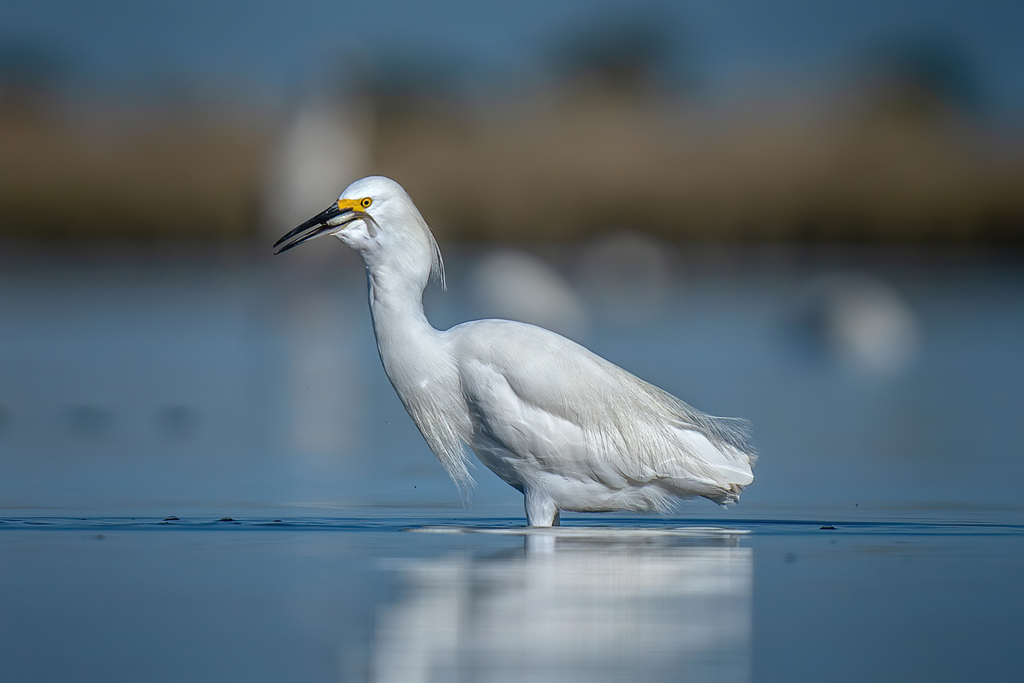
Snowy Egret
Photo © Luciano Massa
Photo © Luciano Massa — CC BY 4.0 — Source: iNaturalist photo #116651420Identification
The snowy egret is a small white heron, easily recognized by its pristine white plumage and distinctive field marks. Adults display yellow lores (the bare skin between the eye and bill), a long black bill, black legs, and bright yellow feet—a striking color combination that sets them apart from other white herons. During breeding season, they develop long, shaggy plumes on the nape and neck known as aigrettes, which give them an elegant, ethereal appearance. Immature birds are similar to adults but have duller, greenish legs rather than the vivid yellow of breeding adults. The snowy egret measures 22–26 inches in length with a wingspan of approximately 39 inches and weighs around 13 ounces.
Range & Habitat
This species is native throughout North, Central, and South America. In South America, the West Indies, Florida, and coastal regions of Central and North America, snowy egrets are present year-round. Further north in the United States, they are migratory, breeding in states including California, Nevada, Utah, Colorado, Arizona, New Mexico, Texas, Louisiana, and Mississippi before moving south for winter.
Snowy egrets inhabit a wide variety of wetland environments: marshes, riverbanks, lakesides, pools, salt marshes, and estuaries. They avoid high-altitude regions and are not typically found on open coastlines. The species has occasionally appeared as a vagrant in Europe (Iceland, Scotland, and the Azores) and has been recorded in South Africa, indicating their potential for long-distance wandering.
Behaviour & Diet
Snowy egrets employ diverse hunting techniques in shallow water. They actively stalk prey by running or shuffling their feet, or they flush hidden prey by swaying their heads, flicking their wings, and vibrating their bills. Some individuals hover above water or "dip-fish" by flying with their feet just touching the surface. Alternatively, they may stand motionless to ambush unsuspecting prey, and they sometimes hunt insects in open fields alongside domestic animals. They frequently forage in mixed-species groups.
Their diet is impressively varied and opportunistic, including fish, crustaceans (crabs, shrimp, and crayfish), insects, small reptiles (lizards and snakes), snails, frogs, toads, and worms. Breeding birds nest in mixed colonies alongside great egrets, night herons, tricolored herons, little blue herons, cattle egrets, glossy ibises, and roseate spoonbills. Males establish territories and begin nest construction in trees, vines, or thick undergrowth, then attract mates with elaborate displays involving dipping, bill raising, aerial maneuvers, and vocalizations. Clutches of up to six pale bluish-green eggs hatch after about 24 days, and chicks fledge within approximately 22 days.
Best Time & Places to See It
For year-round viewing, visit wetland habitats in Florida, the West Indies, or coastal Central and South America. In the western and southern United States, spring through early autumn offers the best opportunities during breeding season. Look for snowy egrets in marshes, estuaries, and along riverbanks and lakeshores during dawn and dusk when feeding activity peaks. Since they often forage in shallow water, coastal wetlands and coastal regions will provide the most reliable sightings.
Photography Tips
The snowy egret's pure white plumage requires careful exposure metering to avoid blown-out highlights; slightly underexpose to retain detail in the plumes. The bird's active, restless behavior—running, shuffling, and wing-flicking—demands a fast shutter speed of at least 1/1000th of a second. Photograph during early morning or late afternoon light to capture the delicate texture of their breeding plumes and to avoid harsh midday shadows. Focus on the eye and bill to showcase the striking yellow lores and black bill. Capture their elaborate courtship displays and hunting techniques by positioning yourself low, at or below water level, for dramatic perspectives.
Acadia National Park
Algonquin Provincial Park
Alligator River National Wildlife Refuge
Amacayacu National Park
Amazônia National Park
Anavilhanas National Park
Arches National Park
Arenal Volcano National Park
Arrecifes de Cozumel National Park
Nothing matches these filters.
No community photos yet. Log in to add the first one.
No community observations of this species yet.