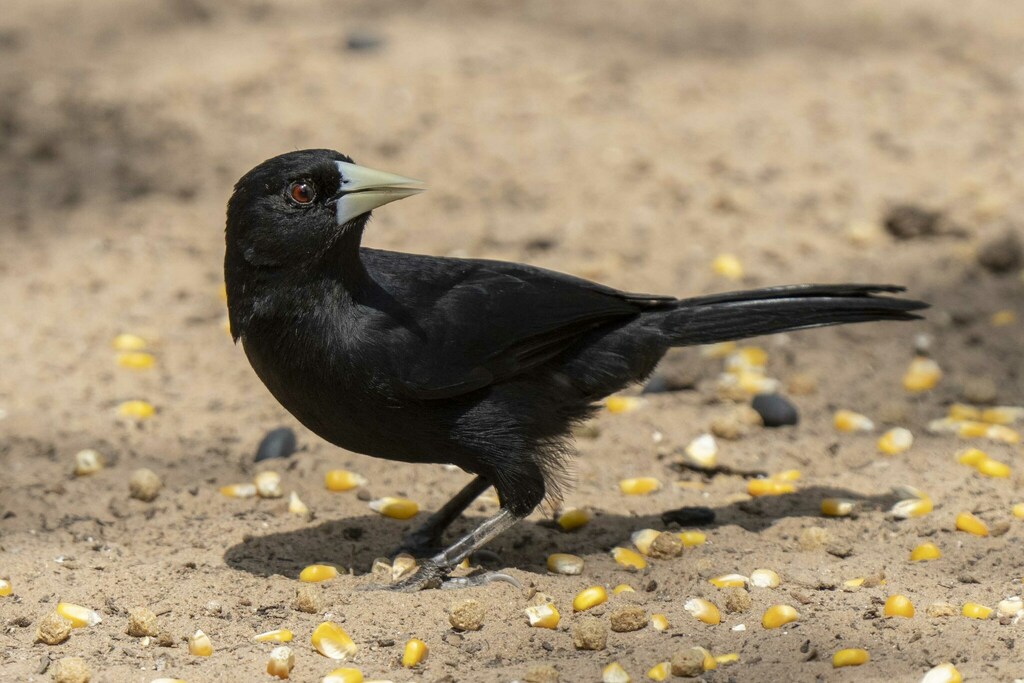
Solitary Cacique
Photo © Luciano Massa
Photo © Luciano Massa — CC BY 4.0 — Source: iNaturalist photo #231253021Identification
The Solitary Cacique is a distinctly black bird, measuring approximately 27 cm in males and 23 cm in females. Its most striking feature is a large, white, chisel-shaped and sharply-pointed beak that sets it apart from all other entirely black birds with dark irises within its range. This unmistakable bill is diagnostic in the field. The bird produces a variety of vocalizations delivered at a measured pace, often interrupted by gurgles and growls.
While it could potentially be confused with the smaller Ecuadorian Cacique (which has a restricted range) or the Yellow-billed Cacique (not found east of the Andes), the Solitary Cacique's larger size and distinctive white bill make positive identification straightforward once observed.
Range & Habitat
This species has an extremely wide distribution across South America, found in Argentina, Bolivia, Brazil, Colombia, Ecuador, Paraguay, Peru, Uruguay, and Venezuela. Its range extends from Amazonian regions southward to northern Argentina and Uruguay, occurring at altitudes up to approximately 800 meters.
The Solitary Cacique inhabits subtropical and tropical moist lowland forests, swamps, and heavily degraded former forest areas. It typically forages in the mid-storey of the canopy and shrubby understorey, where it navigates through dense vines and tangled vegetation with remarkable agility.
Behaviour & Diet
Despite its name, the Solitary Cacique is occasionally found in pairs but notably does not join mixed-species flocks—a behavior that distinguishes it from many congeners. It is an acrobatic forager, sometimes hanging upside-down while hunting through undergrowth. The bird occasionally visits flowering trees higher in the canopy.
Its diet is omnivorous, consisting primarily of invertebrates and small vertebrates including tree frogs, supplemented with fruit and nectar. Breeding occurs between October and January depending on location, with evidence suggesting two broods are reared annually in Argentina. Unlike most members of its genus, the Solitary Cacique nests solitarily rather than in colonies.
Best Time & Places to See It
The Solitary Cacique is fairly common throughout its extensive range, making it a reliable species to encounter across much of tropical and subtropical South America. The breeding season from October to January is an excellent period to locate birds, particularly as they become more vocal and visible during nesting activities.
Look for this species in primary and secondary forests, gallery forests, and flooded forest areas across the Amazon Basin and into the southern cone of South America. Its preference for mid-canopy and understorey levels means patient observation in forested habitats will reward the dedicated birdwatcher.
Photography Tips
The Solitary Cacique's distinctive white bill contrasts dramatically against its black plumage, making it highly photogenic. Position yourself to capture this diagnostic feature in good light—frontal or slightly angled shots that showcase the beak's chisel shape and pointed tip are most effective.
Since this species forages in dense vegetation and the understorey, be prepared with appropriate shutter speeds to freeze its acrobatic movements. Early morning and late afternoon light will enhance the contrast between the white bill and black body. Patience is essential, as the bird's solitary habits and preference for tangled vegetation can make prolonged observation challenging.
Amacayacu National Park
Anavilhanas National Park
Bahuaja Sonene National Park
Calilegua National Park
Cantão State Park
Chaco National Park
Chapada Diamantina National Park
Chapada dos Guimarães National Park
El Palmar National Park
Nothing matches these filters.
No community photos yet. Log in to add the first one.
No community observations of this species yet.