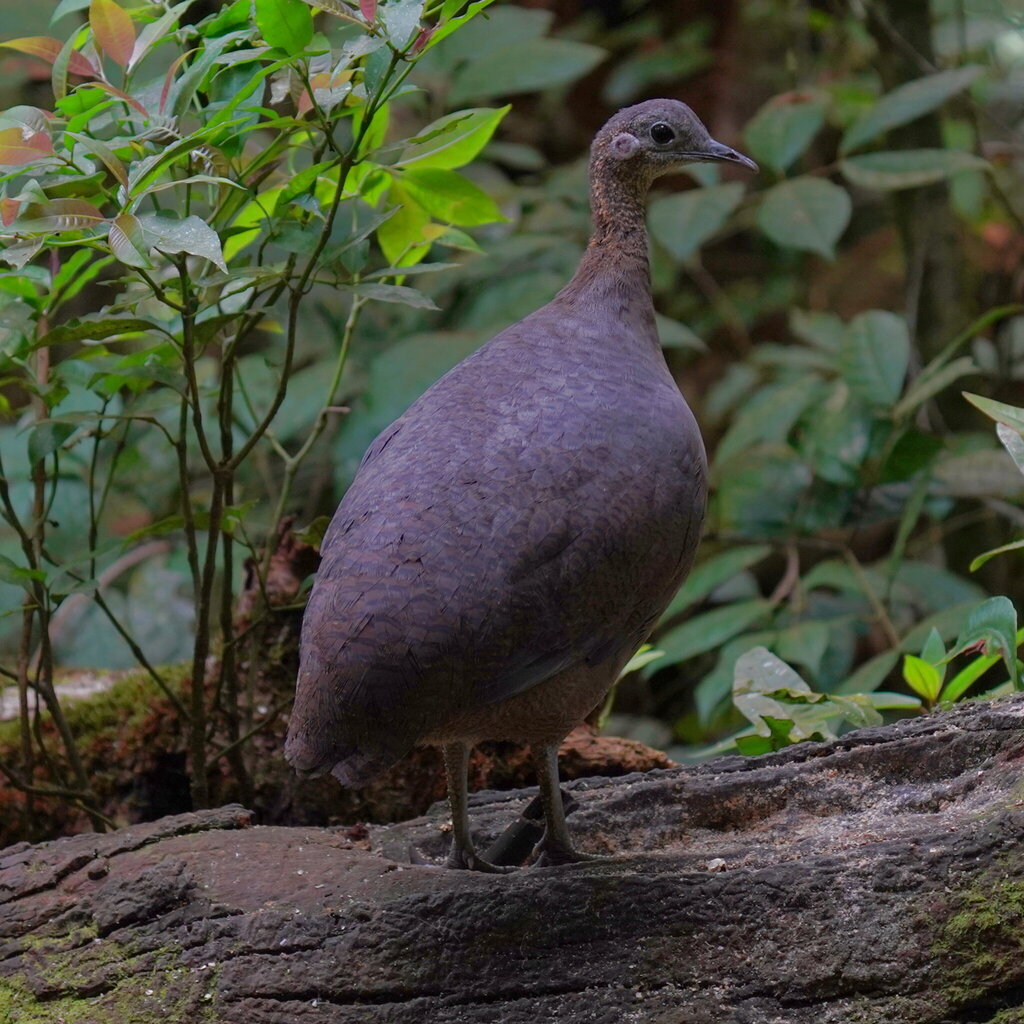
Solitary Tinamou
Photo © Daniel S. Katz
Photo © Daniel S. Katz — CC BY 4.0 — Source: iNaturalist #265851070Identification
The solitary tinamou is a large, heavily barred ground bird averaging 45 cm in length, making it a striking presence in the forest understory. Its most distinctive features include a dark brown crown, a white throat that contrasts sharply with its yellowish head and neck, and a characteristic buff line running along the side of the neck. The body is predominantly brownish, extensively marked with black barring, while the neck, breast, and flanks are grey and the belly is white. Plumage coloration varies noticeably between individual birds: some are yellower with heavier barring especially on the neck, while others show more olive or rusty tones on the back with less intense barring patterns.
Range & Habitat
Native to the Atlantic forest of eastern Brazil, the solitary tinamou inhabits a broad region spanning southeastern Bahia, eastern Minas Gerais, Espírito Santo, Rio de Janeiro, São Paulo, eastern Mato Grosso do Sul, Paraná, Santa Catarina, and northern Rio Grande do Sul. Its range extends beyond Brazil into southeastern Paraguay and extreme northeastern Argentina in Misiones province.
The species favors lowland humid tropical forests and montane forests at elevations up to 1,200 meters. It readily adapts to secondary forest and can tolerate selective logging to a degree, though it avoids large plantations of exotic species. The bird thrives in mosaic landscapes of smallholder plantings interspersed with secondary growth featuring dense bamboo understorey, and can maintain viable populations even in forest fragments as small as 400 hectares.
Behaviour & Diet
Like other tinamous, the solitary tinamou is a ground forager that feeds on fruits and seeds found on the forest floor or low vegetation. The species exhibits an unusual reproductive strategy: females lay oddly-shaped eggs with glossy, colorful shells in ground nests, but males assume full responsibility for egg incubation and rearing the chicks through their brief dependent period.
Best Time & Places to See It
The solitary tinamou inhabits protected Atlantic forest reserves and can be encountered in remaining forest fragments throughout its range in southeastern Brazil, Paraguay, and northeastern Argentina. It can be plentiful in areas with suitable secondary growth and bamboo understorey. While present year-round, access may be seasonal depending on local weather conditions and forest accessibility. Hiring local guides familiar with tinamou calls and behavior will significantly increase your chances of encounters.
Photography Tips
This ground-dwelling forest bird requires patience and stealth. Early morning and late afternoon typically offer the best light and activity levels. The solitary tinamou's cryptic coloration provides excellent camouflage among leaf litter and understory vegetation, so scan the forest floor carefully. A telephoto lens is essential, as the bird typically maintains a cautious distance. Recording tinamou calls beforehand and playing them softly may help attract birds to photography positions, though this should be done sparingly to avoid disturbing breeding birds. The bird's distinctive buff neck line and contrasting throat patch are key features to capture, requiring patience to obtain clear facial detail.
Itatiaia National Park
Brazil
+519 birds+12 mammals
Where granite peaks pierce the Atlantic rainforest canopy in southeastern Brazil, Itatiaia National Park rises as one of the country's oldest and most ecologically vital protected…
VIEW NATIONAL PARKSaint-Hilaire/Lange National Park
Brazil
+225 birds
Subtropical Atlantic forests rise and fall across the plateaus of inland Paraná, where Saint-Hilaire/Lange National Park protects nearly 578 square kilometres of Brazil's most biodiverse woodland…
VIEW NATIONAL PARKSerra do Itajaí National Park
Brazil
+227 birds+2 mammals
Where the Atlantic rainforest rises steeply from the coastal plains of Santa Catarina, Serra do Itajaí National Park spreads across 1,136 square kilometres of montane wilderness…
VIEW NATIONAL PARKSerra da Bocaina National Park
Brazil
+441 birds+5 mammals
Where the escarpment of the Serra da Bocaina rises sharply from the Atlantic coastal plain, tropical rainforest cloaks steep mountainsides that climb toward peaks exceeding 2,000…
VIEW NATIONAL PARKIguaçu National Park
Brazil
+387 birds+17 mammals
Where the Paraná Plateau plunges toward the Atlantic watershed, six thousand square kilometers of subtropical rainforest cling to steep gorges and river valleys in this corner…
VIEW NATIONAL PARKSão Joaquim National Park
Brazil
+222 birds+9 mammals
Where the southern Brazilian highlands rise above the Atlantic Forest, São Joaquim National Park protects nearly 1,000 square kilometers of montane terrain that shifts between temperate…
VIEW NATIONAL PARKPau Brasil National Park
Brazil
+211 birds
Tropical Atlantic forest cloaks the rolling terrain of northeastern Bahia, where Pau Brasil National Park protects nearly 390 square kilometers of one of Brazil's most biodiverse…
VIEW NATIONAL PARKSerra dos Órgãos National Park
Brazil
+446 birds+13 mammals
Granite peaks thrust skyward through the Atlantic Forest canopy in the mountains immediately north of Rio de Janeiro, their bare rock faces rising above a landscape…
VIEW NATIONAL PARKAraucárias National Park
Brazil
+231 birds+3 mammals
Where the southern Brazilian highlands rise into cool temperate forest, Araucárias National Park protects one of the Atlantic Forest's most distinctive ecosystems across 506 square kilometres…
VIEW NATIONAL PARKSerra Geral National Park
Brazil
+211 birds+2 mammals
Where basalt cliffs and sandstone escarpments rise above the subtropical forests of southern Brazil, Serra Geral National Park preserves one of the Atlantic region's most dramatic…
VIEW NATIONAL PARKIguazú National Park
Puerto Iguazú, Argentina
+346 birds+15 mammals
Where the Paraná Plateau plunges toward the Atlantic watershed, nearly 800 square kilometers of subtropical rainforest drape across Misiones Province in a landscape carved by millennia…
VIEW NATIONAL PARKNo community photos yet. Log in to add the first one.
No community observations of this species yet.