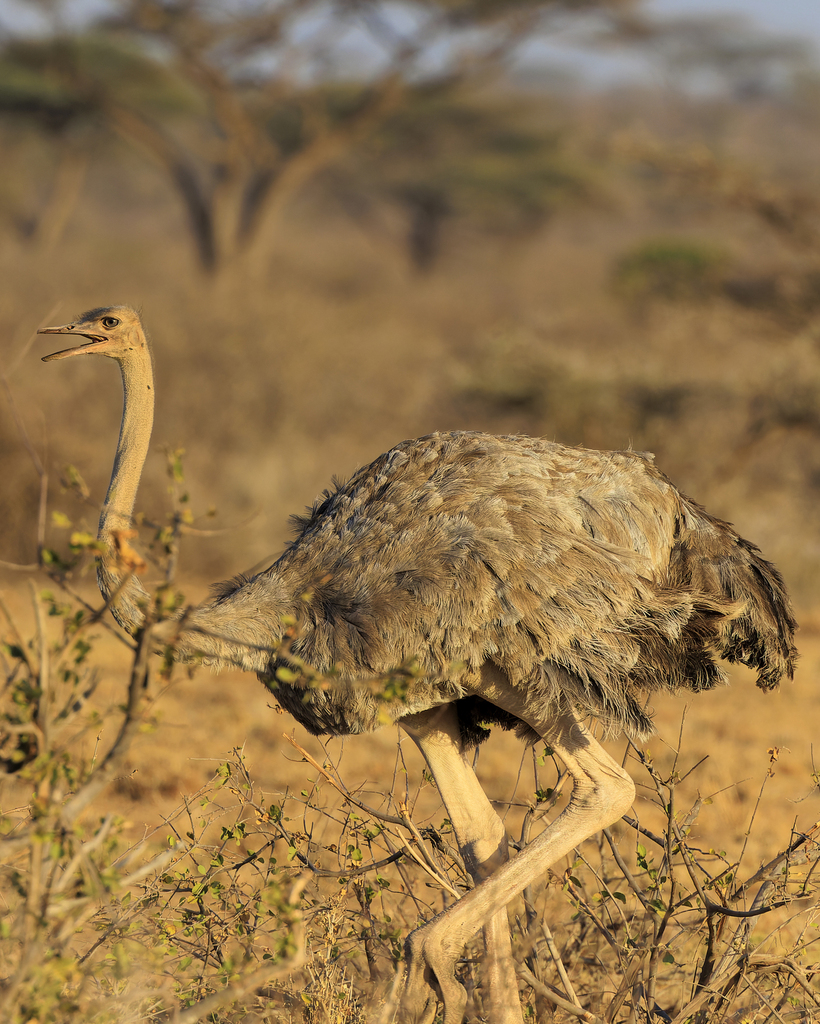
Somali Ostrich
Photo © Gary T. Leavens
Photo © Gary T. Leavens — CC BY-SA 4.0 — Source: iNaturalist photo #363880295Identification
The Somali ostrich, also called the blue-necked ostrich, is one of the world's two largest living bird species. It shares the general form of other ostriches but is distinguished by its distinctive blue-tinged grey neck and thigh skin, which becomes brighter blue in males during breeding season. Unlike some ostrich species, the Somali ostrich lacks a broad white ring around the neck. Males display white primary and tail feathers, while females show brown plumage in these areas. Males are noticeably larger than females, and captive birds have been recorded at around 105 kg, though wild individuals may differ from these weights.
Range & habitat
The Somali ostrich is primarily found across the Horn of Africa, with its range extending through north-eastern Ethiopia, southern Djibouti, most of Kenya, and across Somalia. The species was originally described from the plains of Somaliland and western Galla-Land, stretching from approximately 10 degrees north to the Equator along the east coast of Africa. The East African Rift has historically served as a geographic barrier that has kept this species genetically distinct from other ostrich populations.
Unlike the common ostrich, which prefers open savanna grasslands, the Somali ostrich favors bushier, more thickly vegetated areas. This ecological preference for denser vegetation has helped maintain genetic separation between the two species despite some range overlap in certain regions.
Behaviour & diet
The Somali ostrich's feeding behaviour reflects its habitat preference. Rather than grazing on open grassland like the common ostrich, it feeds largely by browsing on vegetation in bushier environments. This dietary and ecological distinction between the two ostrich species is so significant that interbreeding between them is reportedly difficult.
Best time & places to see it
Kenya offers the most reliable opportunity to observe Somali ostriches, as the species is farmed there for meat, feathers, and eggs. In the wild, the species remains distributed across its native range in Ethiopia, Djibouti, and Somalia, though populations have declined significantly. The bird was reportedly common in central and southern Somalia during the 1970s and 1980s, but uncontrolled hunting has since reduced its range and numbers throughout the Horn of Africa.
Photography tips
The Somali ostrich's distinctive blue-grey neck and thighs provide striking photographic subjects, particularly males in breeding plumage when the neck becomes a brighter blue. The contrasting white feathering in male birds' wings and tails offers excellent opportunities for capturing detail. The bird's preference for bushier, vegetated habitats means photographing wild individuals may require patience and careful positioning to capture clean backgrounds. The species' large size makes it relatively approachable for photography compared to smaller wildlife.
Tsavo East National Park
Athi ward, Kenya
+468 birds+50 mammals
Across the semi-arid lowlands of southeastern Kenya, where acacia woodland fragments into scrubland and the landscape rolls toward the Indian Ocean horizon, lies one of Africa's…
VIEW NATIONAL PARKTsavo West National Park
Mwatate, Kenya
+513 birds+49 mammals
Where volcanic ridges and weathered lava flows meet the semi-arid lowlands of south-central Kenya, Tsavo West National Park unfolds across a landscape sculpted by fire and…
VIEW NATIONAL PARKAbijata-Shalla Lakes National Park
Ethiopia
+438 birds+7 mammals
Two crater lakes of contrasting chemistry define this remote corner of Ethiopia's Rift Valley, where soda lakes and freshwater basins create a mosaic of distinct aquatic…
VIEW NATIONAL PARKAwash National Park
Didiga, Ethiopia
+473 birds+23 mammals
Where the Ethiopian Rift Valley carves through volcanic plateaus, a ribbon of riverine forest winds through acacia scrubland and grassland, creating a mosaic of habitats that…
VIEW NATURAL PARKYabelo Wildlife Sanctuary
Bedewera, Ethiopia
+359 birds+5 mammals
Where acacia woodlands meet volcanic plateaus in southern Ethiopia, a landscape of austere beauty unfolds across nearly 2,500 square kilometers. Yabelo Wildlife Sanctuary sprawls across semi-arid…
VIEW WILDLIFE SANCTUARYMeru National Park
Igembe Central, Kenya
+408 birds+38 mammals
Granite outcrops and acacia woodland rise across the northern reaches of Meru, where semi-arid savanna transitions into drier scrubland under the fierce equatorial sun. The park's…
VIEW NATIONAL PARKSamburu National Reserve
Samburu, Kenya
+430 birds+42 mammals
Across the arid plains of northern Kenya, where scattered acacia woodland gives way to rocky outcrops and dry riverbeds, Samburu National Park unfolds as one of…
VIEW NATURE RESERVENo community photos yet. Log in to add the first one.
No community observations of this species yet.