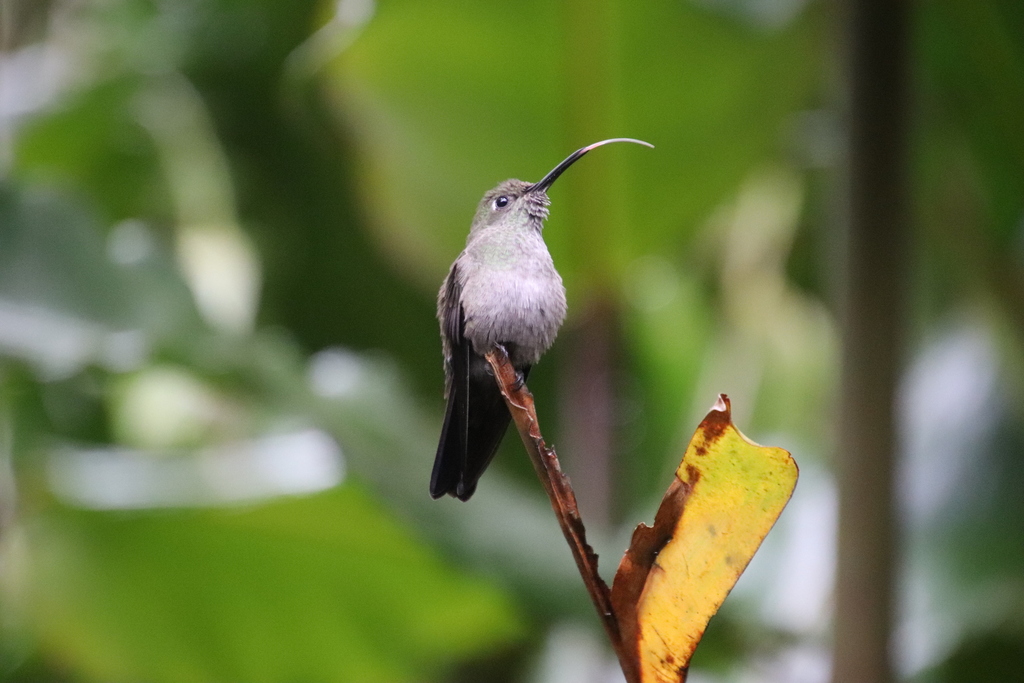
Sombre Hummingbird
Photo © Millie Basden
Photo © Millie Basden — CC BY 4.0 — Source: iNaturalist photo #49393240Identification
The Sombre Hummingbird is a small species, measuring about 12 cm in length and weighing between 7.1 and 9 grams. Males and females are essentially identical in plumage, though females are slightly smaller. This bird's most distinctive features are its slightly decurved black bill and its predominantly dark coloration. The upperparts are bronzy green to blackish bronzy green, with a coppery sheen on the uppertail coverts. The underparts are notably dull gray with only a few dull green spots on the throat, giving this species its suitably "sombre" appearance. The square tail displays shiny green central feathers contrasted with black feathers that have a bronzy gloss.
Range & Habitat
Endemic to Brazil, the Sombre Hummingbird is found in eastern regions from Pernambuco south to Rio Grande do Sul and west as far as Mato Grosso. The core of its distribution lies within the Atlantic Forest biome, though it also inhabits transition zones between the cerrado and caatinga biomes. This species favors the edges and understory of humid primary and secondary forests, as well as plantations and gardens.
Behaviour & Diet
The Sombre Hummingbird is a year-round resident throughout its range. It forages for nectar from a variety of flowering plants, including introduced Eucalyptus species, working from the understory up to heights of 30 meters. Remarkably, this bird is highly territorial and spends approximately half of its time aggressively defending flower patches from other hummingbirds. Beyond nectar, it supplements its diet by hawking arthropods from a perch.
The breeding season extends from November to March. Females construct delicate cup nests from soft plant material decorated with large lichen pieces on the exterior, typically positioned like a saddle on a horizontal branch. Females incubate a clutch of two eggs for 15 to 16 days, with fledging occurring roughly 28 days after hatching. The bird's high-pitched song, a repeated "tchui-ui," is typically delivered at dawn and during aggressive territorial encounters, along with at least six distinct calls including chirps, guttural sounds, vibrato, whistles, and cracks.
Best Time & Places to See It
The Sombre Hummingbird is a year-round resident, making it viewable throughout the year. Except in the far south of its range, it is considered locally common to common. The Atlantic Forest represents the best habitat for encounters, and the species occurs in several protected areas throughout eastern Brazil where visitors may observe it defending flowering plants in gardens, plantations, and forest edges.
Photography Tips
Photographers should focus on capturing this bird in flowering areas where it is most active and predictable. Early morning hours offer excellent opportunities to photograph the bird singing from exposed perches. The bird's dark coloration requires careful exposure management to retain detail in the plumage while capturing the subtle bronzy and coppery sheens. Its highly territorial nature means patients photographers may witness dramatic aerial interactions as the bird defends feeding territories—dynamic behavior that makes compelling images.
Tijuca National Park
Brazil
+317 birds+13 mammals
Where the Atlantic forest rises steeply from Rio de Janeiro's urban edge, Tijuca National Park encompasses a landscape of dramatic granite peaks, cascading waterfalls, and closed-canopy…
VIEW NATIONAL PARKSerra do Cipó National Park
Brazil
+379 birds+5 mammals
Where granite escarpments rise above the Atlantic Forest transition zone in southeastern Brazil, Serra do Cipó National Park unfolds across a landscape of dramatic ridges, cascading…
VIEW NATIONAL PARKItatiaia National Park
Brazil
+519 birds+12 mammals
Where granite peaks pierce the Atlantic rainforest canopy in southeastern Brazil, Itatiaia National Park rises as one of the country's oldest and most ecologically vital protected…
VIEW NATIONAL PARKSuperagui National Park
Brazil
+246 birds+2 mammals
Where the Atlantic rainforest meets the subtropical coast of Paraná, Superagui National Park sprawls across more than 1,000 square kilometres of one of Brazil's most biodiverse…
VIEW NATIONAL PARKSaint-Hilaire/Lange National Park
Brazil
+225 birds
Subtropical Atlantic forests rise and fall across the plateaus of inland Paraná, where Saint-Hilaire/Lange National Park protects nearly 578 square kilometres of Brazil's most biodiverse woodland…
VIEW NATIONAL PARKSerra do Itajaí National Park
Brazil
+227 birds+2 mammals
Where the Atlantic rainforest rises steeply from the coastal plains of Santa Catarina, Serra do Itajaí National Park spreads across 1,136 square kilometres of montane wilderness…
VIEW NATIONAL PARKSerra da Bocaina National Park
Brazil
+441 birds+5 mammals
Where the escarpment of the Serra da Bocaina rises sharply from the Atlantic coastal plain, tropical rainforest cloaks steep mountainsides that climb toward peaks exceeding 2,000…
VIEW NATIONAL PARKSerra dos Órgãos National Park
Brazil
+446 birds+13 mammals
Granite peaks thrust skyward through the Atlantic Forest canopy in the mountains immediately north of Rio de Janeiro, their bare rock faces rising above a landscape…
VIEW NATIONAL PARKChapada dos Veadeiros National Park
Brazil
+324 birds+6 mammals
Where granite plateaus rise above the cerrado savanna in central Brazil, Chapada dos Veadeiros National Park unfolds across 6,665 square kilometres of some of the world's…
VIEW NATIONAL PARKChapada Diamantina National Park
Brazil
+346 birds+5 mammals
Where granite peaks and sandstone cliffs rise abruptly from the Brazilian interior, Chapada Diamantina National Park sprawls across 4,215 square kilometers of some of Brazil's most…
VIEW NATIONAL PARKSerra do Gandarela National Park
Brazil
+333 birds+3 mammals
Where granite massifs rise through Atlantic Forest in southeastern Brazil's highlands, Serra do Gandarela National Park protects nearly 1,000 square kilometres of montane terrain that few…
VIEW NATIONAL PARKBrasília National Park
Plano Piloto, Brazil
+338 birds+15 mammals
Cerrado grassland and scattered woodland sweep across the central Brazilian plateau where this national park sprawls across more than a thousand square kilometres of the Federal…
VIEW NATIONAL PARKNo community photos yet. Log in to add the first one.
No community observations of this species yet.