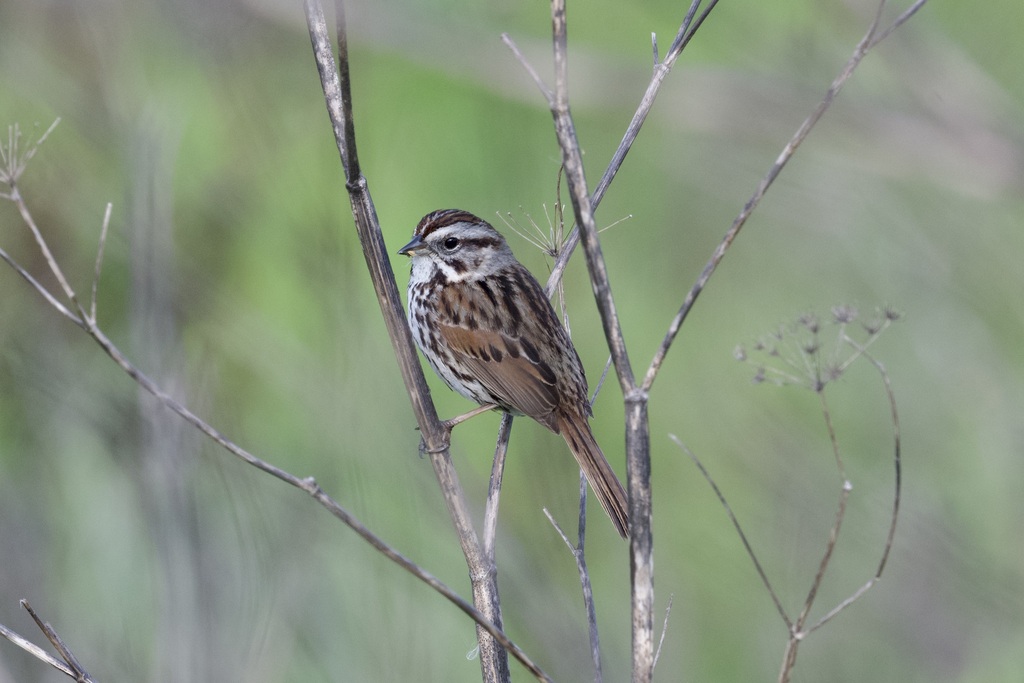
Song Sparrow
Photo © Dario Taraborelli
Photo © Dario Taraborelli — CC0 1.0 — Source: iNaturalist photo #370214211Identification
The song sparrow is a medium-sized New World sparrow with distinctive markings that make it recognizable in the field. Adults have brown upperparts with dark streaks on the back, white underparts with dark streaking, and a characteristic dark brown spot in the middle of the breast. They display a brown cap, gray face with a brown streak through each eye, and a long brown rounded tail. Body length ranges from 11 to 18 cm, with wingspans between 18 and 25.4 cm, and body mass averaging around 32 grams across all subspecies, though the widespread nominate subspecies weighs only about 22 grams on average.
In the field, song sparrows are most easily confused with Lincoln's sparrow and the Savannah sparrow. However, Lincoln's sparrow can be distinguished by its shorter, grayer tail and differently-patterned head with brown cheeks forming a clear-cut angular patch. The Savannah sparrow has a forked tail and yellowish flecks on the face when observed closely. Once you learn these subtle differences, the song sparrow becomes much easier to identify with confidence.
Range & Habitat
The song sparrow is one of the most abundant, variable, and adaptable native sparrows in North America. Though a habitat generalist, it favors brushland and marshes, including salt marshes across most of Canada and the United States. The species also thrives in human-dominated areas such as suburbs, agricultural fields, and along roadsides. Northern populations migrate to the southern United States or Mexico during winter and intermingle with the native, non-migratory populations of the southern half of their range. The song sparrow is a very rare vagrant to western Europe, with only a few recorded sightings in Great Britain and Norway.
Song sparrows with areas of shrub cover in their territory, away from the intertidal coastline, have greater over-winter survival and higher reproductive success. This preference for sheltered shrub cover is an important factor in their distribution and abundance patterns across their range.
Behaviour & Diet
These birds forage on the ground, in shrubs, or in very shallow water, eating mainly insects and seeds. Birds in salt marshes may supplement their diet with small crustaceans. They nest either in a sheltered location on the ground or in trees and shrubs. Females lay three to five eggs per clutch, with an average incubation time of 13–15 days before hatching. The eggs are brown with greenish-white spots. The maximum lifespan in the wild is 11.3 years.
The song sparrow derives its name from its colorful repertoire of songs. Males use a fairly complex song to declare ownership of territory and attract females, consisting of a combination of repeated notes, quickly passing isolated notes, and trills. One bird may know as many as 20 different tunes with as many as 1000 improvised variations on the basic theme. Song sparrows typically learn their songs from a handful of neighboring birds and are most likely to learn songs shared between neighbors. They are able to distinguish neighbors from strangers on the basis of song, and females can distinguish and prefer their mate's songs from those of others.
Best Time & Places to See It
The song sparrow's abundance and adaptability make it one of the easiest North American sparrows to encounter. Look for them year-round in the southern portions of their range, including brushland, marshes, salt marshes, suburban gardens, agricultural areas, and roadsides. Northern populations are present during breeding season and may be found in similar habitats. Winter is an excellent time to search for migrating northern populations as they move through the southern United States and Mexico.
Because song sparrows thrive in human-dominated landscapes, they can often be observed in suburban settings, making them accessible to travelers and photographers without requiring travel to remote locations. Early morning is the best time to hear their distinctive songs and observe territorial behavior.
Photography Tips
The song sparrow's relatively small size and preference for brushy, shrubby habitats require patience and a telephoto lens of at least 300mm. Position yourself near dense shrub cover, marsh vegetation, or brushy roadsides where these birds are known to forage. Early morning light is ideal for capturing the subtle beauty of their brown and white plumage and the distinctive breast spot.
The birds' habit of foraging on the ground and in low shrubs makes them approachable compared to canopy-dwelling species. Use a fast shutter speed to freeze motion, particularly when capturing birds as they hop through vegetation or forage on the ground. Patient waiting near areas of shrub cover will yield opportunities for excellent portraits that showcase their characteristic markings, including the facial pattern and breast spot.
Acadia National Park
Alaska Maritime National Wildlife Refuge
Algonquin Provincial Park
Alligator River National Wildlife Refuge
Arches National Park
Badlands National Park
Banff National Park
Bear River Migratory Bird Refuge
Becharof National Wildlife Refuge
Nothing matches these filters.
No community photos yet. Log in to add the first one.
No community observations of this species yet.