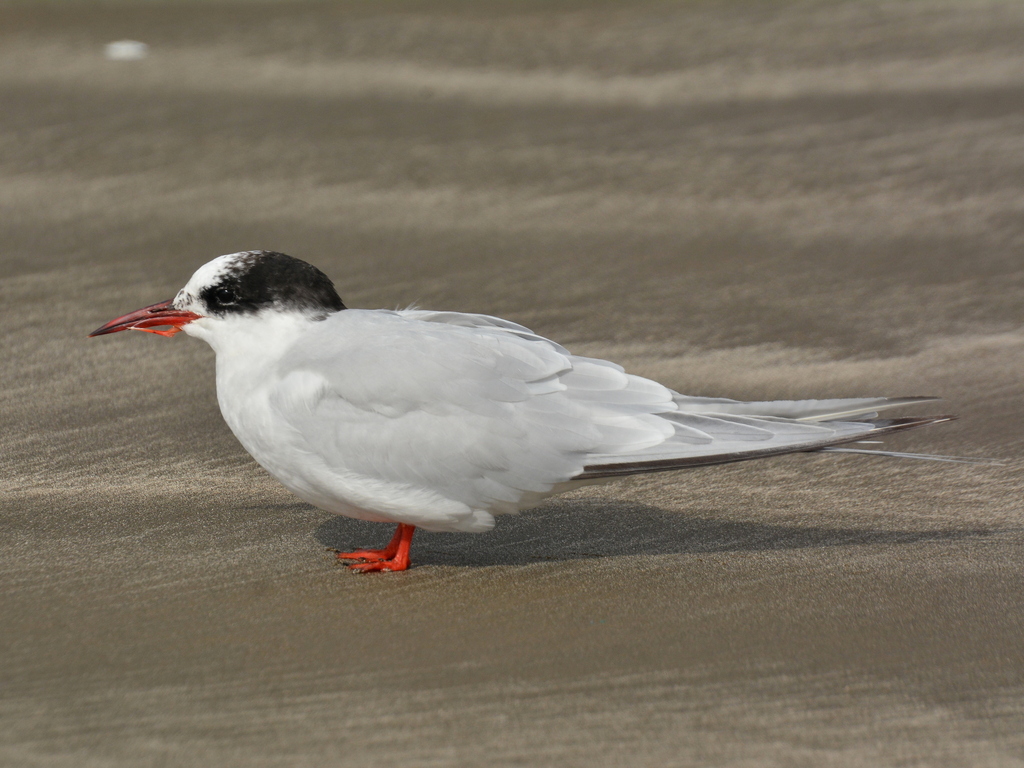
South American Tern
Photo © vinicius_s_domingues
Photo © vinicius_s_domingues — CC BY 4.0 — Source: iNaturalist photo #568285711Identification
The South American tern is a medium-to-large tern, measuring 40 to 44 centimetres in length, making it noticeably larger than the closely related common tern and Arctic tern. While it shares similar plumage patterns with these species year-round, several key features distinguish it. Most notably, adults display a bright red beak—significantly larger than that of its relatives—and lack the dark bar on the carpus (bend of the wing) seen in other terns. The black cap extends below the eye, usually separated from it by a distinctive white crescent, with a sharply defined rear edge. Juveniles are particularly distinctive, showing boldly barred and dusky upper parts and retaining barred tertials into their immature plumage, a feature that sets them apart from juvenile common and Arctic terns.
Range & Habitat
The South American tern inhabits the coasts of southern South America and is generally the most common tern throughout its range. On the Atlantic coast, its breeding range extends from east central Brazil southwards through Argentina and the Falkland Islands to Tierra del Fuego, while on the Pacific coast it breeds in southern Peru and Chile. During winter months, birds from the southern populations migrate northwards to Ecuador, Uruguay, and southern Brazil, demonstrating significant seasonal movement.
This species favours diverse coastal settings, nesting on islands, beaches, and cliff tops. Outside the breeding season, it frequents offshore waters, estuaries, and harbours, making it relatively accessible to observers across multiple habitat types.
Behaviour & Diet
The South American tern is an active forager, feeding primarily on fish along with crustaceans and other small invertebrates, typical of tern hunting behaviour. During breeding season, this species forms impressive colonies, sometimes of extraordinary density. A historic 1877 account documented a breeding colony in Chubut Province, Argentina, where an estimated 135,000 birds occupied just 130 square metres, with approximately 67,500 nests containing 112,500 eggs. Nests consist of mere scrapes in gravel and shingle, each typically holding one to three eggs that vary considerably in their individual markings.
Best Time & Places to See It
The South American tern is best observed in its breeding range during the breeding season, particularly in coastal Argentina, Chile, Peru, and the Falkland Islands. The Falkland Islands offer particularly reliable viewing opportunities, as this region supports significant populations. Winter visitors to Ecuador, Uruguay, and southern Brazil may also encounter migrant birds in estuaries and coastal waters. Year-round, coastal regions throughout southern South America provide opportunities to observe this generally common species in its preferred habitats.
Photography Tips
Photographers should target breeding colonies during nesting season for the most dramatic and accessible opportunities. The bird's larger size compared to common and Arctic terns, combined with its distinctive red beak and white-crescent eye marking, makes it highly photogenic. The striking black cap and neat demarcation of plumage provide excellent contrast in photographs. Coastal and estuarine settings offer natural backdrops, while the bird's habit of frequenting harbours and offshore waters means that patient observers may capture feeding or diving sequences. Early morning light is ideal for highlighting the red beak coloration and the crisp plumage patterns that characterize this elegant species.
Chile: Fuegian Snipe & Juan Fernandez
Tijuca National Park
Brazil
+317 birds+13 mammals
Where the Atlantic forest rises steeply from Rio de Janeiro's urban edge, Tijuca National Park encompasses a landscape of dramatic granite peaks, cascading waterfalls, and closed-canopy…
VIEW NATIONAL PARKParque Nacional de Galápagos
Santo Tomás, Ecuador
+139 birds+23 mammals
Volcanic peaks and weathered lava fields dominate this remote archipelago in the Pacific, where the interplay of cold ocean currents and tropical latitude creates an ecological…
VIEW ISLAND & ARCHIPELAGOPeixe National Park Lagoon
Brazil
+293 birds+4 mammals
Where the coastal plains of Rio Grande do Sul meet the Atlantic, Peixe National Park Lagoon sprawls across nearly 2,200 square kilometres of shallow waters, reed…
VIEW NATIONAL PARKSuperagui National Park
Brazil
+246 birds+2 mammals
Where the Atlantic rainforest meets the subtropical coast of Paraná, Superagui National Park sprawls across more than 1,000 square kilometres of one of Brazil's most biodiverse…
VIEW NATIONAL PARKSerra da Bocaina National Park
Brazil
+441 birds+5 mammals
Where the escarpment of the Serra da Bocaina rises sharply from the Atlantic coastal plain, tropical rainforest cloaks steep mountainsides that climb toward peaks exceeding 2,000…
VIEW NATIONAL PARKSea Lion Island
Sealion Island Settlement, Falkland Islands
+74 birds+3 mammals
Windswept tussock grasslands roll across volcanic terrain where Southern Ocean swells crash against rocky shores, creating one of the Falkland Islands' most dramatic wildlife theatres. This…
VIEW ISLAND & ARCHIPELAGOKidney Island
Stanley, Falkland Islands
+47 birds
Wind-scoured tussock grassland sweeps across this remote South Atlantic outcrop, where peaty soils and exposed rock formations create a landscape as austere as it is vital.…
VIEW ISLAND & ARCHIPELAGOPort Stephens
Port Stephens, Falkland Islands
+29 birds
Windswept moorlands sweep down to pristine beaches where kelp forests fringe the turquoise shallows, their giant fronds swaying in the southern current. Port Stephens, cradled on…
VIEW NATURE RESERVEMurrell Farm
falskland islands, Falkland Islands
+54 birds
Rolling grasslands sweep across windswept plateaux where the South Atlantic exerts its relentless influence on the vegetation, sculpting tussock grassland into a tapestry of browns and…
VIEW NATURE RESERVECape Dolphin
falskland islands, Falkland Islands
+54 birds+1 mammals
Where windswept grasslands meet dramatic coastal cliffs, the Falkland Islands' northern reaches reveal one of the Southern Hemisphere's most compelling seabird sanctuaries. The terrain here is…
VIEW NATURE RESERVEVolunteer Point
Stanley, Falkland Islands
+70 birds+3 mammals
Windswept grasslands meet volcanic black sand beaches where three penguin species converge in the South Atlantic's most theatrical wildlife theatre. This remote peninsula on East Falkland…
VIEW NATURE RESERVEWest Point Island
West Point, Falkland Islands
+67 birds+3 mammals
Windswept cliffs plunge dramatically into the South Atlantic, their rust-coloured rock faces sculpted by millennia of gales and spray. This northwestern outpost of the Falkland Islands…
VIEW ISLAND & ARCHIPELAGOChiloé National Park
Dalcahue, Chile
+122 birds+6 mammals
Temperate rainforest cloaks the Chiloé archipelago's northwestern reaches, where granite ridges thrust through dense, moisture-laden canopy and freshwater streams carve ravines toward the Pacific. Across approximately…
VIEW NATIONAL PARKCabo de Hornos National Park
Cape Horn, Chile
+88 birds+9 mammals
Where the Andes plunge into the Southern Ocean and the Drake Passage churns between two continents, Cabo de Hornos National Park sprawls across one of Earth's…
VIEW NATIONAL PARKPan de Azúcar National Park
Chañaral, Chile
+74 birds+4 mammals
Where the Atacama Desert plunges toward the Pacific, Pan de Azúcar National Park sprawls across 727 square kilometres of one of Earth's most extreme transitions—a landscape…
VIEW NATIONAL PARKTorres del Paine National Park
Torres del Paine, Chile
+143 birds+10 mammals
Where granite spires pierce the Patagonian sky, Torres del Paine commands one of South America's most dramatic landscapes. Across 4,106 square kilometres of southern Chile, jagged…
VIEW NATIONAL PARKPuyehue National Park
Puyehue, Chile
+110 birds+4 mammals
Across the volcanic spine of the Los Lagos Region, where the Andes descend toward temperate rainforest, Puyehue National Park encompasses nearly 2,600 square kilometers of one…
VIEW NATIONAL PARKVicente Pérez Rosales National Park
Puerto Varas, Chile
+109 birds+8 mammals
Where the Andes descend toward the temperate rainforests of Chile's Lake District, nearly 4,641 square kilometers of pristine wilderness unfolds across Vicente Pérez Rosales National Park.…
VIEW NATIONAL PARKPatagonia National Park
Cochrane, Chile
+133 birds+8 mammals
Where the Andes meet the Patagonian steppe, vast grasslands and shrublands sweep across rolling terrain carved by ancient glaciation, their contours softened by distance and dramatic…
VIEW NATIONAL PARKReserva Nacional Magallanes
Punta Arenas, Chile
+78 birds+2 mammals
Where windswept steppe meets sub-Antarctic forest near the southern tip of continental South America, Reserva Nacional Magallanes unfolds across roughly 352 square kilometres of profound ecological…
VIEW NATIONAL PARKParque Provincial Península de Magallanes
Argentina
+125 birds+4 mammals
Granite peaks and windswept steppe converge across this 415-square-kilometre peninsula jutting into the cold Atlantic waters of southern Patagonia, where the Magallanes landscape embodies the raw,…
VIEW NATIONAL PARKMonte León National Park
Argentina
+100 birds+4 mammals
Where the Patagonian steppe meets the Atlantic, Monte León National Park protects a landscape of windswept coastal cliffs, rocky outcrops, and semi-arid grassland spanning over 1,200…
VIEW NATIONAL PARKLos Glaciares National Park
Argentina
+121 birds+3 mammals
Where granite peaks and sprawling ice fields dominate the landscape, Los Glaciares National Park encompasses over ten thousand square kilometres of Patagonian wilderness in southern Argentina.…
VIEW NATIONAL PARKCampos del Tuyú National Park
Argentina
+169 birds+5 mammals
Subtropical forest graces the borderlands where Misiones Province meets Paraguay, a landscape shaped by the Paraná Plateau's weathered topography and the warm, humid climate of northeastern…
VIEW NATIONAL PARKNo community photos yet. Log in to add the first one.
No community observations of this species yet.