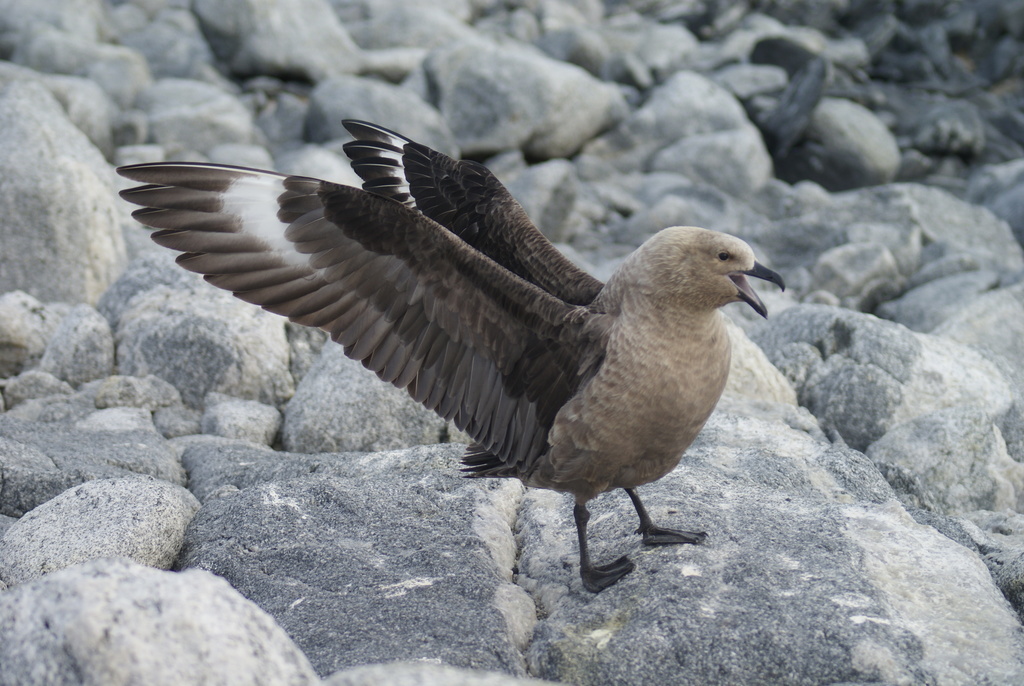
South Polar Skua
Photo © Kimberley Collins
Photo © Kimberley Collins — CC BY 4.0 — Source: iNaturalist photo #20805240Identification
The South Polar Skua is a large seabird measuring around 53 cm (21 in) in length. Adults display distinctive plumage that varies by morph: pale morph birds have greyish-brown upperparts with a whitish head and underparts, while intermediate morph birds show straw-brown colouring instead. This stark contrast between head and body is a key field mark that separates them from similar species with good views. The bird's large size, massive barrel chest, and white wing flashes are distinctive even at a distance, with powerful, direct flight.
Distinguishing South Polar Skuas from Northern Hemisphere species such as Arctic, pomarine, and long-tailed skuas is straightforward, but identification becomes more challenging when separating them from closely related Southern Hemisphere species, particularly the great skua of the North Atlantic. Juveniles and adult dark morphs are more difficult to distinguish from relatives and require observation of subjective criteria such as colder brown plumage and a blue bill base.
Range & Habitat
The South Polar Skua breeds on Antarctic coasts, typically laying two eggs in November and December. This species is a long-distance migrant, wintering at sea across the Pacific, Indian, and Atlantic Oceans. Remarkably, South Polar Skuas have been recorded at the actual Geographic South Pole, making them one of the most southerly-ranging birds in the world. In the eastern North Atlantic, this species is replaced by the closely related great skua.
Behaviour & Diet
Like other skuas, South Polar Skuas are highly aggressive defenders of their breeding territories, flying at the head of any human or other intruder approaching their nest. The species is primarily piscivorous, feeding mainly on fish, though it obtains much of its food through piracy—robbing gulls, terns, and even gannets of their catches. This kleptoparasitic behaviour continues throughout the year.
Beyond fish, South Polar Skuas supplement their diet with other birds, rabbits, and carrion. Compared to smaller skua species (jaegers), they employ less agility and more brute force when harassing their victims, relying on their considerable size and strength to overcome prey and competitors alike.
Best Time & Places to See It
South Polar Skuas are best observed in their Antarctic breeding grounds during the austral spring and summer (November–December and beyond), when they come ashore to nest on Antarctic coasts. Those seeking to observe these birds during winter months should look to pelagic waters of the Pacific, Indian, and Atlantic Oceans, where the species disperses after breeding.
Photography Tips
The South Polar Skua's large size, distinctive white wing flashes, and powerful flight make it relatively approachable for photography, even at considerable distances. The pale morph's striking contrast between whitish head and greyish-brown body provides excellent compositional opportunities. Photographing birds in their breeding territories requires caution, as skuas are notoriously aggressive defenders of their nests. Capturing the bird in direct, powerful flight showcases its characteristic barrel-chested silhouette and wing patterns to best effect.
Redwood National Park
Humboldt County, United States
+343 birds+43 mammals
Where the Pacific fog rolls deep into northern California's coastal valleys, some of the tallest trees on Earth rise from a landscape shaped by tectonic forces…
VIEW NATIONAL PARKFitzgerald River National Park
Fitzgerald River National Park, Australia
+209 birds+11 mammals
Where granite peaks rise above windswept heathlands and pristine river systems carve through untamed wilderness, one of Australia's most biodiverse landscapes unfolds across the southwestern corner…
VIEW NATIONAL PARKDeception Island
Gabriel de Castilla Base, Antarctica
+26 birds+10 mammals
Steaming geothermal vents pierce a landscape of blackened volcanic sand and ice, where the earth's raw power still trembles beneath your feet. This horseshoe-shaped caldera, flooded…
VIEW ISLAND & ARCHIPELAGOCuverville Island
Cuverville Island, Antarctica
+19 birds+10 mammals
Granite peaks and sculpted ice define this windswept archipelago off the Antarctic Peninsula, where steep rocky shores plunge into waters thick with drifting brash ice. Cuverville…
VIEW ISLAND & ARCHIPELAGONeko Harbour
Neko Harbour, Antarctica
+18 birds+10 mammals
Towering peaks of fractured ice rise abruptly from gunmetal waters, their faces scarred by millennia of glacial advance and retreat. This pocket of the Antarctic Peninsula…
VIEW PROTECTED LANDSCAPEParadise Bay
Brown Station, Antarctica
+18 birds+9 mammals
Where the Antarctic Peninsula's rugged coastline meets the Southern Ocean, Brown Station stands sentinel over Paradise Bay—a protected landscape of ice-carved inlets, towering glacial faces, and…
VIEW PROTECTED LANDSCAPEBrown Bluff
Brown Bluff, Antarctica
+23 birds+9 mammals
Where rust-colored volcanic peaks pierce the Antarctic Peninsula's icy realm, a geologist's dreamscape unfolds beneath towering cliffs of iron oxide and ancient lava. Brown Bluff rises…
VIEW PROTECTED LANDSCAPEPort Lockroy
Port Lockroy, Antarctica
+19 birds+9 mammals
Towering peaks of black rock pierce through Antarctic pack ice on the Gerlache Strait, where one of the continent's most accessible harbors cradles a living microcosm…
VIEW PROTECTED LANDSCAPEHalf Moon Island
Cámara Base, Antarctica
+25 birds+8 mammals
Jagged volcanic peaks rise from the cobalt waters of the South Shetland Islands, their slopes carpeted in moss and lichen where hardy vegetation clings to windswept…
VIEW ISLAND & ARCHIPELAGOPetermann Island
Petermann Island, Antarctica
+16 birds+9 mammals
Icebound cliffs rise dramatically from the Bellingshausen Sea, their weathered faces sculpted by millennia of Antarctic wind and tide. This slender wedge of rock and ice,…
VIEW ISLAND & ARCHIPELAGOPaulet Island
Paulet Island, Antarctica
+20 birds+6 mammals
Windswept ice and weathered rock converge at this remote Antarctic outcrop, where jagged peaks pierce through perpetual pack ice and glacial moraines descend toward cobalt waters.…
VIEW ISLAND & ARCHIPELAGODanco Island
Danco Island, Antarctica
+17 birds+10 mammals
Dramatic black rock pierces the Antarctic Peninsula's icy waters, crowned with permanent snow and ringed by calving glaciers that thunder into the sea. This volcanic outcrop…
VIEW ISLAND & ARCHIPELAGOWilhelmina Bay
Wilhelmina Bay, Antarctica
+20 birds+10 mammals
Sheer cliffs of black volcanic rock plunge into waters so pristine they reflect the Antarctic sky like polished obsidian. This remote western Antarctic inlet, ringed by…
VIEW PROTECTED LANDSCAPELemaire Channel
Orne Harbour, Antarctica
+25 birds+13 mammals
Where granite peaks plunge into steel-grey waters, the Lemaire Channel carves one of Antarctica's most dramatic passages. This narrow strait, squeezed between the Antarctic Peninsula and…
VIEW PROTECTED LANDSCAPECabo Peñas
Susacasa, Spain
+303 birds+21 mammals
Where sea cliffs rise sheer from the Bay of Biscay, Susacasa's observation point commands one of Asturias's most dramatic coastal vistas. The landscape here is defined…
VIEW OBSERVATION POINTChannel Islands National Park
Santa Barbara County, United States
+330 birds+15 mammals
A chain of eight volcanic islands rises from the cold Pacific waters off the California coast, their rugged sea cliffs and windswept terrain shaped by millions…
VIEW NATIONAL PARKKodiak National Wildlife Refuge
United States
+221 birds+22 mammals
Where temperate rainforest meets subarctic coast, Kodiak National Wildlife Refuge sprawls across Alaska's largest island, a sanctuary defined by steep valleys carved by tidewater glaciers and…
VIEW WILDLIFE SANCTUARYAlaska Maritime National Wildlife Refuge
Alaska, United States
+391 birds+58 mammals
Where the North Pacific collides with Alaska's rugged coastline, a sprawling archipelago of islands, rocky outcrops, and coastal headlands forms one of North America's most remote…
VIEW WILDLIFE SANCTUARYFarallon National Wildlife Refuge
San Francisco, United States
+384 birds+16 mammals
Windswept granite peaks rising abruptly from the Pacific, the Farallon Islands form a wildlife sanctuary of extraordinary seabird abundance and ecological significance just twenty-seven miles west…
VIEW WILDLIFE SANCTUARYPea Island National Wildlife Refuge
Dare County, United States
+356 birds+15 mammals
Where the Outer Banks taper toward the Atlantic, a sliver of barrier island creates a microcosm of coastal ecology. Pea Island National Wildlife Sanctuary spans over…
VIEW WILDLIFE SANCTUARYNo community photos yet. Log in to add the first one.
No community observations of this species yet.