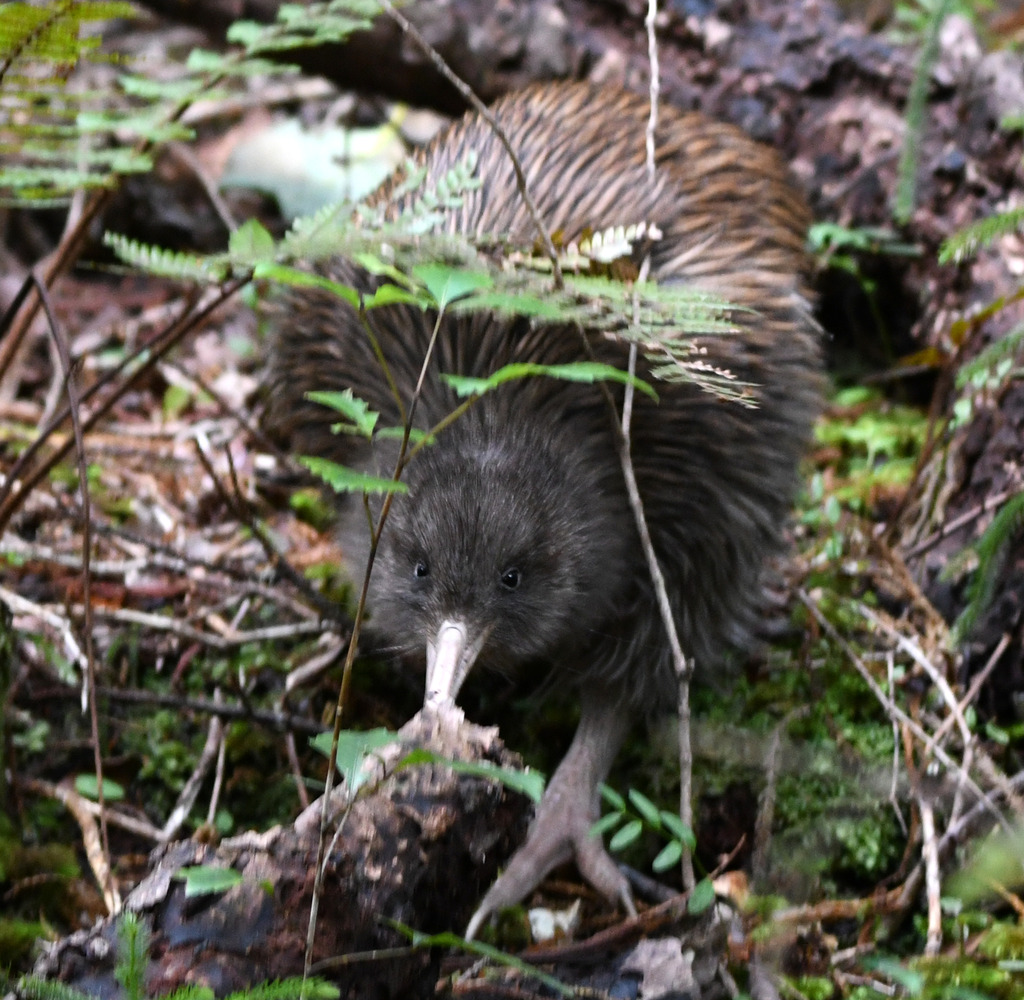
Southern Brown Kiwi
Photo © Ben Keen
Photo © Ben Keen — CC0 1.0 — Source: iNaturalist #319714024Identification
The southern brown kiwi is a small, flightless bird measuring 45 to 55 centimetres in length, with females weighing considerably more than males (2.1 to 3.9 kg compared to 1.6 to 2.8 kg). Its most distinctive feature is its long, slender, slightly downward-curving bill, which houses nostrils at the tip—an adaptation perfectly suited to its foraging lifestyle. The plumage is rufous with streaking; birds from different regions show subtle variations, with Haast tokoeka displaying notably rufous colouring and Stewart Island birds showing lengthwise reddish-brown streaking. Like all kiwis, it lacks a tail, has no preen gland, and possesses large whisker-like vibrissae around its gape.
Range & Habitat
The southern brown kiwi is endemic to New Zealand's South Island, with populations concentrated in Fiordland and Westland on the mainland, as well as throughout Stewart Island. The species comprises two recognised subspecies: the Fiordland tokoeka (approximately 15,000 birds) and the Stewart Island tokoeka (around 20,000 birds, relatively common at about 17 per square kilometre). A rare disjunct population near Haast numbers only about 350 specimens. These birds favour temperate and sub-tropical forests, grassland, and shrubland—the denser the vegetation, the better—and on Stewart Island they also inhabit sand dunes.
Behaviour & Diet
Southern brown kiwis are strictly nocturnal and highly vocal, using calls to defend territories and communicate with mates. Males produce a distinctive shrill "kee-wee" or "kee-kee" call, while females respond with hoarse "kurr kurr" vocalizations, often delivered in duet with legs stretched and bills pointed upward. The species is monogamous; paired birds defend territories ranging from 4.9 to 43 hectares and roost alone in sheltered ground-level locations when not breeding.
Their long, slender bill with tip-positioned nostrils gives them an exceptional sense of smell, their primary foraging tool. They probe soil and leaf litter for invertebrates—earthworms, beetle larvae, snails, crayfish, spiders, centipedes, and orthoptera—as well as eels and amphibians. Their weak gizzard and long, narrow caeca are adaptations reflecting their almost entirely invertebrate diet.
Best Time & Places to See It
Observing southern brown kiwis requires patience and nocturnal dedication, as these birds are strictly night-active. Stewart Island offers the most accessible viewing opportunities, with a stable population and fewer introduced predators than mainland populations. Fiordland provides another option for dedicated birdwatchers. Guided night walks and sanctuaries offer the best chance of encounters, though sightings remain challenging given the birds' elusive nature and dense forest habitat preferences.
Photography Tips
Photographing southern brown kiwis demands specialized equipment for low-light conditions: fast lenses (f/2.8 or wider), high ISO capabilities, and potentially infrared or thermal imaging technology. A headlamp with a red filter minimizes disturbance while allowing composition. Their nocturnal, ground-dwelling habits make them difficult subjects; patience, stillness, and local guide cooperation are essential. Focus on the distinctive bill and facial features that characterize the species, and capture their characteristic upright posture during vocalizations if fortunate enough to witness territorial calling.
No community photos yet. Log in to add the first one.
No community observations of this species yet.