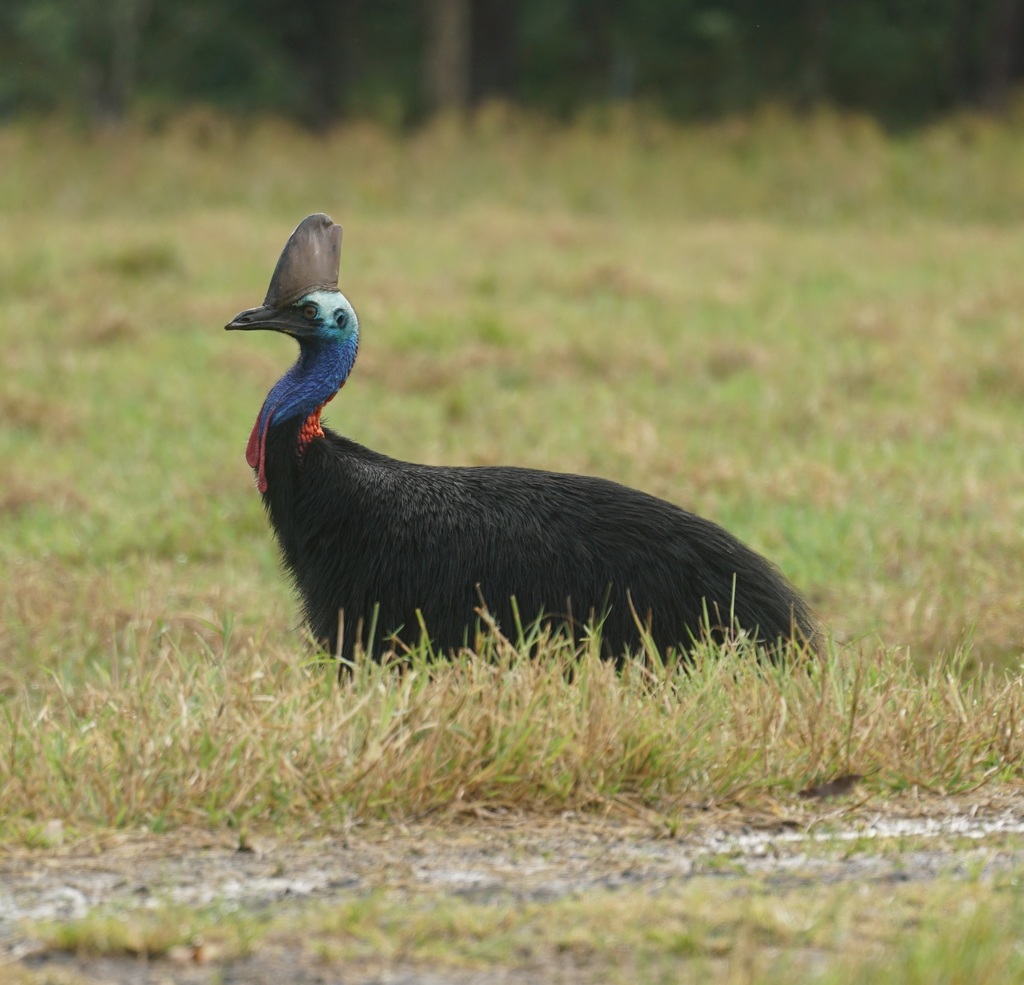
Southern Cassowary
Photo © Tim
Photo © Tim — CC BY 4.0 — Source: iNaturalist photo #164533906Identification
The southern cassowary is among the world's largest living birds, typically standing 1.5–1.8 m (4.9–5.9 ft) tall, with some individuals reaching 2 m (6 ft 6½ in) and weighing up to 85 kg (187 lb). This imposing flightless bird is instantly recognizable by its stiff, bristly black plumage combined with striking bare skin on the head and neck. The face is bright blue, while the long neck displays red colouring on the cape, complemented by two distinctive red wattles hanging down around the throat, each measuring up to 18 cm (7.1 in) in length—a feature that earns it the alternative name "double-wattled cassowary." Crowning the head is a horn-like brown casque measuring 13 to 20 cm (5.1 to 7.9 in) high. Females are notably larger and more dominant than males, with brighter bare parts, a longer casque, and a larger bill. Juveniles differ markedly, displaying soft, fuzzy, and striped plumage initially, before maturing into brown, hair-like feathers that eventually darken to the adult's glossy black.
The bird's most formidable feature is its powerful three-toed feet, equipped with a lethal dagger-like claw up to 12 cm (4.7 in) on the inner toe. These remarkable adaptations, combined with powerful legs capable of propelling the bird to speeds of 50 km/h (31 mph) and nearly 2 m (6.6 ft) vertical jumps, make the southern cassowary a truly impressive athlete among avian species.
Range & Habitat
The southern cassowary is found across Indonesia, Papua New Guinea, and northeastern Australia, inhabiting tropical rainforests as its primary habitat. The species may also venture into nearby savannah forests or mangrove stands when opportunity allows. Elevation preferences vary by region: in Australia, the bird typically remains below 1,100 m (3,600 ft), while populations in New Guinea favour elevations below 500 m (1,600 ft). The Australian population is listed as Endangered under both federal and Queensland state legislation, reflecting conservation concerns for this iconic species.
Behaviour & Diet
Southern cassowaries are solitary birds except during breeding season, when they pair in late winter or spring (though timing is highly variable). Males take sole responsibility for nest construction—building a ground-level mattress of herbaceous plant material 5 to 10 centimetres thick and up to 100 centimetres wide—and for incubating and raising the resulting chicks alone. Clutches typically consist of three or four bright pea-green eggs. During mating season, these birds produce thunderous calls; otherwise, they communicate through hissing and rumblings, while chicks make high-pitched contact whistles and chirps.
Foraging primarily on the forest floor, cassowaries seek fallen fruit and seeds, displaying the remarkable ability to safely digest fruits and seeds toxic to other animals. Their diet also includes fungi, insects, snails, small vertebrates such as fish, frogs, small birds and eggs, and small mammals, supplemented occasionally with carrion. When food becomes scarce, both wild and captive birds have been observed ingesting earth, likely to obtain supplementary minerals. Common fruits consumed include species from the palm, quandong, laurel, and myrtle families.
Best Time & Places to See It
Southern cassowaries inhabit tropical rainforests across Indonesia, Papua New Guinea, and northeastern Australia. For the best viewing opportunities, seek out primary rainforest habitats within the bird's range, particularly areas with fruiting trees during seasons of abundance. Breeding season in late winter and spring offers the chance to witness dramatic territorial behaviour and hear the species' distinctive thunderous calls, though these birds remain solitary for much of the year and can be challenging to locate.
Photography Tips
Photographing southern cassowaries requires patience and respect for their space. These powerful birds demand careful approach; their agility and formidable claws mean photographers should maintain a safe distance. Early morning visits to fruiting areas within their rainforest habitat offer the best chances of encounters. The bird's striking coloration—glossy black plumage contrasting with vibrant blue face and red wattles—photographs dramatically with natural rainforest lighting. Capture the distinctive casque and powerful build in profile to showcase the species' impressive size and prehistoric appearance. During breeding season, listening for their thunderous calls can help locate birds, though approach must be cautious and respectful of their solitary nature.
Herberton Range National Park
Australia
+115 birds+10 mammals
Rainforest-clad ridges and rocky outcrops define this 324-square-kilometre reserve in far north Queensland, where the mountainous terrain of the Herberton Range rises through layered eucalypt woodland…
VIEW NATIONAL PARKDaintree National Park
Dedin, Australia
+362 birds+37 mammals
Daintree National Park is one of the world’s oldest and most biologically diverse tropical rainforests, protecting an extraordinary landscape where ancient forests meet the Great Barrier…
VIEW NATIONAL PARKManusela National Park
Maluku Tengah, Indonesia
+112 birds+3 mammals
Across the Maluku Tengah district of Indonesia's eastern archipelago, a sprawling expanse of 4,175 square kilometers of largely intact tropical forest rises from coastal lowlands toward…
VIEW NATIONAL PARKGirringun National Park
Australia
+231 birds+10 mammals
Where granite gorges cleave through subtropical woodland in North Queensland, Girringun National Park unfolds across rugged terrain shaped by millions of years of weathering and erosion.…
VIEW NATIONAL PARKWooroonooran National Park
Australia
+240 birds+28 mammals
Where the Great Dividing Range rises sharply inland from Queensland's tropical coast, Wooroonooran National Park encompasses a landscape of steep, forested gorges and cascading waterways carved…
VIEW NATIONAL PARKNo community photos yet. Log in to add the first one.
No community observations of this species yet.