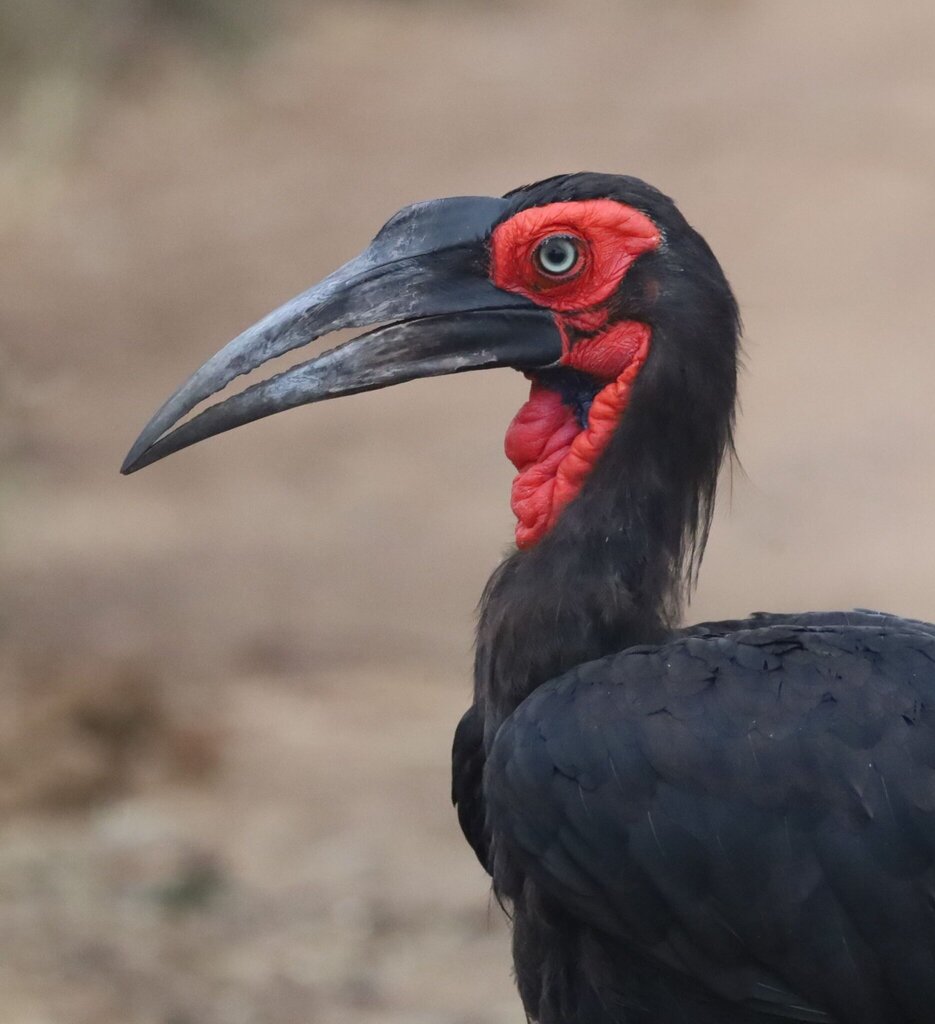
Southern Ground Hornbill
Photo © Paul Hoekman
Photo © Paul Hoekman — CC BY 4.0 — Source: iNaturalist photo #504321591Identification
The southern ground hornbill is the largest species in the entire hornbill order worldwide, measuring 90 to 129 cm in length with a wingspan of 1.2 to 1.8 m. Males are noticeably larger than females, weighing 3.5 to 6.2 kilograms compared to females at 2.2 to 4.6 kilograms. These striking birds are entirely black except for vivid red patches of bare skin on the face and throat in adults—a feature that turns yellow in juveniles. One of the few birds with eyelashes, this adaptation is believed to keep dust from their eyes while foraging in dry conditions. In flight, look for the distinctive white tips on the primary feathers. The black, slightly curved beak sports a casque (a ridge-like structure) that is more prominent in males. Female southern ground hornbills are smaller and can be distinguished by their deep violet-blue throat patches, while juveniles under six years old display a duller grey patch rather than the prominent red pouch of adults.
Range & Habitat
Southern ground hornbills are found exclusively in Africa, ranging from Kenya and southern Burundi in the north, through Zimbabwe and northern Namibia and Angola, to South Africa in the south. They inhabit savannas and woodlands, though their specific requirements are quite particular: they need large, old trees for nesting cavities and areas with dense but short grass for foraging. Their range is limited at its western extent by the scarcity of suitable nesting trees. Today, these birds are mainly confined to national reserves and national parks, reflecting both their ecological requirements and conservation status.
Behaviour & Diet
Southern ground hornbills are carnivorous ground foragers that feed on reptiles, frogs, snails, insects, and small mammals up to the size of hares, making them apex predators of ecological importance. These highly social birds live in groups of 5 to 10 individuals and are remarkably vocal, using chorus calls that can be heard up to 3 kilometres away to maintain territories that may span as large as 100 square kilometres. Neighbouring groups often engage in aerial pursuits. Notably, these are obligate cooperative breeders—breeding pairs always require assistance from at least two other birds, and birds must gain at least six years of experience helping at nests before they can breed successfully themselves. Southern ground hornbills are exceptionally long-lived, with lifespans of 50–60 years in the wild and up to 70 years in captivity, though they do not reach sexual maturity until 4–6 years old and typically begin breeding around 10 years of age.
Best Time & Places to See It
Kruger National Park in South Africa is the premier destination for viewing southern ground hornbills, where they are listed among the park's celebrated 'Big Six' bird species. These birds are most active during the breeding season, which begins at the start of the wet season when they lay their eggs. The early morning hours, when groups are most vocal and engaged in foraging, offer excellent opportunities for observation. Because they maintain such large territories and their numbers have declined significantly due to habitat destruction, persecution, and cultural beliefs, sightings require patience and knowledge of local movements. Your guide will be invaluable in locating these vulnerable birds.
Photography Tips
The southern ground hornbill's striking appearance—jet-black plumage contrasting vividly with red or violet-blue facial skin—makes for compelling photography, though patience is essential given their vulnerable status and sparse distribution. Early morning light is ideal for capturing the glossy black feathers and the brilliant colouration of their bare facial patches. When birds are in flight, aim to capture the diagnostic white primary feather tips. The birds' large size and distinctive profile make them recognizable even at distance, but a good telephoto lens will allow you to capture the fine details: the eyelashes, the subtle differences between males and females, and the casque on the beak. Ground-level or slightly elevated positions work well for photographing these terrestrial foragers in their natural habitat.
Serengeti National Park
Tanzania
+558 birds+57 mammals
Across Tanzania's northern plateau, where volcanic soils meet acacia woodland and open grassland, unfolds one of Earth's most dynamic ecosystems. The Serengeti National Park sprawls across…
VIEW NATIONAL PARKArusha National Park
Tanzania
+555 birds+16 mammals
Where the slopes of Mount Mawenzi rise above the Arusha region, a compact yet ecologically rich national park unfolds across montane forest, moorland, and alpine zones.…
VIEW NATIONAL PARKMapungubwe National Park
Musina Local Municipality, South Africa
+358 birds+29 mammals
Where the Limpopo River cuts through sandstone ridges at the convergence of South Africa, Botswana, and Zimbabwe, Mapungubwe National Park preserves a landscape of profound ecological…
VIEW NATIONAL PARKChobe National Park
Botswana
+446 birds+45 mammals
Where the Chobe River cuts a sinuous path through northern Botswana, the landscape transforms into one of Africa's most dynamic wetland-savanna mosaics. This national park encompasses…
VIEW NATIONAL PARKNxai Pan National Park
Botswana
+226 birds+16 mammals
Across the northwestern reaches of Botswana stretches a landscape of profound seasonal transformation—a sprawling pan system where shallow depressions fill and empty with the rains, creating…
VIEW NATIONAL PARKKhaudum National Park
Botswana
+213 birds+13 mammals
Where the Okavango's northern tributaries meander through miombo woodland and riverine forest, Khaudum National Park unfolds across a landscape of profound ecological richness and isolation. This…
VIEW NATIONAL PARKTsavo East National Park
Athi ward, Kenya
+468 birds+50 mammals
Across the semi-arid lowlands of southeastern Kenya, where acacia woodland fragments into scrubland and the landscape rolls toward the Indian Ocean horizon, lies one of Africa's…
VIEW NATIONAL PARKTsavo West National Park
Mwatate, Kenya
+513 birds+49 mammals
Where volcanic ridges and weathered lava flows meet the semi-arid lowlands of south-central Kenya, Tsavo West National Park unfolds across a landscape sculpted by fire and…
VIEW NATIONAL PARKAmboseli National Park
Etonet/Lenkism ward, Kenya
+501 birds+43 mammals
Where the Amboseli basin opens toward the Tanzanian frontier, a shallow alkaline lake mirrors vast skies across one of East Africa's most iconic savanna landscapes. The…
VIEW NATIONAL PARKTarangire National Park
Tanzania
+527 birds+50 mammals
Acacia woodland and grassland sweep across the Manyara Region where the Tarangire River carves through low hills and volcanic soils, creating one of East Africa's most…
VIEW NATIONAL PARKNgorongoro Conservation Area
Tanzania
+626 birds+55 mammals
Volcanic calderas and open grassland dominate this high plateau in northern Tanzania, where the landscape rises above 2,000 metres and ancient geological forces have shaped both…
VIEW WILDLIFE MANAGEMENT AREAKruger National Park
Ba-Phalaborwa Local Municipality, South Africa
+540 birds+91 mammals
Across the low-lying savanna of northeastern South Africa unfolds one of Africa's largest and most ecologically intact protected areas, where acacia woodlands merge into mopane scrub…
VIEW NATIONAL PARKAddo Elephant National Park
Sundays River Valley Local Municipality, South Africa
+388 birds+55 mammals
Where the Eastern Cape's semi-arid scrublands meet transitional woodland, Addo sprawls across 13,478 square kilometres of one of southern Africa's most biodiverse landscapes. The terrain rises…
VIEW NATIONAL PARKIthala Game Reserve
uPhongolo Local Municipality, South Africa
+328 birds+26 mammals
Rolling thornbush savanna and acacia woodland dominate the landscape of this 494-square-kilometre national park in KwaZulu-Natal's uPhongolo Local Municipality, where granite outcrops punctuate grassland plateaus and…
VIEW NATIONAL PARKKhaudum National Park
Namibia
+221 birds+13 mammals
Where the Kavango River flows through northeastern Namibia, vast miombo woodlands and riverine forests create one of southern Africa's most remote and biodiverse wilderness corridors. Khaudum…
VIEW NATIONAL PARKNkasa Rupara National Park
Namibia
+283 birds+17 mammals
Where the Zambezi's floodplains spill across the border between Namibia and Botswana, Nkasa Rupara National Park unfolds across 518 square kilometers of wetland and woodland mosaic.…
VIEW NATIONAL PARKBwabwata National Park
Namibia
+377 birds+35 mammals
Where the Kavango River winds through northeastern Namibia, vast floodplains and dense riparian woodland create one of southern Africa's most ecologically dynamic protected landscapes. Spanning 14,249…
VIEW NATIONAL PARKMakgadikgadi Pans National Park
Gucta, Botswana
+272 birds+27 mammals
Where salt-crusted flatlands stretch endlessly toward a shimmering horizon, one of Africa's most extraordinary ecosystems awakens with the rains. The Makgadikgadi Pans comprise vast mineral-rich basins…
VIEW NATIONAL PARKLake Nakuru National Park
Nakuru West, Kenya
+494 birds+32 mammals
Alkaline waters ringed by acacia woodland and grassland create one of East Africa's most distinctive wetland ecosystems, where the interplay of geology and climate sustains a…
VIEW NATIONAL PARKHell’s Gate National Park
Olkaria ward, Kenya
+388 birds+18 mammals
Volcanic scarps and geothermal vents dominate the floor of Hell's Gate, where the East African Rift has carved a dramatic gorge through crystalline rock formations. The…
VIEW NATIONAL PARKChyulu Hills National Park
Kibwezi East, Kenya
+232 birds+30 mammals
Volcanic cones rise abruptly from the Kenyan savanna floor, their flanks clothed in dense acacia woodland and grassland that transforms the Chyulu Hills into an ecological…
VIEW NATIONAL PARKNo community photos yet. Log in to add the first one.
No community observations of this species yet.