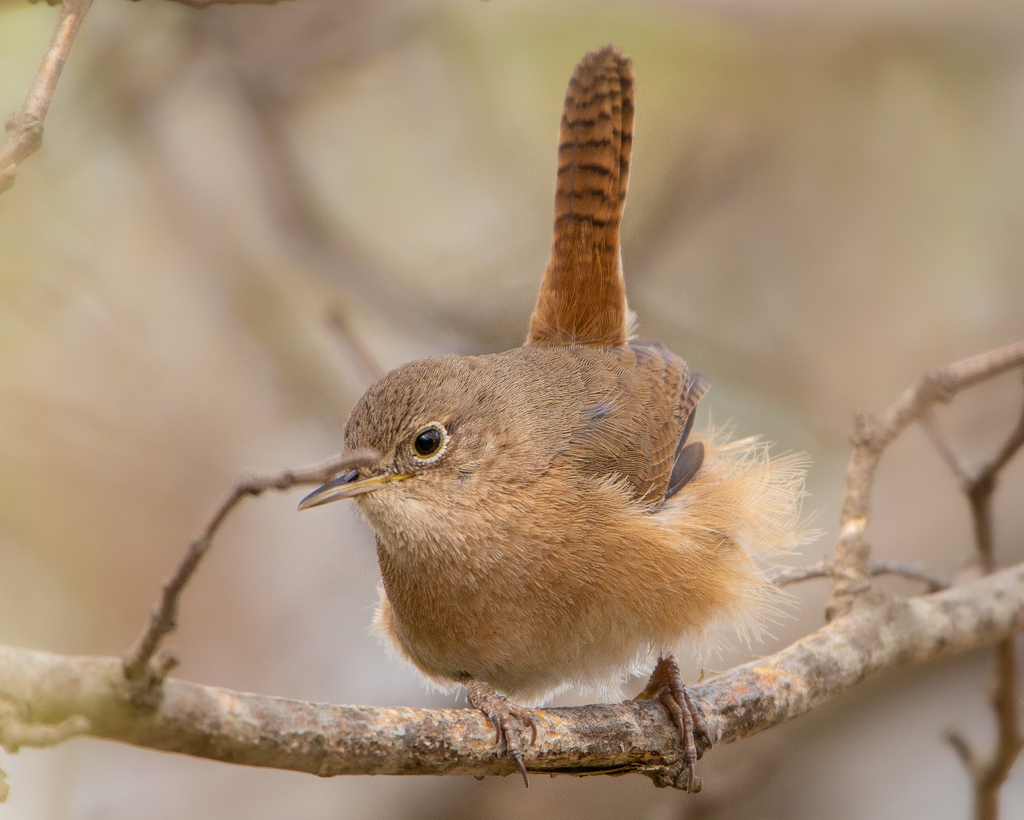
Southern House Wren
Photo © Nicolás Villaseca Merino
Photo © Nicolás Villaseca Merino — CC BY-SA 4.0 — Source: iNaturalist photo #230074325Identification
The southern house wren is a very small passerine bird belonging to the wren family Troglodytidae. Its scientific name, Troglodytes, means "hole dweller"—a fitting description for a bird with a remarkable tendency to disappear into crevices and tight spaces when hunting insects or seeking shelter. The specific epithet musculus is Latin for "little mouse," aptly capturing the bird's diminutive size and mouse-like behaviour as it forages through vegetation and architectural crevices.
Range & Habitat
The southern house wren is found across a vast geographic range extending from southern Mexico through Central America, across South America, and down to southern Chile and southern Argentina. This extraordinarily wide distribution is reflected in the recognition of twenty-one subspecies, each showing subtle variations in plumage and morphology adapted to their respective regions. From the Yucatán Peninsula and Costa Rica in the north to the temperate forests and grasslands of Patagonia in the south, this adaptable species has colonized diverse habitats across the Americas.
In subtropical montane forests, such as those found in northwestern Argentina and similar elevated terrain, the southern house wren is a familiar resident. Its ability to thrive across such varied climates and elevations demonstrates remarkable ecological flexibility, allowing it to inhabit everything from lowland tropical regions to cool, high-altitude forests.
Behaviour & Diet
The southern house wren is an insectivorous forager, actively hunting through crevices and dense vegetation for its prey. Its hole-dwelling habits extend beyond mere shelter-seeking; the bird regularly disappears into tight spaces while hunting, utilizing its small body size to access food sources unavailable to larger birds.
Breeding behaviour varies with geography. In subtropical montane forests, the southern house wren breeds during the rainy summer months, from late October to late December. Population studies in Argentina have revealed interesting dispersal patterns: females disperse more frequently between seasons than males, and widowed or unpaired males show higher dispersal rates than paired males. Notably, predation pressure on nestlings appears relatively light in some populations, with predation losses being almost insignificant in certain regions like the Southern Andean Yungas.
Best Time & Places to See It
For travellers wishing to encounter the southern house wren, the breeding season in subtropical montane forests—late October through late December—offers excellent opportunities to observe active, territorial birds. The species' wide distribution means it can be found across numerous locations throughout its range, from Mexican highlands to Argentine foothills. Habitat selection should focus on areas with abundant crevices, dense vegetation, and suitable breeding cavities, where the bird's characteristic hole-dwelling behaviour can be observed.
Photography Tips
Photographing the southern house wren requires patience and attention to its cryptic habits. Position yourself near areas with natural crevices, hollow trees, or human structures where the bird is likely to forage. The bird's tendency to disappear into tight spaces means you should remain still and watch for sudden appearances. Early morning during the breeding season will yield the most active behaviour. Use a fast shutter speed to capture the bird as it darts between cover, and be prepared for challenging lighting conditions as these wrens often forage in shadowed areas near crevices and vegetation.
Full-day Birds of the desert
Nothing matches these filters.
Alerce Costero National Park
Amacayacu National Park
Amazônia National Park
Anavilhanas National Park
Antisana National Park
Araucárias National Park
Arenal Volcano National Park
Bahuaja Sonene National Park
Barbilla National Park
Nothing matches these filters.
No community photos yet. Log in to add the first one.
No community observations of this species yet.