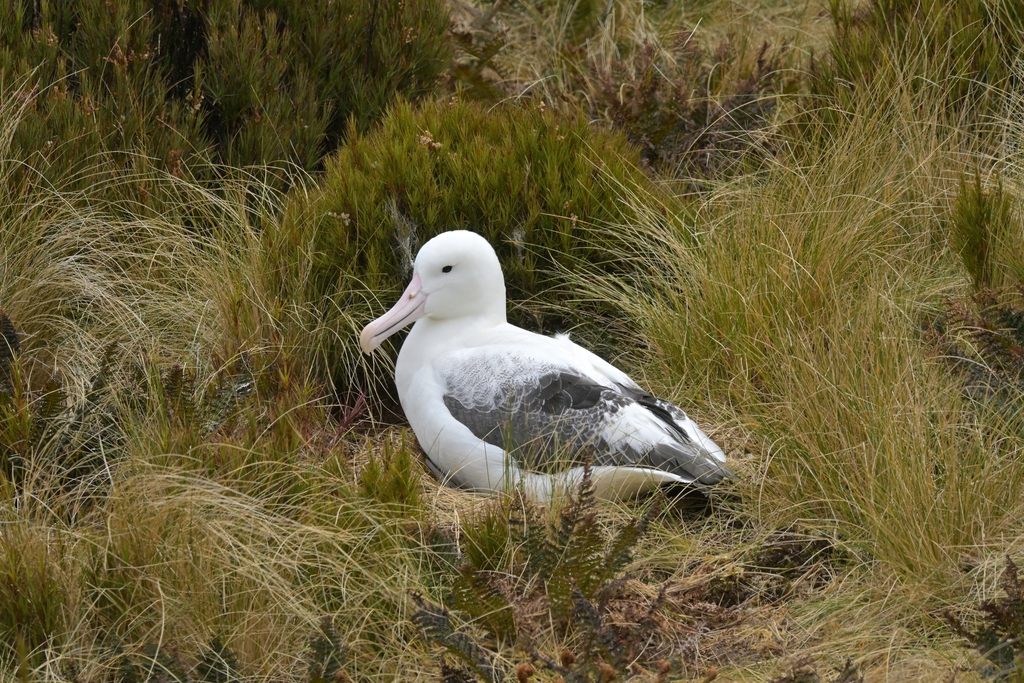
Southern Royal Albatross
Photo © Christopher Stephens
Photo © Christopher Stephens — CC BY-SA 4.0 — Source: iNaturalist photo #359965852Identification
The southern royal albatross is a massive seabird with an average wingspan exceeding 3 metres, making it one of the two largest albatross species alongside the wandering albatross. Adults measure 112–123 cm in length and average around 9 kg, with males significantly heavier than females. They display a striking clean black and white plumage pattern: white head, neck, upper mantle, rump and underparts contrast sharply with dark brown or black wings. The bill is distinctively pink with black cutting edges on the upper mandible, and legs are flesh-coloured. Juveniles are similar but gradually acquire white markings on the upperwing, starting as speckles from the leading edge. Unlike wandering albatrosses, southern royals lack the characteristic peach neck spot and have a cleaner overall appearance.
Key field marks include the pale bill with dark median stripe, the clean white-and-black wing pattern, and the white tail except for a black tip. Young birds with all-dark upperwings can resemble northern royal albatrosses, but the two species are now recognized as distinct. These magnificent birds can live an average of 58 years.
Range & Habitat
Southern royal albatrosses are found primarily between 30° and 45° South, ranging across the southern oceans with concentrations along the west and east coasts of southern South America and in waters surrounding New Zealand. The majority of the global population—approximately 8,200 to 8,600 pairs—nests on the rat-free subantarctic Campbell Island. Smaller colonies exist on Adams Island and Enderby Island in the Auckland Islands, with combined populations of around 67 pairs. The species favours tussock grassland, plateaus, and ridges for nesting.
Behaviour & Diet
Southern royal albatrosses are highly social during breeding season, attracting mates through elaborate displays including bill-snapping, clapping, gulping, and dramatic sky-calling with outstretched wings. They feed primarily on squid and fish, supplemented by smaller amounts of carrion, crustaceans, and salps. Foraging typically occurs within a 1,250 km radius of breeding sites, though they travel vast distances across open ocean. Unlike wandering albatrosses, they tend to forage in shallower waters closer to continental shelves.
Breeding is strictly biennial, with pairs laying a single egg in November or December on tussock grassland or elevated terrain. Both parents share incubation duties and chick-rearing responsibilities. Fledging takes approximately 240 days, after which young birds are independent. When provisioning chicks, adults range south to the Campbell Plateau and north to the Chatham Rise.
Best Time & Places to See It
Campbell Island is the premier destination for observing southern royal albatrosses, hosting the vast majority of the world population. The breeding season from November through the following September offers the best viewing opportunities, with peak activity during the incubation and early chick-rearing phases. Access to Campbell Island is restricted and typically requires special permission, but guided wildlife expeditions occasionally visit. Waters off the New Zealand coast, particularly around the Auckland Islands and along the southern approaches, offer opportunities to encounter these albatrosses at sea during their foraging voyages.
Photography Tips
Photographing southern royal albatrosses requires patience and proper planning. At sea, use fast shutter speeds (1/2000s or faster) to freeze the dynamic wing movements during take-off and landing. The bird's predominantly white plumage requires careful exposure metering to avoid blown highlights; bracket exposures and use spot metering on the darker wing and back areas. The pink bill and flesh-coloured legs provide striking colour accents—ensure adequate lighting to render these details clearly.
On land during breeding season, shoot from low angles to emphasize the bird's massive size and impressive wingspan. Early morning and late afternoon light enhances the clean black-and-white contrast. Use longer focal lengths (400–600mm) to maintain safe distances and avoid disturbance. Capture behavioural sequences: courtship displays, incubation changes, and chick feeding all provide compelling documentary images of this vulnerable species.
Cabo de Hornos National Park
Elsehul Bay
Fiordland National Park
Fortuna Bay
Murrell Farm
Prion Island
Rakiura National Park
Sea Lion Island
Nothing matches these filters.
No community photos yet. Log in to add the first one.
No community observations of this species yet.