Identification
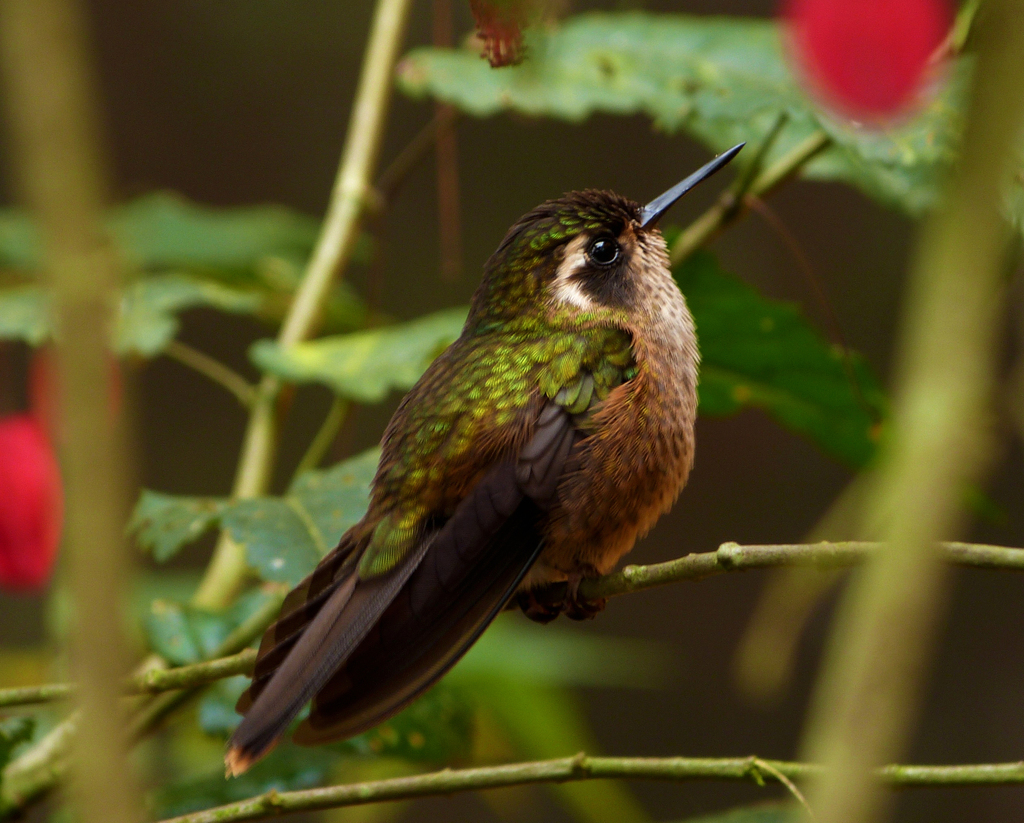
The Speckled Hummingbird is a small, compact hummingbird measuring approximately 8 cm in length. This is a monomorphic species, meaning males and females are visually identical, which simplifies field identification. The upper plumage is glossy green and bronze, while the underside is pale with distinctive green and bronze speckling that gives the species its common name. A striking black cheek patch below the eye is framed by a white stripe above, providing a key field mark for identification.
Range & Habitat
The Speckled Hummingbird is endemic to the Andes Mountains, occurring across Colombia, Venezuela, Ecuador, Peru, Bolivia, and Argentina. The species inhabits montane cloud forests between 1,000 and 2,500 meters elevation, though in Ecuador it shows remarkable altitudinal flexibility, ranging from subtropical forests at 1,400 m to cloud forests at 3,000 m. Notably, an isolated population exists in the Chongón Colonche cordillera in coastal evergreen montane forest at just 600 meters, approximately 130 km from the main Andean range. Genetic evidence suggests that populations on either side of the Andes are distinct, highlighting the species' adaptation to diverse montane environments.
Behaviour & Diet
The Speckled Hummingbird is a solitary, predominantly sedentary species that neither flocks nor migrates, though individuals may disperse to lower altitudes after breeding. Males play no role in nest construction or chick rearing, disengaging after copulation. Females construct bulky, cup-shaped nests from moss and cobweb, lined with plant fibre, typically placing them 1–3 meters high on moss-covered trunks, rocky ridges, or cave entrances. Clutches consist of two white eggs with an incubation period of 17–20 days, followed by 7–8 days of brooding after hatching. The species feeds primarily on nectar from short-tubed flowers or at the base of longer flowers, often foraging near the ground. Unusually for hummingbirds, they feed solitarily rather than congregating at flowering trees, and they likely supplement their diet with small insects caught on or near the nest.
Best Time & Places to See It
The Speckled Hummingbird is a very common species at moderate elevations in the Andes, with nests found year-round. The species is particularly abundant above Cali, Colombia, where densities reach at least 10–12 pairs per km². Travellers visiting Andean cloud forests in Ecuador, Peru, Colombia, or Venezuela between 1,400 and 3,000 meters elevation have excellent chances of encountering this species. The species' solitary feeding behaviour and preference for lower flowers make it accessible to observers exploring montane forest understory and edges.
Photography Tips
The Speckled Hummingbird's small size and solitary foraging behaviour present both challenges and opportunities for photographers. Position yourself near flowering plants at mid-canopy level and lower, where the species typically feeds. The glossy green and bronze upper plumage and pale, speckled underside photograph well in overcast cloud forest light, which is typical of its habitat. Focus on capturing the distinctive black cheek patch and white stripe above the eye. Since females tend the nest alone and may visit repeatedly, patient observers who locate a nest site can achieve compelling behavioural and nesting images. The species' habit of perching motionless near its nest after brooding provides opportunities for detailed portraiture.