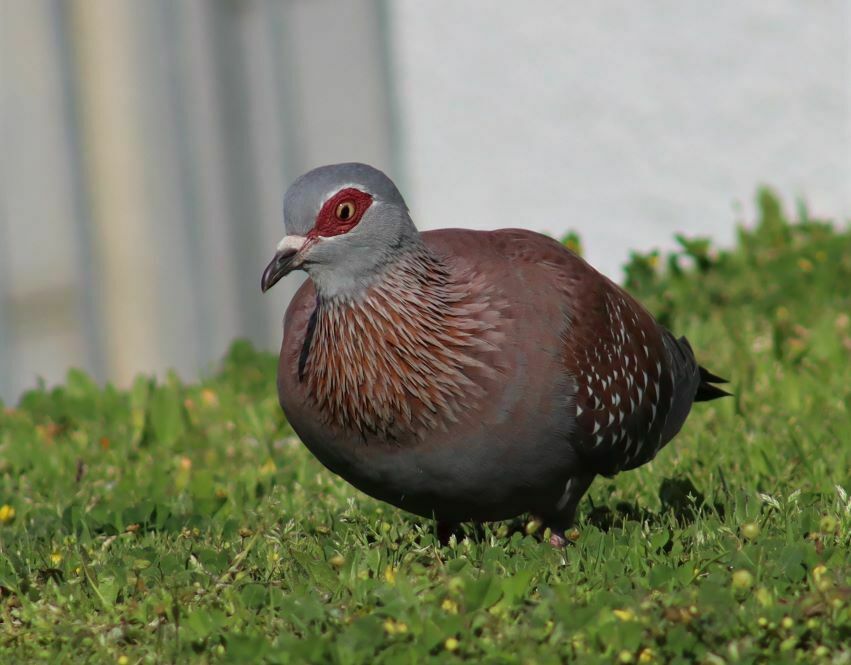
Speckled Pigeon
Photo © Dave Brown
Photo © Dave Brown — CC0 1.0 — Source: iNaturalist photo #232418988Identification
The speckled pigeon is a medium-sized pigeon, measuring 32–35 cm in length and roughly comparable in size to the rock dove and stock dove. Its most distinctive features are its rufous back and wings, which are heavily speckled with white spots, contrasting with blue-grey upperparts and underparts. The head is grey with striking red patches of bare skin around the eye, while the neck is brownish and streaked with white. Its legs are bright red. The sexes are similar in appearance, though immatures are browner overall and lack the characteristic red eye patches of adults. When heard, the speckled pigeon produces a loud, repetitive doo-doo-doo call.
Range & Habitat
The speckled pigeon is a resident breeding bird found throughout much of Africa south of the Sahara, though its distribution includes sizable gaps. Two recognised subspecies occur across the continent: C. g. guinea ranges from Mauritania to Ethiopia and south to the Democratic Republic of the Congo and northern Malawi, while C. g. phaeonota occupies southwestern Angola, Zimbabwe, and South Africa. This species is common and widespread in open habitats across much of its range and is frequently encountered around human habitation and cultivation.
Behaviour & Diet
The speckled pigeon is primarily herbivorous, with most of its diet consisting of vegetable matter. It gathers in large numbers in areas where grain or groundnuts are available, making it a conspicuous presence in agricultural landscapes. The species exhibits the characteristic quick, strong flight typical of pigeons, with regular wingbeats punctuated by occasional sharp flicks. Breeding birds construct large stick nests on protected rocky outcrops, and in urban areas they readily adapt by nesting atop covered pergola pillars and on flat roofs under deep eaves. Each clutch consists of two white eggs.
Best Time & Places to See It
The speckled pigeon's status as a common and widespread resident means it can be encountered year-round throughout its range in suitable habitat. Look for it in open country and around human settlements, particularly in areas with grain cultivation or groundnut farms where birds congregate in larger numbers. Rocky outcrops and urban areas with suitable nesting structures are reliable locations. Its association with human habitation makes it accessible to travellers visiting towns, villages, and farmland across sub-Saharan Africa.
Photography Tips
The speckled pigeon's striking plumage—particularly the rufous, white-speckled wings contrasting against grey-blue body feathers and the distinctive red eye patches—makes it a rewarding photographic subject. The bird's frequent presence around human habitation means it is often relatively approachable. Capture the bright red facial skin patches and eye-ring in good light to show these diagnostic features clearly. Its rapid, characteristic flight with sharp wing flicks offers dynamic shooting opportunities for those skilled in tracking moving birds. Photographing flocks gathering at grain or groundnut sources can yield compelling images of gregarious behaviour.

Nothing matches these filters.
Bwindi Impenetrable National Park
Lake Mburo National Park
Mabamba Swamp
Murchison Falls National Park
Queen Elizabeth National Park
Aberdare National Park
Abijata-Shalla Lakes National Park
Addo Elephant National Park
Agulhas National Park
Nothing matches these filters.
No community photos yet. Log in to add the first one.
No community observations of this species yet.