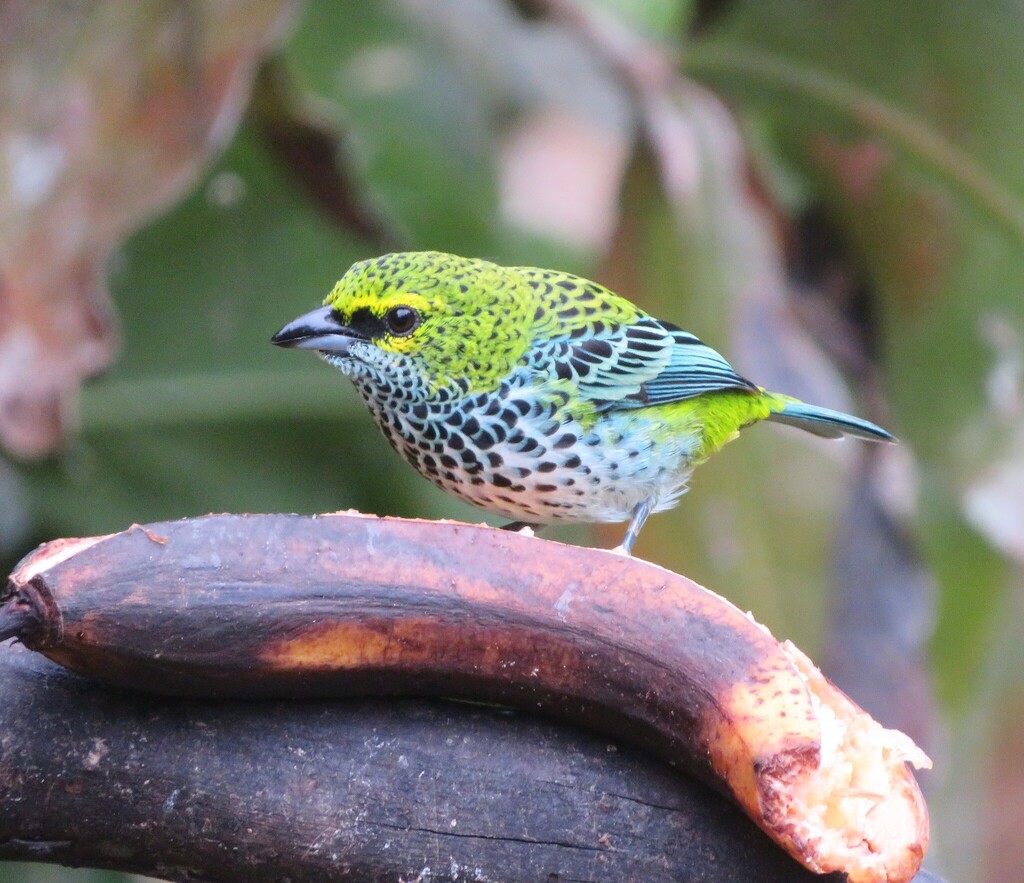
Speckled Tanager
Photo © sprcrkwild
Photo © sprcrkwild — CC BY 4.0 — Source: iNaturalist #337508757Identification
The Speckled Tanager is a medium-sized passerine measuring 13.2 cm in length and weighing just 18 grams. Despite its diminutive size, it is remarkably distinctive. The bird's upperparts are green adorned with black spotting, while its face is bright yellow marked by a characteristic black line running from the eye to the gape. The wings and tail are black but elegantly edged with green, and the white underparts are peppered with black spots. The sexes are similar in appearance, making identification straightforward for both male and female birds.
The Trinidadian subspecies, I. g. trinitatis, displays particularly striking plumage with brighter and more extensive yellow on the head and more conspicuous black spotting overall. In the field, listen for the species' weak metallic chirping call, described as a soft tsip, which can help confirm identification when visual sighting proves difficult in dense forest canopy.
Range & Habitat
The Speckled Tanager is a resident breeder across northern South America and Central America, with populations established in Costa Rica, Panama, Trinidad, Venezuela, Colombia, Guyana, Suriname, and northern Brazil. Sight records also exist from French Guiana. The species is closely related to the Spotted Tanager, which occupies ranges to the south, and these two species are generally considered fully allopatric, though recent evidence suggests they may occasionally overlap at the boundaries of their ranges.
This is predominantly a subtropical species that favours humid montane and secondary forest environments. Unlike some relatives, the Speckled Tanager prefers areas with generally not-very-tall trees and a dense understory, making it well-adapted to the varied forest types across its range rather than strictly primary forest canopy.
Behaviour & Diet
Speckled Tanagers are highly social birds, frequently encountered in mixed-species flocks with bay-headed tanagers and honeycreepers. Their diet consists mainly of fruit, supplemented by insects, making them important seed dispersers within their forest habitats. This fruit-eating specialization influences their behaviour and movement patterns throughout the year.
During breeding season, females construct small cup nests in trees and typically lay a clutch of two white eggs marked with brown blotches. The female alone incubates the eggs for 13 days until hatching, then both parents presumably contribute to chick-rearing for a further 15 days before the young fledge, though specific details of post-hatching parental care are limited.
Best Time & Places to See It
Travellers seeking the Speckled Tanager should focus on humid montane forests and secondary growth areas throughout its range. The species' preference for mid-storey and understory levels makes it more accessible than canopy-dwelling tanagers, though patience and attention remain necessary. Its social nature means that finding one individual often leads to observing multiple species within a mixed flock, rewarding the attentive birder with broader biodiversity encounters.
The breeding season is likely the best period for observation, as nesting activities and territorial behaviour increase visibility. Areas in Trinidad, Colombia, and Venezuela represent particularly accessible locations for northern hemisphere travellers seeking this subtropical species.
Photography Tips
The Speckled Tanager's small size and preference for dense understory vegetation present considerable photographic challenges. Position yourself at or below eye level with the forest understory to maximize opportunities. The bird's bright yellow face and contrasting black markings photograph well in overcast conditions typical of montane forests, which provide soft, even lighting that reveals plumage details without harsh shadows.
Since these birds are social and often move in flocks, patience at promising feeding sites—particularly fruiting trees—increases encounter probability. Early morning typically offers the best light and highest activity levels. A telephoto lens of at least 300mm is essential given the species' size and the typical forest viewing distances involved.
Manuel Antonio National Park
Quepos, Costa Rica
+426 birds+22 mammals
Where tropical rainforest descends steeply to a rocky Pacific coastline, Manuel Antonio National Park distills Central American biodiversity into one of Costa Rica's most compressed and…
VIEW NATIONAL PARKArenal Volcano National Park
Peñas Blancas, Costa Rica
+551 birds+21 mammals
Straddling the border between Alajuela and Guanacaste in northwestern Costa Rica, this national park rises dramatically around one of Central America's most active volcanic systems. The…
VIEW NATIONAL PARKChirripó National Park
Rivas, Costa Rica
+274 birds+6 mammals
Where the volcanic spine of Costa Rica's Central Cordillera reaches its apex, Chirripó National Park encompasses a landscape that shifts dramatically with elevation, from montane cloud…
VIEW NATIONAL PARKBraulio Carrillo National Park
Las Horquetas, Costa Rica
+547 birds+18 mammals
Where the Caribbean slope descends from the central volcanic cordillera toward the humid lowlands of Heredia, Braulio Carrillo National Park preserves one of Costa Rica's most…
VIEW NATIONAL PARKNatural Serranía de los Yariguíes National Park
El Carmen de Chucurí, Colombia
+320 birds+3 mammals
Where the northern cordilleras of Colombia rise toward cloud forest, the Serranía de los Yariguíes unfolds across nearly 1,820 square kilometers of some of the most…
VIEW NATIONAL PARKNatural el Cocuy National Park
Güicán, Colombia
+313 birds+3 mammals
Where the Andes rise to their highest peaks in Colombia's eastern cordillera, El Cocuy National Park sprawls across more than 6,600 square kilometers of some of…
VIEW NATIONAL PARKGuácharos Cave National Natural Park
Acevedo, Colombia
+359 birds
High in the Andean foothills of southern Huila, where mist-laden slopes rise above 1,600 metres, lies a landscape carved by underground rivers and crowned by karst…
VIEW NATIONAL PARKNatural Sumapaz National Park
Cubarral, Colombia
+368 birds+1 mammals
Where the Andes descend toward the Amazon basin, the high páramo grasslands of Sumapaz National Park sprawl across more than five thousand square kilometers of Meta…
VIEW NATIONAL PARKEl Tamá National Park
Toledo, Colombia
+435 birds
Where the Andes descend toward the Caribbean coastal lowlands of northern Colombia, El Tamá National Park sprawls across nearly 3,800 square kilometres of montane forest, cloud…
VIEW NATIONAL PARKNatural Sierra de la Macarena National Park
Vista Hermosa, Colombia
+566 birds+15 mammals
Across nearly 20,000 square kilometres of Colombia's Meta Department, the terrain rises from lowland savanna into Andean foothills through a mosaic of gallery forests, palm-fringed wetlands,…
VIEW NATIONAL PARKMonte Roraima National Park
Brazil
+226 birds+1 mammals
Where the tepuis rise from the Amazon basin like islands in a sea of forest, Monte Roraima National Park sprawls across 3,714 square kilometres of one…
VIEW NATIONAL PARKBaru Volcano National Park
Cerro Punta, Panama
+402 birds+6 mammals
Where the land rises sharply toward the Caribbean's western spine, Baru Volcano National Park sprawls across roughly 220 square kilometres of southwestern Panama, anchored by the…
VIEW NATIONAL PARKGeneral de División Omar Torrijos Herrera National Park
La Pintada, Panama
+401 birds+2 mammals
Across the highlands of central Panama, where the continental divide funnels moisture-laden trade winds into steep river valleys, the terrain rises and falls in a landscape…
VIEW NATIONAL PARKSoberanía National Park
Cristóbal, Panama
+495 birds+34 mammals
Rainforest and riverine woodland blanket the rolling terrain of this 714-square-kilometre national park in Colón Province, where the Caribbean watershed feeds a maze of streams and…
VIEW NATIONAL PARKChagres National Park
Caimitillo, Panama
+486 birds+19 mammals
Where the Chagres River carves through the humid tropics of central Panama, a vast montane and lowland forest sprawls across more than 2,300 square kilometers, anchoring…
VIEW NATIONAL PARKDarién National Park
Tucutí, Panama
+534 birds+13 mammals
Where the spine of Central America crumbles into wetland and rainforest, Darién National Park sprawls across more than 20,000 square kilometres of some of the tropics'…
VIEW NATIONAL PARKParque Internacional la Amistad
Teribe, Panama
+325 birds+11 mammals
Where the continental divide rises between the Caribbean and Pacific watersheds, a wilderness of extraordinary biological richness unfolds across the Talamanca Range and into lowland rainforest—a…
VIEW NATIONAL PARKLos Quetzales National Park
Copey, Costa Rica
+232 birds+3 mammals
Cloud forest sweeps across the upper slopes of the Central Valley watershed, where elevation and persistent moisture forge an ecosystem unlike any other in Costa Rica.…
VIEW NATIONAL PARKTapantí Macizo de la Muerte National Park
Orosi, Costa Rica
+503 birds+18 mammals
Where montane cloud forest rises steeply from the Orosi Valley, Tapantí Macizo de la Muerte National Park enfolds a landscape of perpetual moisture and emerald complexity.…
VIEW NATIONAL PARKLa Amistad International Park
Crorina, Costa Rica
+532 birds+20 mammals
Where the Caribbean slopes of Costa Rica's Talamanca Mountains rise steeply inland from Limón, the boundary between two nations dissolves into an unbroken expanse of rainforest.…
VIEW NATIONAL PARKMarino Ballena National Park
Bahía Ballena, Costa Rica
+336 birds+8 mammals
Where mangrove forests meet coral-fringed shorelines along Costa Rica's southern Pacific coast, Marino Ballena National Park encompasses a marine and terrestrial mosaic that ranks among Central…
VIEW NATIONAL PARKNo community photos yet. Log in to add the first one.
No community observations of this species yet.