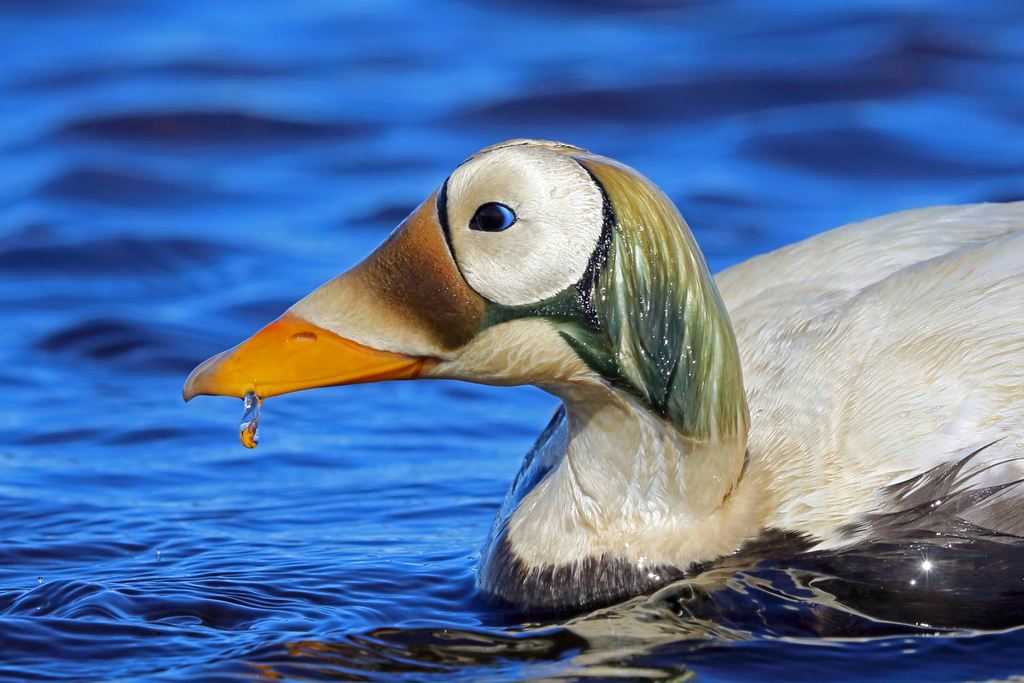
Spectacled Eider
Photo © Nigel Voaden
Photo © Nigel Voaden — CC BY 4.0 — Source: iNaturalist #2629861Identification
The spectacled eider is a large sea duck measuring 52–57 cm (20.5–22.5 in) in length, slightly smaller than the common eider. Males are unmistakable with their striking plumage: a black body, white back, and yellow-green head adorned with the species' most distinctive feature—large circular white eye patches that resemble spectacles. These dramatic facial markings give the bird its common name and make identification straightforward for any observer.
Females present a different appearance, with rich brown plumage, but can still be readily distinguished from other duck species by their large size and robust structure. The paler goggles around the eyes are visible with a reasonable view and confirm identification. Immature birds and eclipse adult males resemble females in plumage. Males produce a weak crooning call, while females utter a harsh croak.
Range & Habitat
Spectacled eiders breed on the coasts of Alaska and northeastern Siberia, with two breeding populations in Alaska and one in Russia. Historically, Alaska supported larger breeding numbers, but the Russian population is now considerably larger. The United States population comprises an estimated 3,000–4,000 nesting pairs. These ducks inhabit frigid coastal areas and breed near ponds where females construct nests on raised ridges called hummocks.
After breeding, spectacled eiders molt at sea between 2 and 45 kilometers from shore, north of 63°N. Because they remain so closely tied to their breeding grounds, their wintering locations in the Bering Sea remained mysterious until satellite telemetry revealed them in 1995. They are rarely encountered outside their breeding range, making them difficult to study outside their remote Arctic home.
Behaviour & Diet
As diving ducks, spectacled eiders forage by swimming and diving underwater, and are believed capable of remaining submerged longer than most diving duck species. At sea, they primarily feed on mollusks, while on breeding grounds they consume aquatic insects, crustaceans, and plant material. Breeding pairs form during winter on the molting grounds through elaborate male displays and female selection, then migrate to nesting sites in spring.
Females build nests lined with plant materials and feathery down, often reusing the same nest in subsequent years. They incubate an average of three to six olive-buff colored eggs for 24 days. Chicks leave the nest shortly after hatching and are led to water by the female, who provides protection while they forage independently. Young spectacled eiders develop rapidly, achieving flight in approximately 53 days or less.
Best Time & Places to See It
The spectacled eider's remote Arctic breeding range in Alaska and northeastern Siberia limits accessibility for most observers. Breeding season is the most reliable time to encounter these ducks on their coastal nesting grounds. Their inaccessible habitat—frigid, remote coastal areas—means sightings are uncommon even for dedicated birders. Wintering birds gather in the Bering Sea, but viewing opportunities there are similarly challenging.
Researchers and specialized Arctic expeditions offer the best chance of encountering this elusive species. The spectacled eider's threatened status and preference for undisturbed breeding habitat make encounters a privilege rather than an expectation for most nature travelers.
Photography Tips
Photographing spectacled eiders presents significant challenges due to their remote habitat and limited accessibility. The dramatic facial markings of males—those distinctive white eye patches contrasting against yellow-green plumage—offer striking photographic subjects when opportunity allows. The rich brown tones of females require careful exposure management to capture detail in both highlights and shadows.
Arctic lighting conditions, including extended daylight during breeding season, provide excellent opportunities for photography during expeditions. Patience and distance are essential, as spectacled eiders are wary birds in their undisturbed habitat. Capturing behavioral moments—females with broods or males displaying—requires long lenses and respectful positioning that avoids disturbing these vulnerable, threatened birds.
Forlandet National Park
Vera, Norway
+38 birds+12 mammals
Windswept Arctic tundra meets jagged coastal cliffs where the Barents Sea crashes against Norway's northernmost wilderness. This sliver of protected terrain on the Nordkapp Peninsula comprises…
VIEW NATIONAL PARKSt. Paul Island
Saint Paul, United States
+255 birds+8 mammals
Windswept tundra rolls across this remote Pribilof island, where volcanic basalt cliffs plunge into the Bering Sea and fog rolls in thick enough to erase the…
VIEW PROTECTED LANDSCAPEAlaska Maritime National Wildlife Refuge
Alaska, United States
+391 birds+58 mammals
Where the North Pacific collides with Alaska's rugged coastline, a sprawling archipelago of islands, rocky outcrops, and coastal headlands forms one of North America's most remote…
VIEW WILDLIFE SANCTUARYYukon Delta National Wildlife Refuge
Bethel, United States
+156 birds+12 mammals
Across the Yukon Delta sprawls one of North America's most expansive coastal wetland sanctuaries, where the boreal subarctic climate strips down existence to essentials. This vast…
VIEW WILDLIFE SANCTUARYNo community photos yet. Log in to add the first one.
No community observations of this species yet.