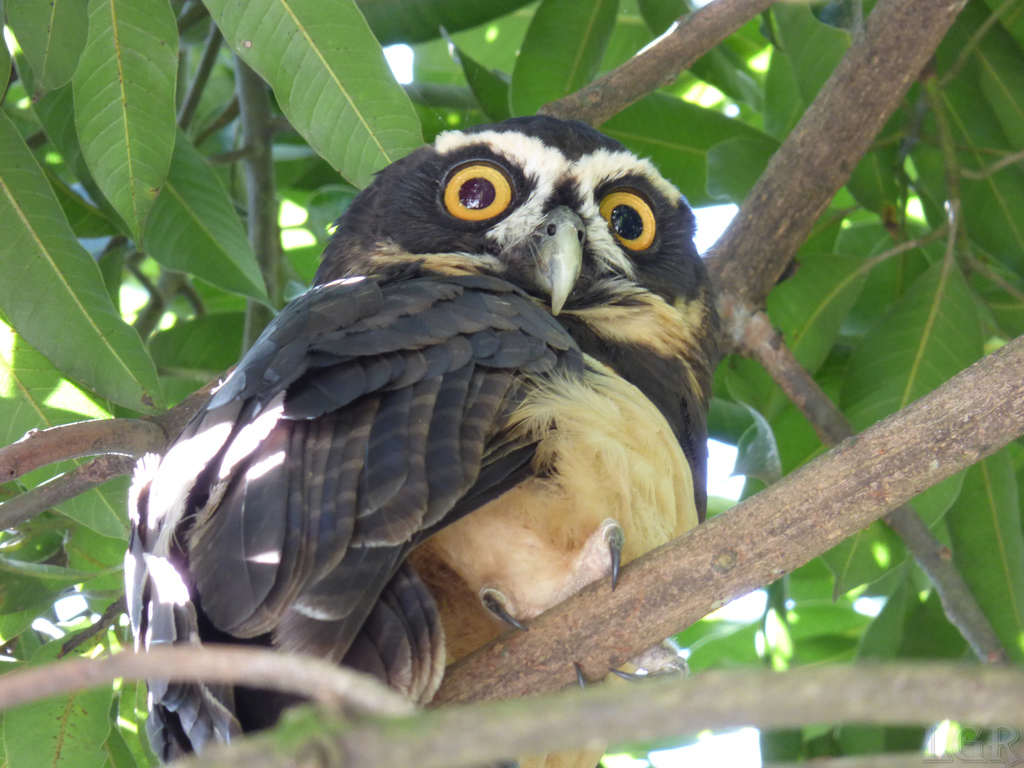
Spectacled Owl
Photo © Luis G Restrepo
Photo © Luis G Restrepo — CC BY 4.0 — Source: iNaturalist photo #13977911Identification
The Spectacled Owl is a large tropical owl, 41–52 cm in length, unmistakable within most of its range. It features blackish-brown upperparts and head contrasting sharply with distinctive white facial markings and yellowish-ochre underparts. The eyes are bright yellow—a unique field mark among Pulsatrix owls—and the beak is pale. The head is typically darker than the back, and a subtle breast band helps distinguish subspecies. Juveniles are remarkably different: almost entirely white except for a chocolate-brown facial disc, making them easily recognizable to experienced observers.
In areas where the Spectacled Owl's range overlaps with congeners, care is needed to distinguish it from the Band-bellied Owl, which has dark eyes, white eyebrows, and a brown chest band with buffy-whitish barring throughout, or the smaller Tawny-browed Owl with its ochraceous-tawny plumage and dark chestnut eyes.
Range & Habitat
This resident breeder ranges from southern Mexico and Trinidad through Central America (Belize, Guatemala, El Salvador, Honduras, Nicaragua, Costa Rica, and Panama) to South America, including Colombia, Venezuela, Guyana, Suriname, French Guiana, Ecuador, Peru, Bolivia, Brazil, Paraguay, and northwestern Argentina. Six subspecies are currently recognized, with slight plumage variations across their distributions.
The Spectacled Owl is primarily a bird of tropical rainforests, strongly preferring dense, old-growth forest. However, it adapts to secondary habitats including forest edges, especially when hunting, and occasionally inhabits dry forests, treed savannas, plantations, and semi-open woodlands. In montane regions such as Costa Rica, it reaches subtropical cloud forests up to 1,500 m (4,900 ft), though lowland forests remain its stronghold.
Behaviour & Diet
The Spectacled Owl is vocal and distinctive, particularly on calm, moonlit nights. The primary call consists of guttural knocking or tapping sounds with a popping effect, rendered as PUP-pup-pup-pup-po or BOO-boo-boo-boo, with each successive note becoming weaker, lower-pitched, and faster. Males sing from the upper branches of tall trees to proclaim territory, though females also vocalize in a higher pitch, and duets between pairs occur on moonlit nights. Females additionally produce a hawk-like scream with emphasis on a drawn-out second syllable, compared to a steam whistle. Young owls beg with harsh, high-pitched calls. The resemblance of the song to the tapping pattern of the Great Spotted Woodpecker has been noted in Colombia, and in Brazil the species is known locally as the "knocking owl."
Best Time & Places to See It
Search for Spectacled Owls in primary rainforests throughout the neotropics, from Central America to southern Brazil and Argentina. Dawn and dusk are productive times, but vocal activity peaks on calm, moonlit nights, when territorial males sing from emergent trees. Forest reserves with intact old-growth habitat offer the best opportunities. In Costa Rica, montane cloud forests at higher elevations provide an alternative habitat to explore.
Photography Tips
The Spectacled Owl's striking white facial markings and pale eye-ring provide excellent compositional elements. Photograph at dawn or dusk when the owl is most active. The pale beak and yellow eyes are key identifying features worth capturing in detail. If observing at night with a headlamp, use minimal light to avoid distressing the bird. The juvenile's distinctive white plumage with chocolate facial disc is highly photogenic—if you encounter one, prioritize capturing its unique appearance. Position yourself between the bird and forest gaps to maximize available light on the owl's face.
Guided Birding Tour
Nothing matches these filters.
Amacayacu National Park
Amazônia National Park
Anavilhanas National Park
Arenal Volcano National Park
Bahuaja Sonene National Park
Barra del Colorado National Wildlife Refuge
Braulio Carrillo National Park
Cahuita National Park
Calilegua National Park
Nothing matches these filters.
No community photos yet. Log in to add the first one.
No community observations of this species yet.