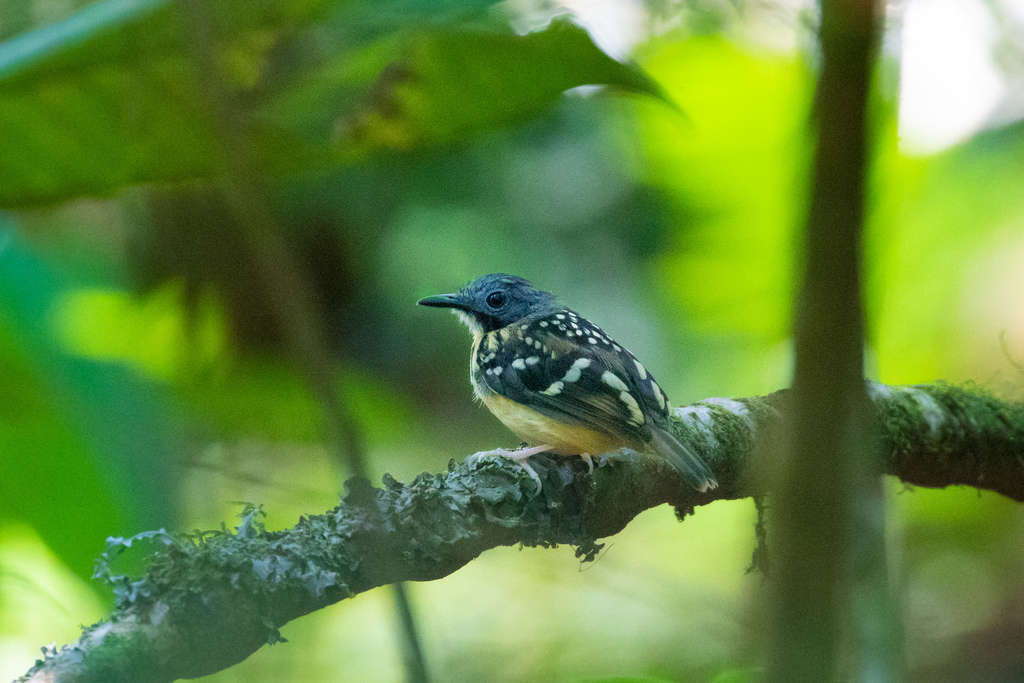
Spot-backed Antbird
Photo © Thibaud Aronson
Photo © Thibaud Aronson — CC BY-SA 4.0 — Source: iNaturalist photo #94375561Identification
The spot-backed antbird is a small passerine, measuring 10.5 to 11.5 cm in length and weighing just 11 to 14 grams. Males of the nominate subspecies display a dark yellowish-brown crown and nape, with distinctive black spotting on pale buff underparts and a striking white patch between the scapulars. The face is mostly gray, and the throat and lower neck are black. Females are similar but paler overall, with a white throat bordered by black and buff rather than white underparts. Juveniles lack the interscapular patch and breast spots, instead showing buffy-brown plumage with an olive-brown breast band. The species encompasses up to six recognized subspecies, which vary in crown color, back pattern, and underpart coloration—some showing olive-tinged plumage or ochre-yellow bellies rather than the white and buff of the nominate form.
Range & Habitat
This antbird is distributed across much of northern and central South America, found in Bolivia, Brazil, Colombia, Ecuador, French Guiana, Guyana, Peru, Suriname, and Venezuela. Different subspecies occupy distinct regions, from southeastern Ecuador and Peru in the west to the Atlantic coast in the east, with populations both north and south of the Amazon River depending on subspecies. The spot-backed antbird inhabits humid evergreen forest in lowlands and Andean foothills, showing a preference for terra firme, várzea, and transitional forest types as well as secondary woodlands. It favors the understorey, particularly near natural openings created by fallen trees and along watercourses, typically remaining below 700 meters in elevation though reaching 1,300 meters in parts of Brazil and Peru.
Behaviour & Diet
The spot-backed antbird is a year-round resident throughout its range. It feeds primarily on a diverse diet of insects and spiders, employing a mixed foraging strategy that includes occasional participation in army ant swarms—capturing roughly half its prey as insects flee the advancing ants—though it seldom follows swarms for extended periods. The bird sometimes associates loosely with mixed-species feeding flocks and forages as individuals, pairs, or small family groups, typically staying within 3 meters of the ground. It moves through semi-open understorey habitat, hopping among branches and capturing prey through sallies from perches to the ground, gleaning from foliage, and lunging at prey on leaves, twigs, and branches.
Best Time & Places to See It
The spot-backed antbird breeds year-round across its range, with breeding seasons varying geographically, making it potentially visible throughout the year. It can be found in humid lowland forests across its wide range, particularly in areas with well-developed understorey near fallen trees and watercourses. Travellers seeking this species should focus on primary and mature secondary forests in lowland regions of Venezuela, the Guianas, Colombia, Ecuador, Peru, Brazil, and Bolivia, concentrating their search in the understorey where the bird habitually forages.
Photography Tips
Photographing the spot-backed antbird presents the typical challenges of understorey forest birds: dim lighting and dense vegetation. Position yourself in semi-open understorey areas, particularly near natural gaps where light penetrates, to maximize both visibility and photographic opportunity. The bird's small size, low-altitude foraging habits, and tendency to hop along branches at modest heights offer advantages for patient photographers. Early morning when the bird is most active provides the best light conditions. Focus on capturing the distinctive spotted breast pattern of males and the contrasting white interscapular patch, which serve as key identification features. Since the bird often forages within a few meters of the ground and associates with mixed-species flocks, scanning actively for movement and listening for calls will increase your chances of locating and photographing this elusive antbird.
Yasuní National Park
Aguarico, Ecuador
+601 birds+43 mammals
Where the western Amazon basin converges with Ecuador's Orellana Province, lowland rainforest reaches toward the horizon in an unbroken canopy of staggering botanical density. Yasuní National…
VIEW NATIONAL PARKSumaco Napo-Galeras National Park
Loreto, Ecuador
+563 birds+4 mammals
Where Ecuador's Amazon transitions into cloud forest, a massive shield volcano rises from the emerald lowlands of Orellana Province, anchoring one of the continent's most biodiverse…
VIEW NATIONAL PARKNatural Sierra de Chiribiquete National Park
Solano, Colombia
+359 birds+27 mammals
Massive table-top mountains rise abruptly from the lowland rainforest of southeastern Colombia, their sheer sandstone cliffs and isolated summits creating some of the most dramatic topography…
VIEW NATIONAL PARKNatural la Paya National Park
Puerto Leguízamo, Colombia
+262 birds+4 mammals
Where the Amazon's western reaches fold into the Andes foothills, La Paya National Park sprawls across more than 8,500 square kilometers of pristine Amazonian rainforest in…
VIEW NATIONAL PARKNatural Sierra de la Macarena National Park
Vista Hermosa, Colombia
+566 birds+15 mammals
Across nearly 20,000 square kilometres of Colombia's Meta Department, the terrain rises from lowland savanna into Andean foothills through a mosaic of gallery forests, palm-fringed wetlands,…
VIEW NATIONAL PARKAmacayacu National Park
Leticia, Colombia
+567 birds+25 mammals
Where the Rio Amazonas curves through the tri-border region where Colombia, Peru, and Brazil converge, Amacayacu National Park sprawls across more than 5,250 square kilometres of…
VIEW NATIONAL PARKAmazônia National Park
Brazil
+439 birds+6 mammals
Where the Rio Amazonas and its tributaries weave through the heart of Pará state, a vast tapestry of rainforest stretches across 23,611 square kilometers of unbroken…
VIEW NATIONAL PARKMapinguari National Park
Brazil
+354 birds
Vast tracts of western Amazonian rainforest blanket the remote terrain of this 56,827 square kilometre national park in Amazonas state, where seasonal rivers wind through dense…
VIEW NATIONAL PARKJaú National Park
Brazil
+354 birds+3 mammals
Vast floodplain forests and blackwater rivers define this remote corner of western Amazonas, where the Rio Negro and its tributaries have carved an intricate mosaic of…
VIEW NATIONAL PARKPacaás Novos National Park
Brazil
+279 birds+1 mammals
Across the border between Rondônia and Amazonas, vast tracts of humid tropical forest rise and fall in gentle undulations, carved by clear-flowing rivers that feed into…
VIEW NATIONAL PARKAnavilhanas National Park
Brazil
+468 birds+8 mammals
Across the Rio Negro in central Amazonas, an archipelago of over a thousand islands rises from the world's largest rainforest river system, creating a labyrinth of…
VIEW NATIONAL PARKCampos Amazónicos National Park
Amazonas, Brazil
+434 birds+7 mammals
Sprawling across the southwestern Amazon basin in Amazonas state, this 27,263-square-kilometre national park encompasses some of the region's most pristine lowland rainforest, where terra firme forest…
VIEW NATIONAL PARKSerra do Divisor National Park
Brazil
+448 birds+10 mammals
Where the western Amazon meets the Andes foothills, Serra do Divisor National Park sprawls across one of South America's most biodiverse and least accessible frontiers. Spanning…
VIEW NATIONAL PARKYanachaga–chemillén National Park
Palcazu, Peru
+639 birds+6 mammals
Where the eastern slopes of Peru's central cordillera plunge into cloud forest, Yanachaga–Chemillén National Park protects nearly three thousand square kilometres of montane wilderness that few…
VIEW NATIONAL PARKManu National Park
Manu, Peru
+892 birds+26 mammals
Across the eastern slopes of the Peruvian Andes, tropical rainforest descends into the Amazon basin with a complexity that few terrestrial ecosystems match. Manu National Park…
VIEW NATIONAL PARKSierra del Divisor National Park
Alto Tapiche, Peru
+298 birds+2 mammals
Where the western Amazon meets the Andes foothills, nearly 41,000 square kilometres of pristine rainforest rise across Peru's Alto Tapiche region in a landscape of extraordinary…
VIEW NATIONAL PARKBahuaja Sonene National Park
San Pedro de Putina Punco, Peru
+602 birds+8 mammals
Where the Madre de Dios and Heath rivers converge in southeastern Peru rises one of South America's most biodiverse wilderness regions: a vast protected realm of…
VIEW NATIONAL PARKTingo Maria National Park
Mariano Dámaso Beraún, Peru
+423 birds
Where the eastern slopes of the Peruvian Andes descend toward the Amazon basin, the landscape fractures into a maze of limestone ridges, humid gorges, and cloud-wrapped…
VIEW NATIONAL PARKNo community photos yet. Log in to add the first one.
No community observations of this species yet.