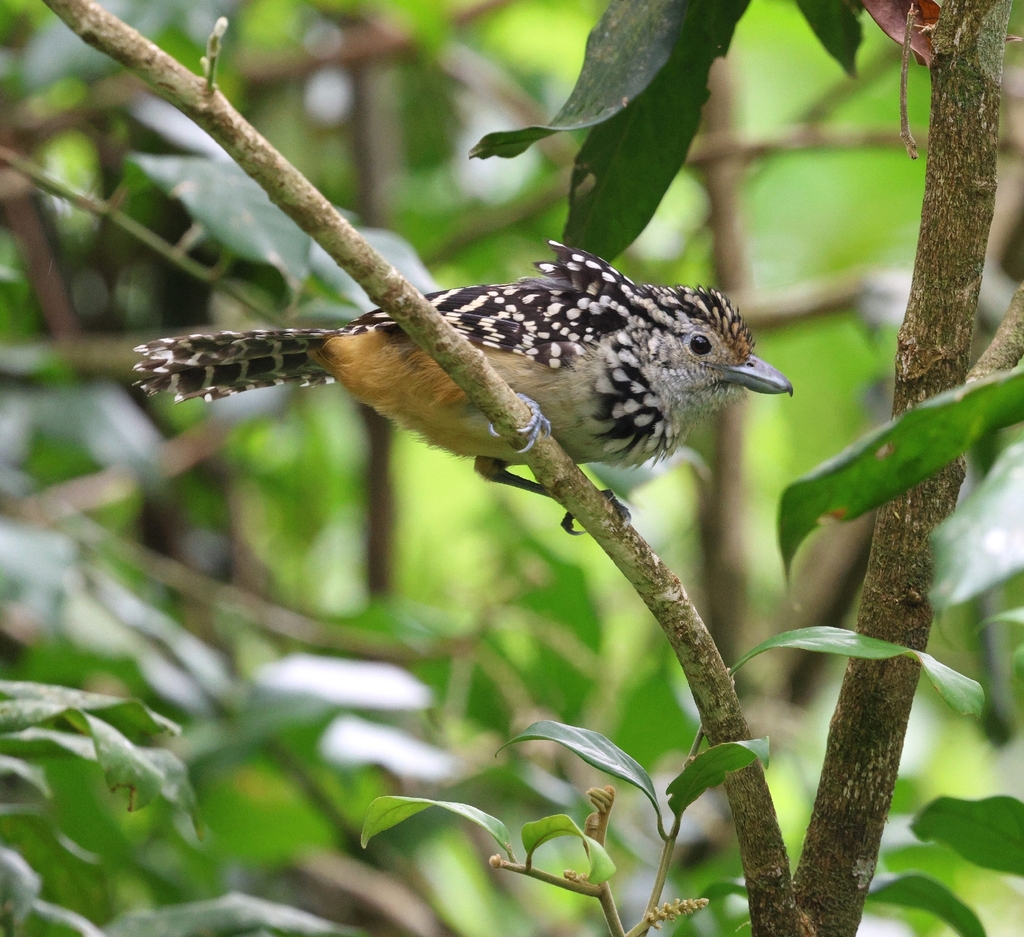
Spot-backed Antshrike
Photo © Miguel
Photo © Miguel — CC BY-SA 4.0 — Source: iNaturalist photo #605814418Identification
The spot-backed antshrike is a large antbird measuring 20 to 21 cm in length, characterized by a short, heavy gray bill with a distinctive hooked tip resembling that of true shrikes. The species exhibits slight sexual dimorphism. Adult males display a striking black crown, nape, and upperparts heavily spotted with white, along with a brownish-black tail featuring white barring. Their throat and breast are white with pale gray sides, while the belly and crissum are nearly white in northern populations, gradually darkening to brownish-yellow toward the southern extent of the range. Adult females follow a similar pattern but feature buff-colored spots on their upperparts and more extensive brownish-yellow coloring on their underparts.
Range & Habitat
The spot-backed antshrike is found exclusively in South America, ranging from eastern Alagoas in eastern Brazil southward to northern Rio Grande do Sul, and through eastern Paraguay into northeastern Argentina's Misiones Province. This species is endemic to the Atlantic Forest, where it inhabits the subcanopy and canopy layers of lowland evergreen forest. It shows a strong preference for wetter areas with dense vines and abundant vegetation, occurring from sea level to approximately 900 meters elevation.
Behaviour & Diet
The spot-backed antshrike is presumed to be a year-round resident throughout its range. It feeds opportunistically on insects, arthropods, snails, and possibly small vertebrates including tree-frogs and lizards. The bird typically forages in pairs, usually between 8 and 15 meters above the ground, and occasionally participates in mixed-species feeding flocks. It moves sluggishly through dense vines and vegetation, gleaning prey from leaves—particularly those of bromeliads and epiphytic ferns—as well as from stems and branches. Notably, it has been observed following army ant swarms, dropping to lower levels to capture insects disturbed by the ants.
The species' song is described as a very high, slow rattle lasting four or five seconds, initially rising then descending with a shivering quality. Its calls include a long, downward-inflected whistle, a shorter slightly descending churr, and an abrupt chip sound. Eggs are white with lilac dots and larger blackish spots, though little else is known about its breeding biology.
Best Time & Places to See It
The spot-backed antshrike occurs in several protected areas throughout the Atlantic Forest region and appears generally rare outside of these reserves. As a year-round resident, it can potentially be encountered in any season, though the dense forest habitat and preference for wetter areas with thick vegetation make this a challenging species to locate. The bird's occurrence in protected areas suggests that visiting established nature reserves within its range in Brazil, Paraguay, and Argentina offers the best opportunities for encounters.
Photography Tips
Photographing the spot-backed antshrike presents considerable challenges due to its preference for dense vegetation and canopy habitats. The species typically forages between 8 and 15 meters above ground in thick vines and vegetation, requiring patience and careful positioning. Its sluggish movement through dense cover offers occasional opportunities, though backlit conditions are common in the shaded subcanopy. The distinctive spotted back pattern and contrasting plumage of males provide good identifying features when visibility permits. Listening for its characteristic high, shivering rattle can help locate individuals, allowing photographers to anticipate movement and positioning.
Tijuca National Park
Brazil
+317 birds+13 mammals
Where the Atlantic forest rises steeply from Rio de Janeiro's urban edge, Tijuca National Park encompasses a landscape of dramatic granite peaks, cascading waterfalls, and closed-canopy…
VIEW NATIONAL PARKItatiaia National Park
Brazil
+519 birds+12 mammals
Where granite peaks pierce the Atlantic rainforest canopy in southeastern Brazil, Itatiaia National Park rises as one of the country's oldest and most ecologically vital protected…
VIEW NATIONAL PARKSuperagui National Park
Brazil
+246 birds+2 mammals
Where the Atlantic rainforest meets the subtropical coast of Paraná, Superagui National Park sprawls across more than 1,000 square kilometres of one of Brazil's most biodiverse…
VIEW NATIONAL PARKSaint-Hilaire/Lange National Park
Brazil
+225 birds
Subtropical Atlantic forests rise and fall across the plateaus of inland Paraná, where Saint-Hilaire/Lange National Park protects nearly 578 square kilometres of Brazil's most biodiverse woodland…
VIEW NATIONAL PARKSerra do Itajaí National Park
Brazil
+227 birds+2 mammals
Where the Atlantic rainforest rises steeply from the coastal plains of Santa Catarina, Serra do Itajaí National Park spreads across 1,136 square kilometres of montane wilderness…
VIEW NATIONAL PARKSerra da Bocaina National Park
Brazil
+441 birds+5 mammals
Where the escarpment of the Serra da Bocaina rises sharply from the Atlantic coastal plain, tropical rainforest cloaks steep mountainsides that climb toward peaks exceeding 2,000…
VIEW NATIONAL PARKIguaçu National Park
Brazil
+387 birds+17 mammals
Where the Paraná Plateau plunges toward the Atlantic watershed, six thousand square kilometers of subtropical rainforest cling to steep gorges and river valleys in this corner…
VIEW NATIONAL PARKSão Joaquim National Park
Brazil
+222 birds+9 mammals
Where the southern Brazilian highlands rise above the Atlantic Forest, São Joaquim National Park protects nearly 1,000 square kilometers of montane terrain that shifts between temperate…
VIEW NATIONAL PARKSerra dos Órgãos National Park
Brazil
+446 birds+13 mammals
Granite peaks thrust skyward through the Atlantic Forest canopy in the mountains immediately north of Rio de Janeiro, their bare rock faces rising above a landscape…
VIEW NATIONAL PARKIguazú National Park
Puerto Iguazú, Argentina
+346 birds+15 mammals
Where the Paraná Plateau plunges toward the Atlantic watershed, nearly 800 square kilometers of subtropical rainforest drape across Misiones Province in a landscape carved by millennia…
VIEW NATIONAL PARKNo community photos yet. Log in to add the first one.
No community observations of this species yet.