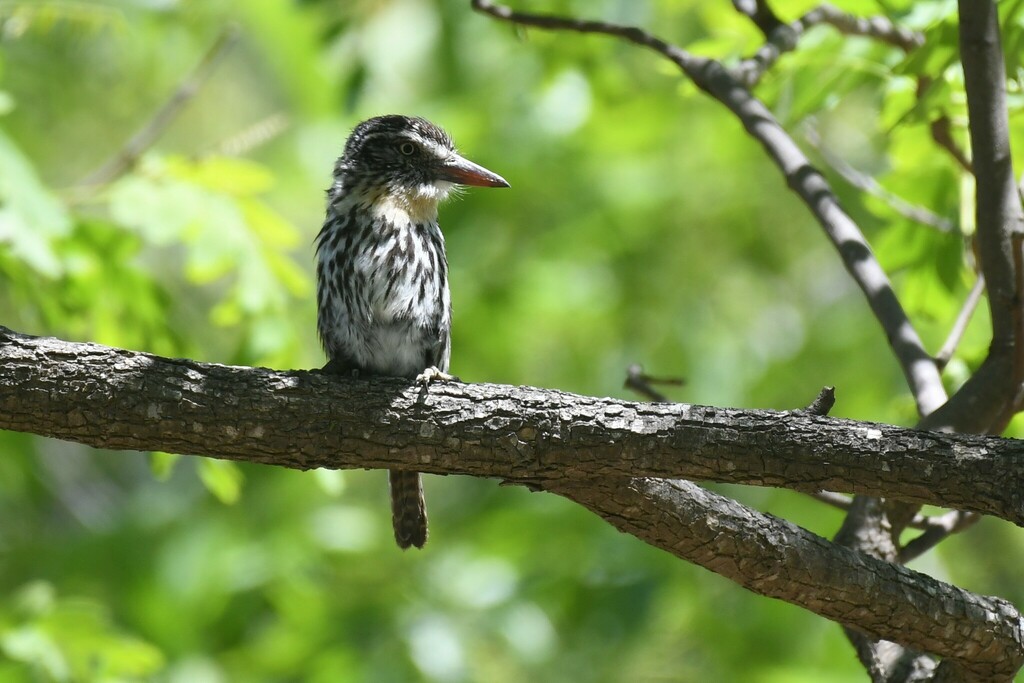
Spot-backed Puffbird
Photo © Tristan Jobin
Photo © Tristan Jobin — CC BY 4.0 — Source: iNaturalist photo #248094314Identification
The Spot-backed Puffbird is a small bird, measuring 18 to 19 cm in length and weighing 32 to 38 grams. Despite its diminutive size, it is quite distinctive in appearance. The bird features a dark brown crown adorned with bold buffy spangles, and a pale rufous collar on the hindneck. Its upperparts and wing coverts are dark brown with buffy spangles and bars, while the long, narrow tail displays broad black and narrow buffy bars. The face is mostly off-white with dusky streaks that intensify toward the rear, complemented by a buffy supercilium. A striking feature is the orange-red coloring of the throat, upper breast, and sides of the neck, which contrasts sharply with the white chin and remaining white underparts. The upper breast bears bold black spots, and the flanks are streaked with black. The bill is mostly red, the eye is pale yellow, and the feet are brownish olive.
Range & Habitat
The Spot-backed Puffbird is found across a vast region of South America, ranging from northeastern Brazil to northwestern Argentina, with populations also occurring in central and eastern Bolivia and Paraguay. This puffbird is a resident of lowland and foothill cerrado, caatinga, and campo regions—open and semi-open landscapes that characterize much of central and eastern South America. The species inhabits a variety of semi-open environments including the interior and edges of deciduous woodland, savanna, palm groves, shrub- and scrublands, and pastures. It is thought to be resident year-round throughout most of its range, though some seasonal wandering may occur in certain areas.
Behaviour & Diet
The Spot-backed Puffbird employs a sally-hunting technique, launching from a low perch to capture prey on the ground or among foliage. Its diet consists primarily of insects, with caterpillars being a particularly important food source. The bird produces a distinctive undulating song described as "tewre-tewtewretewtewre," often performed as a duet or by three birds together, making it audible to attentive observers in its habitat.
Breeding biology remains incompletely documented, but the species nests in leaf-lined cavities within soil banks or level ground. Clutch sizes typically comprise two or three eggs, suggesting a modest reproductive output consistent with small puffbird species.
Best Time & Places to See It
The Spot-backed Puffbird appears to be common throughout its extensive range and maintains a stable population, making it a reliable species for travelers visiting appropriate habitats across central and eastern Brazil, Bolivia, Paraguay, and northwestern Argentina. Its preference for semi-open landscapes such as cerrado, caatinga, and campo regions means it can often be found in accessible areas. Since the species is year-round resident, viewing opportunities exist throughout the year, though vocalizing birds may be most conspicuous during breeding season when their duetting calls ring out across scrubland and savanna.
Photography Tips
Photographers should focus on the bird's distinctive orange-red throat and breast area, which provides strong color contrast against the pale underparts and white face. The black spots on the upper breast and flank streaks are diagnostic field marks worth capturing in clear detail. Early morning light is ideal for highlighting the subtle buffy spangles on the crown and upperparts. Since the species hunts from low perches in semi-open habitat, patient observation of likely lookout points—dead branches, shrub tops, or exposed ground perches—will yield optimal opportunities for photography. The undulating song is an auditory cue that can help locate singing individuals during the breeding season.
Serra do Cipó National Park
Brazil
+379 birds+5 mammals
Where granite escarpments rise above the Atlantic Forest transition zone in southeastern Brazil, Serra do Cipó National Park unfolds across a landscape of dramatic ridges, cascading…
VIEW NATIONAL PARKUbajara National Park
Brazil
+122 birds+1 mammals
Granite peaks rise sharply from the humid tropical forests of northeastern Brazil, where Ubajara's 234 square kilometres straddle the transition between Atlantic rainforest and drier cerrado…
VIEW NATIONAL PARKSerra do Teixeira National Park
Brazil
+160 birds+5 mammals
Rugged plateaus and deep escarpments define this 3,112-square-kilometre sweep of the Brazilian Northeast, where the crystalline bedrock of the Borborema Plateau rises abruptly from the surrounding…
VIEW NATIONAL PARKSerra da Capivara National Park
Brazil
+156 birds+6 mammals
Across the semi-arid plateaus and deeply incised canyons of northeastern Brazil, where Piauí's ancient sandstone formations rise and fall in weathered waves, Serra da Capivara National…
VIEW NATIONAL PARKSete Cidades National Park
Brazil
+125 birds+1 mammals
Sete Cidades sprawls across 113 square kilometres of northeastern Brazil's interior plateau, where weathered sandstone formations rise dramatically from the cerrado landscape. The park's geology tells…
VIEW NATIONAL PARKChapada dos Guimarães National Park
Brazil
+450 birds+1 mammals
Where weathered sandstone plateaus rise above the cerrado grasslands of central Brazil, Chapada dos Guimarães National Park protects 624 square kilometres of ecological transition zone that…
VIEW NATIONAL PARKChapada dos Veadeiros National Park
Brazil
+324 birds+6 mammals
Where granite plateaus rise above the cerrado savanna in central Brazil, Chapada dos Veadeiros National Park unfolds across 6,665 square kilometres of some of the world's…
VIEW NATIONAL PARKPantanal Matogrossense National Park
Brazil
+322 birds+17 mammals
Where the flooded forests of central Brazil meet vast seasonally inundated grasslands, Pantanal Matogrossense National Park sprawls across nearly 2,900 square kilometers of one of the…
VIEW NATIONAL PARKLençóis Maranhenses National Park
Brazil
+98 birds+2 mammals
Where white sand dunes rise in dramatic ridges across a coastal lowland, Lençóis Maranhenses National Park reveals one of Brazil's most otherworldly landscapes. Spanning 3,670 square…
VIEW NATIONAL PARKChapada Diamantina National Park
Brazil
+346 birds+5 mammals
Where granite peaks and sandstone cliffs rise abruptly from the Brazilian interior, Chapada Diamantina National Park sprawls across 4,215 square kilometers of some of Brazil's most…
VIEW NATIONAL PARKCatimbau National Park
Brazil
+118 birds+6 mammals
Where sandstone plateaus rise from the semi-arid scrublands of northeastern Brazil, Catimbau National Park unfolds across more than 1,000 square kilometres of geological drama and surprising…
VIEW NATIONAL PARKBrasília National Park
Plano Piloto, Brazil
+338 birds+15 mammals
Cerrado grassland and scattered woodland sweep across the central Brazilian plateau where this national park sprawls across more than a thousand square kilometres of the Federal…
VIEW NATIONAL PARKEl Rey National Park
Municipio de Las Lajitas, Argentina
+317 birds+4 mammals
Where the eastern slopes of the Andes descend into northwestern Argentina's subtropical transition zone, El Rey National Park unfolds across 841 square kilometers of dramatically varied…
VIEW NATIONAL PARKCalilegua National Park
Municipio de Calilegua, Argentina
+288 birds+8 mammals
Where the eastern Andean slopes plunge into northwestern Argentina's humid subtropics, nearly 2,645 square kilometers of steep terrain and luxuriant forest compose one of South America's…
VIEW NATIONAL PARKSierra de las Quijadas National Park
Argentina
+168 birds+5 mammals
Sandstone cliffs and deeply incised canyons define this 1,137-square-kilometre expanse in San Luis Province, where the dry Chacoan landscape of central Argentina reveals an unexpected ecological…
VIEW NATIONAL PARKParque Provincial Pampa del Indio
Laguna Limpia, Argentina
+231 birds+4 mammals
Across the flat horizons of Chaco Province, where the Paraná River system spills into vast wetlands and grasslands, Parque Provincial Pampa del Indio protects one of…
VIEW NATURE RESERVENo community photos yet. Log in to add the first one.
No community observations of this species yet.