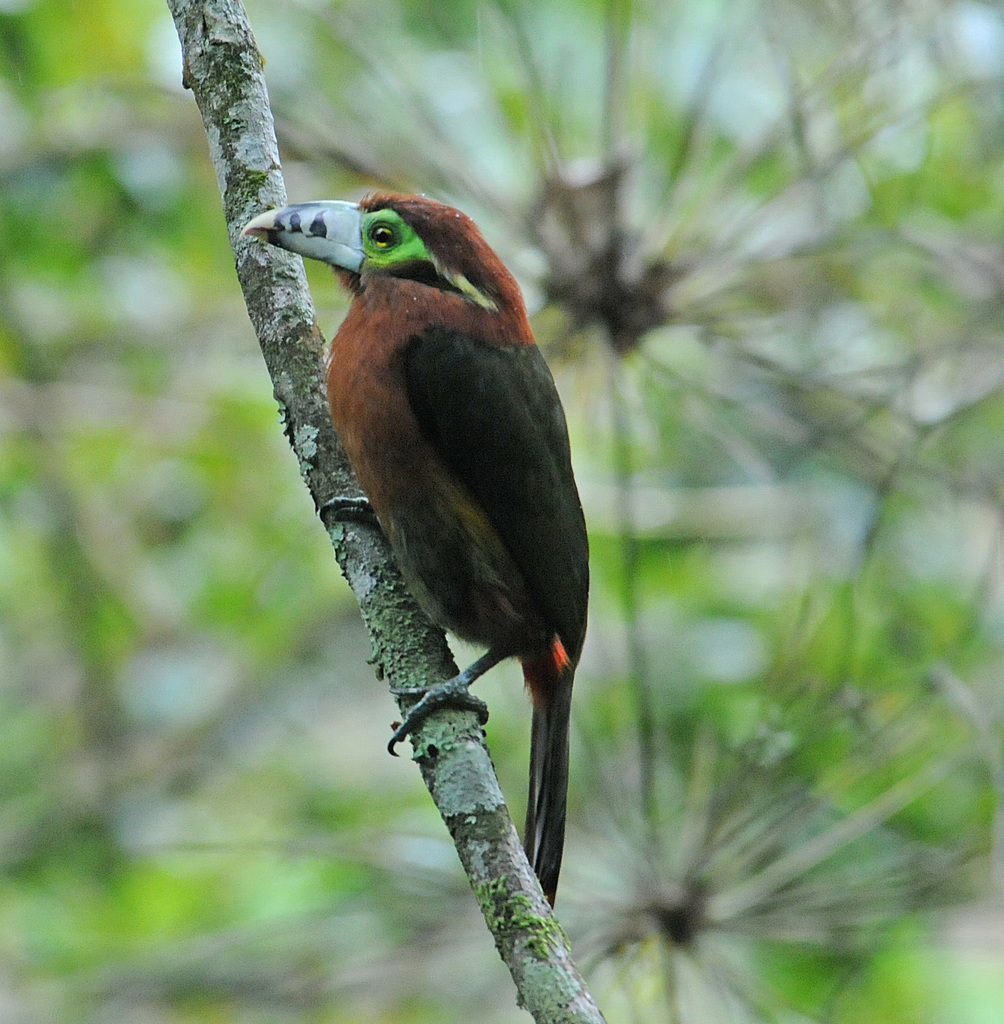
Spot-billed Toucanet
Photo © Todd Boland
Photo © Todd Boland — CC BY 4.0 — Source: iNaturalist #67583542Identification
The spot-billed toucanet is a compact toucan measuring 33 to 37 cm in length and weighing 137 to 193 g. Both sexes share the distinctive bill pattern: mostly ivory at the base transitioning to greenish-yellow at the tip, with a thin vertical black line at the bill's base, black striping on the middle culmen, three to five vertical black stripes on the maxilla, and a black patch on the mandible near the end. Both sexes display striking bare green-yellow to blue skin around the eye with a golden-yellow tuft of feathers behind it, though these markings are paler in females.
Males are dramatically marked with a black head, nape, chin, throat, and belly contrasting with green upperparts and a yellow band on the lower neck. The tail is green with chestnut tips on the central three pairs of feathers, flanks are yellow, and undertail coverts are bright red. Females are considerably different, displaying chestnut to cinnamon-rufous coloring where males are black, and they have a noticeably shorter bill. Immature birds are duller overall, typically lacking the yellow neck band and displaying less-defined bill patterning.
Range & Habitat
The spot-billed toucanet is found in southeastern South America, inhabiting parts of Brazil (from Bahia and Minas Gerais southward), eastern Paraguay, and Argentina's Misiones Province. This species is endemic to the Atlantic Forest region, occupying a variety of forest habitats including old-growth and secondary forest, selectively logged areas, remnant forest patches, palm groves, and gallery forest bordering the cerrado. The species occurs from sea level to at least 1,000 meters elevation.
The toucanet appears to be a year-round resident throughout its range, showing no seasonal migration patterns. It is common in some protected areas but faces local threats in other parts of its distribution, making habitat conservation critical for the species' long-term persistence.
Behaviour & Diet
The spot-billed toucanet forages from the undergrowth through the forest's mid-storey, typically singly, in pairs, or in small family groups. Its diet consists primarily of fruit, with documented consumption of Euterpe and Cecropia species, supplemented by cultivated fruits. The species also occasionally takes animal prey, including nestlings and other vertebrate matter, though detailed dietary studies remain limited.
Breeding occurs from December to June in the northern portions of its range and from October to January in the southern range. The species nests in tree cavities where both sexes provision the young. In captivity, clutches typically contain two to three eggs with an incubation period of approximately 15 days and fledging occurring after six to seven weeks. The toucanet is vocal, producing gruff, growling calls ranging from 'ggrooaw' to 'kkrowk' notes delivered in series, along with low 'tut' notes, rattling sounds, purring, and bill-snapping behaviors. Typically, mates sing one at a time rather than simultaneously.
Best Time & Places to See It
The spot-billed toucanet is best observed during its breeding season (December to June in northern areas, October to January in the south) when vocal activity increases and pairs are actively provisioning nests. The species is common in several protected areas within its range, making these reserves the most reliable locations for sightings. Visiting the Atlantic Forest regions of Misiones Province, Argentina, and the corresponding areas in Brazil and Paraguay offers the best opportunities to encounter this colorful toucan.
Early morning hours typically provide the best viewing conditions, as the birds are most active during cooler periods. Working through appropriate elevation ranges and focusing on mid-storey forest levels where the species forages will increase your chances of observation.
Photography Tips
The spot-billed toucanet's striking sexual dimorphism makes it a rewarding photographic subject. The male's bold black and contrasting green and yellow plumage photographs particularly well in dappled mid-storey light. Position yourself to capture the distinctive bare facial skin and the golden-yellow eye tuft, which are key field marks. The impressive bill with its intricate pattern of black and ivory-to-yellow coloring deserves close attention and warrants longer focal lengths for detailed shots.
Patient observation near fruiting trees and known nesting cavities will reward you with active feeding and breeding behavior photographs. The species' relatively small size compared to larger toucans means that steady higher shutter speeds will be necessary to freeze movement in forest conditions. Females present a more subtle subject but their chestnut to cinnamon-rufous plumage offers warmer tones that can be striking against green foliage. Record the species' distinctive vocalizations alongside your images for complete documentation of the bird's natural history.
Tijuca National Park
Brazil
+317 birds+13 mammals
Where the Atlantic forest rises steeply from Rio de Janeiro's urban edge, Tijuca National Park encompasses a landscape of dramatic granite peaks, cascading waterfalls, and closed-canopy…
VIEW NATIONAL PARKItatiaia National Park
Brazil
+519 birds+12 mammals
Where granite peaks pierce the Atlantic rainforest canopy in southeastern Brazil, Itatiaia National Park rises as one of the country's oldest and most ecologically vital protected…
VIEW NATIONAL PARKSaint-Hilaire/Lange National Park
Brazil
+225 birds
Subtropical Atlantic forests rise and fall across the plateaus of inland Paraná, where Saint-Hilaire/Lange National Park protects nearly 578 square kilometres of Brazil's most biodiverse woodland…
VIEW NATIONAL PARKSerra do Itajaí National Park
Brazil
+227 birds+2 mammals
Where the Atlantic rainforest rises steeply from the coastal plains of Santa Catarina, Serra do Itajaí National Park spreads across 1,136 square kilometres of montane wilderness…
VIEW NATIONAL PARKSerra da Bocaina National Park
Brazil
+441 birds+5 mammals
Where the escarpment of the Serra da Bocaina rises sharply from the Atlantic coastal plain, tropical rainforest cloaks steep mountainsides that climb toward peaks exceeding 2,000…
VIEW NATIONAL PARKIguaçu National Park
Brazil
+387 birds+17 mammals
Where the Paraná Plateau plunges toward the Atlantic watershed, six thousand square kilometers of subtropical rainforest cling to steep gorges and river valleys in this corner…
VIEW NATIONAL PARKIlha Grande National Park
Brazil
+233 birds
Across the subtropical plateaus and Atlantic forest remnants of southern Brazil, a vast protected landscape spanning nearly 4,600 square kilometers safeguards one of the continent's most…
VIEW NATIONAL PARKSerra dos Órgãos National Park
Brazil
+446 birds+13 mammals
Granite peaks thrust skyward through the Atlantic Forest canopy in the mountains immediately north of Rio de Janeiro, their bare rock faces rising above a landscape…
VIEW NATIONAL PARKIguazú National Park
Puerto Iguazú, Argentina
+346 birds+15 mammals
Where the Paraná Plateau plunges toward the Atlantic watershed, nearly 800 square kilometers of subtropical rainforest drape across Misiones Province in a landscape carved by millennia…
VIEW NATIONAL PARKNo community photos yet. Log in to add the first one.
No community observations of this species yet.