Spot-winged Wood Quail
Photo © Nathan Ruser
Photo © Nathan Ruser — CC BY 4.0 — Source: iNaturalist photo #244059481Identification
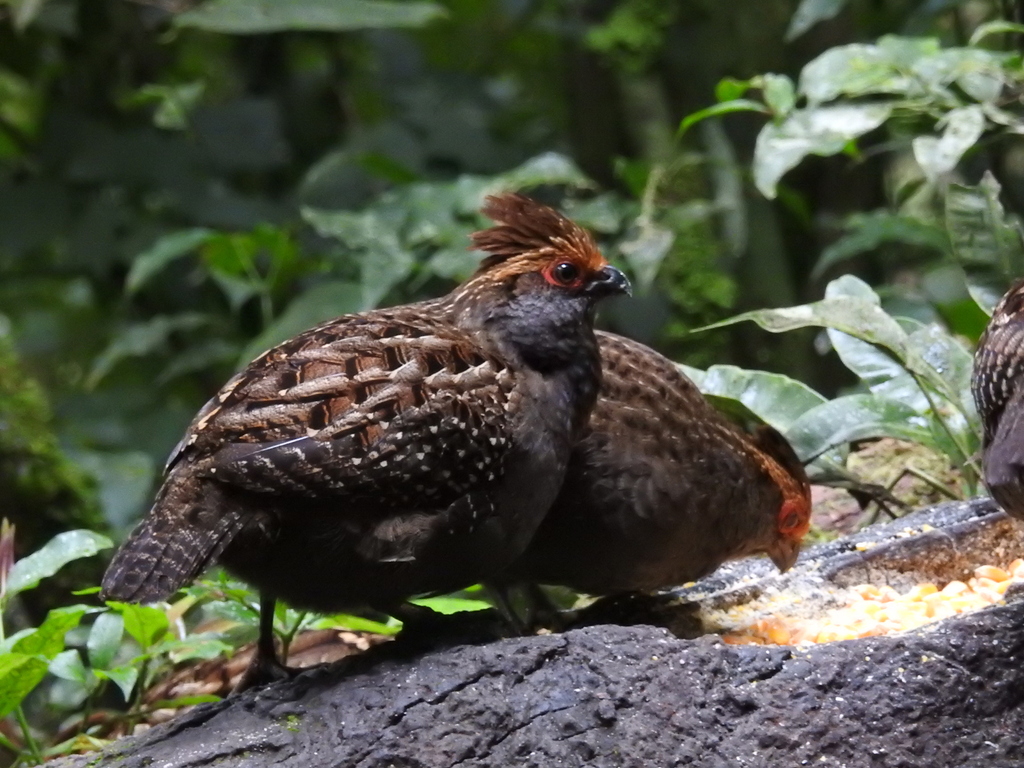
The spot-winged wood quail is a compact ground-dwelling bird measuring 26 to 30 cm in length, with males and females appearing similar though females are slightly smaller. Both sexes display a distinctive reddish-brown crown topped with a loose crest speckled with buff, and a reddish-cinnamon supercilium (stripe above the eye) and chest-band. The upper parts are greyish-brown with dark vermiculations and speckling, while the individual feathers of the neck, mantle, back and scapulars feature white streaks beside the shaft. The sides of the head, throat and underparts are slatey-grey, providing good contrast with the warmer tones of the head and neck. The bird has dark grey legs, a blackish bill, brown iris and a distinctive red bare area around the eyes. Juveniles share similar colouring but have reddish bills, more heavily speckled upper parts and grey underparts flushed with rust and white speckling.
Range & Habitat
The spot-winged wood quail is found in eastern and southeastern Brazil, the extreme northeastern part of Argentina and the eastern part of Paraguay, with historical records from Uruguay. The species inhabits subtropical and tropical dry lowland forests, including secondary forest growth, at altitudes not exceeding 1,600 metres. In Portuguese and Spanish-speaking regions, it is known as uru or Corcovado Urú.
Behaviour & Diet
These are strongly terrestrial birds that move about on the ground during daylight hours in small groups, typically numbering six to eight individuals though occasionally up to fifteen. When disturbed, they prefer to slip quietly into undergrowth rather than take flight, especially when young chicks are present—they may freeze and crouch to avoid detection. At night, the species roosts well off the ground in trees, a behaviour that likely provides protection from ground predators.
The diet includes fallen nuts from Araucaria trees and other species, berries from pokeweed and other plants, and probably invertebrates. Breeding occurs between August and November, with birds being monogamous. Females construct ground nests with a side entrance and a roof of dead leaves, typically laying about four white eggs that soon become discoloured. The female alone incubates the clutch for approximately eighteen days and rears the chicks without assistance from the male.
Best Time & Places to See It
The breeding season from August to November offers good opportunities for observation, as birds may be more vocal and active during this period. The species is common in at least parts of its range across Brazil, Paraguay and Argentina, particularly in subtropical and tropical dry lowland forests and secondary forest growth. While the overall population is stable and assessed as "least concern" by the IUCN, northern populations may be subject to hunting pressure.
Photography Tips
Patience and early mornings will reward photographers seeking this ground-dwelling species. Look for small groups moving deliberately through leaf litter and understory vegetation. The bird's reluctance to fly makes extended observation possible if you remain still and quiet. The distinctive head pattern—particularly the reddish-brown crown, cinnamon chest-band and red eye-ring—provides good photographic subjects. Since birds roost in trees at night, scanning elevated perches at dusk or dawn may yield opportunities for roosting photographs.
Serra do Cipó National Park
Brazil
+379 birds+5 mammals
Where granite escarpments rise above the Atlantic Forest transition zone in southeastern Brazil, Serra do Cipó National Park unfolds across a landscape of dramatic ridges, cascading…
VIEW NATIONAL PARKItatiaia National Park
Brazil
+519 birds+12 mammals
Where granite peaks pierce the Atlantic rainforest canopy in southeastern Brazil, Itatiaia National Park rises as one of the country's oldest and most ecologically vital protected…
VIEW NATIONAL PARKPeixe National Park Lagoon
Brazil
+293 birds+4 mammals
Where the coastal plains of Rio Grande do Sul meet the Atlantic, Peixe National Park Lagoon sprawls across nearly 2,200 square kilometres of shallow waters, reed…
VIEW NATIONAL PARKSuperagui National Park
Brazil
+246 birds+2 mammals
Where the Atlantic rainforest meets the subtropical coast of Paraná, Superagui National Park sprawls across more than 1,000 square kilometres of one of Brazil's most biodiverse…
VIEW NATIONAL PARKSerra do Itajaí National Park
Brazil
+227 birds+2 mammals
Where the Atlantic rainforest rises steeply from the coastal plains of Santa Catarina, Serra do Itajaí National Park spreads across 1,136 square kilometres of montane wilderness…
VIEW NATIONAL PARKSerra da Bocaina National Park
Brazil
+441 birds+5 mammals
Where the escarpment of the Serra da Bocaina rises sharply from the Atlantic coastal plain, tropical rainforest cloaks steep mountainsides that climb toward peaks exceeding 2,000…
VIEW NATIONAL PARKIguaçu National Park
Brazil
+387 birds+17 mammals
Where the Paraná Plateau plunges toward the Atlantic watershed, six thousand square kilometers of subtropical rainforest cling to steep gorges and river valleys in this corner…
VIEW NATIONAL PARKIlha Grande National Park
Brazil
+233 birds
Across the subtropical plateaus and Atlantic forest remnants of southern Brazil, a vast protected landscape spanning nearly 4,600 square kilometers safeguards one of the continent's most…
VIEW NATIONAL PARKSão Joaquim National Park
Brazil
+222 birds+9 mammals
Where the southern Brazilian highlands rise above the Atlantic Forest, São Joaquim National Park protects nearly 1,000 square kilometers of montane terrain that shifts between temperate…
VIEW NATIONAL PARKSerra dos Órgãos National Park
Brazil
+446 birds+13 mammals
Granite peaks thrust skyward through the Atlantic Forest canopy in the mountains immediately north of Rio de Janeiro, their bare rock faces rising above a landscape…
VIEW NATIONAL PARKAraucárias National Park
Brazil
+231 birds+3 mammals
Where the southern Brazilian highlands rise into cool temperate forest, Araucárias National Park protects one of the Atlantic Forest's most distinctive ecosystems across 506 square kilometres…
VIEW NATIONAL PARKSerra Geral National Park
Brazil
+211 birds+2 mammals
Where basalt cliffs and sandstone escarpments rise above the subtropical forests of southern Brazil, Serra Geral National Park preserves one of the Atlantic region's most dramatic…
VIEW NATIONAL PARKCampos Gerais National Park
Brazil
+143 birds
Where rolling plateaus rise above the Atlantic forest escarpment in Paraná's interior, Campos Gerais National Park unfolds across 539 square kilometers of highland grassland and forest…
VIEW NATIONAL PARKIguazú National Park
Puerto Iguazú, Argentina
+346 birds+15 mammals
Where the Paraná Plateau plunges toward the Atlantic watershed, nearly 800 square kilometers of subtropical rainforest drape across Misiones Province in a landscape carved by millennia…
VIEW NATIONAL PARKNo community photos yet. Log in to add the first one.
No community observations of this species yet.